Canada is an enormous country, and as such, folks need to travel both across it and away from it. With airport fees being some of the highest in the developed world, our flag carrier, the venerable Air Canada, is therefore highly incentivized to provide lots of economy-class products for budget-conscious business and leisure travelers alike.
To put things into perspective, Air Canada has five main cabin products: Basic, Standard, Flex, Comfort, and Latitude. We’ve written about the differences between Air Canada fare classes before.
While the Basic and Standard fares understandably appeal to the most price-sensitive consumers, they achieve their attractive low price points by systematically stripping away nearly all ancillary benefits, such as checked or even carry-on luggage, as well as flexibility.
Cancellation fees, for example, are often punitive, creating a product most suitable for customers who are certain of their travel dates. These fares also don’t grant much in the way of progress within the Air Canada Aeroplan elite status program, making them less than ideal for folks interested in that.
So today, we’re going to dive into the three changeable fare classes of Air Canada: Flex, Comfort, and Latitude. Which fare might be worth it, when are they worth it, and why might they be worth it?
Why Does Flexibility With Airline Tickets Cost Extra?
Before we dive into the specifics, let’s get two things straight about how airlines think. The first is that the act of transporting customers, getting them from point A to point B, is very low-margin, with enormous labor costs, fuel charges, and legal regulation.
This means anything extra the airline can charge you for – especially the ability to change your mind, but also to check bags or earn a respectable amount of points–is a feature with a price tag. Airline algorithms do the math and try to charge you based on what they think you’ll pay for what you’ll need.
Second, there is a universal “oops” button available on every single ticket: the 24-hour cancellation rule. While this isn’t a specific Canadian law, it’s a welcome piece of consumer protection that largely exists because our airlines have to align with the legally mandated 24-hour rule from the US Department of Transportation. This law applies to any airline flying to or from the United States, thus making this a mandatory business feature for any Canadian airline that wishes to survive.

In practical terms, what this means is that for a full day after you book, you can cancel for any reason and get a full refund to your original payment method, no questions asked. This doesn’t just apply to cases of buyer’s remorse or botched plans; it’s a 24-hour price protection guarantee. If you spot a fare drop for the same flight within that window, you can cancel the first ticket and rebook at the lower price. It’s a small window, but a powerful one.
As we get into the different fare classes, please remember that the detailed rules for each class can be found directly on Air Canada’s website and vary based on your destination.
When To Book Air Canada Flex, Comfort, Or Latitude Fare Classes
Economy (Flex) Fare Class: Weird Flex, But OK
The Economy (Flex) fare represents the entry point into Air Canada’s more adaptable ticket options, serving as a hybrid product that carefully balances a moderate increase in price over a Standard fare, albeit with significant gains in loyalty earnings and changeability.
For flight changes, Flex fares permit modifications. On most routes within Canada and to the United States or Sun Destinations, Air Canada waives the change fee, requiring the traveler to pay only the difference in fare.

Whilst all Flex fares are officially classified as non-refundable, they do provide you with the option to receive most or all of your fare back as a credit to your travel bank. Do be advised that international Flex fares are less lenient, with modifications or refund requests incurring additional fees. These fees are then deducted before your refund hits your travel bank.
Regardless of whether you’re dinged or not, any Flex ticket canceled 24 hours after purchase goes into one of two types of travel bank: a travel voucher or your AC Wallet.
AC Wallet is for Aeroplan members, so if you have an Aeroplan number, this is what you get, and it automatically loads your refunded amount to your profile. Those who don’t opt to sign up (not that there’s any real reason not to) will still get a travel credit, but need to make sure to apply it the next time they book, as the system won’t automatically detect it!
Added into this nuance is the annoyance that you can only pay for fares with two methods at a time:

What this means is you can’t use a credit card to complete the booking for a $1,000 booking if you have $600 in travel credits, $350 in gift cards, and are short $50. You’d have to pay at least $400 on a credit card.
This is savvy from a business perspective as it means the company is collecting money, but it sucks from the consumer standpoint.
Are these cancellation policies ideal? Probably not if you’re paying a lot of money out of pocket, but if you want some flexibility for the lowest imaginable price increase, then look no further. This is your fare. However, the real benefits come from how Flex fares interact with your Aeroplan elite status….
A Flex fare accrues 4 status qualifying credits (SQC) per dollar spent and redeemable Aeroplan points for the distance flown, a substantial leap from lower fares, some of which earn zero or 2 SQC per dollar spent.
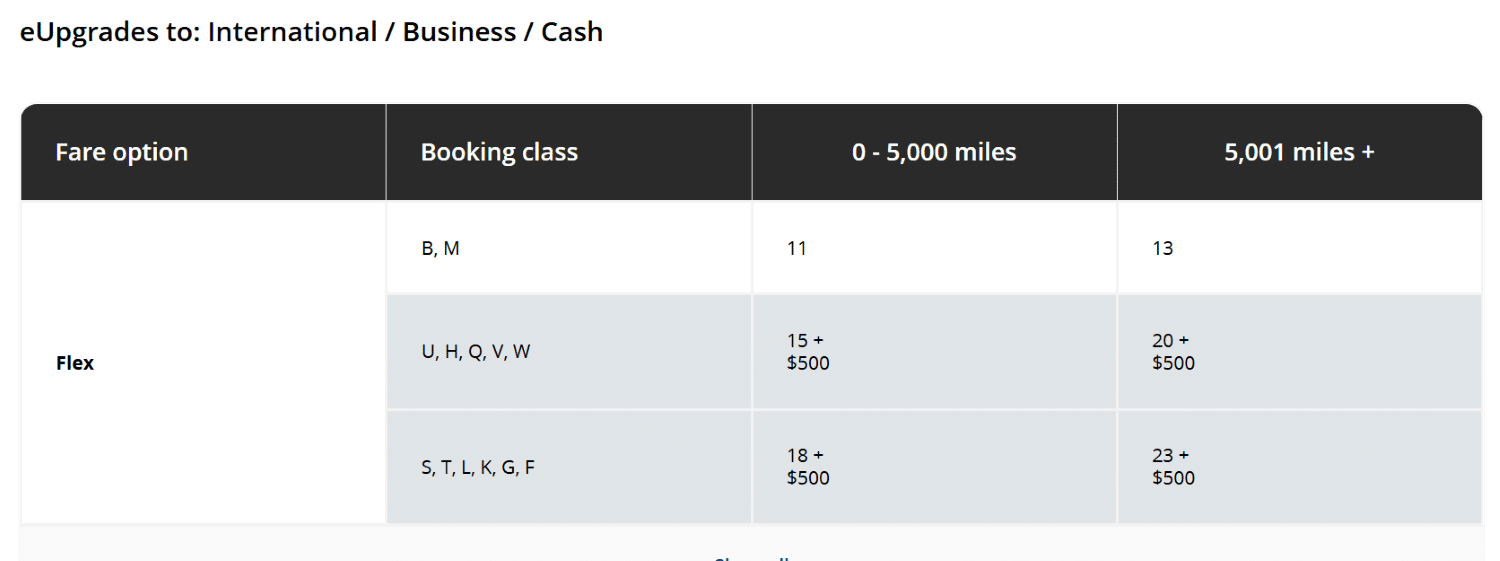
Lastly, we should consider the ancillary benefits of Flex fares: one free checked bag, complimentary standard seat selection, and the ability to attempt to use eUpgrade credits for a bump to the business class cabin on domestic, US, and Sun destination flights without a cash co-payment. For international flights, the e-Upgrade probably isn’t worth it due to the very high number of eUpgrades needed plus additional fees (though, as always, feel free to try your luck):
Thus, Flex fares are for two types of travelers. The first is focused on achieving or maintaining Aeroplan Elite Status, as these passengers can view the additional cost of a Flex fare not as an expense, but as a strategic purchase of the qualifying miles needed to secure their status for the following year.
The second type of traveler is someone who just needs a bit more flexibility on their ticket and is alright with paying a bit more for the privilege. The free checked luggage benefit is just gravy on top of everything else.
Economy (Comfort) Class: Is Comfort Class Worth It?
The Economy (Comfort) fare is a specialized product that bridges the gap between the quasi-refundable Flex fare and the premium-priced Latitude fare, but its single most important constraint is its limited availability.
Comfort fares are offered exclusively for travel within Canada, to and from the United States, and to Sun destinations; it is not an option for long-haul international flights. However, it offers a very unique value proposition: within this bubble, the refund policy is a gold standard. A Comfort ticket is fully refundable to the original form of payment, with no cancellation fees applied, providing the highest level of financial security.

According to my research, this also makes it a bit of a fare class unicorn. Whilst other North American airlines provide fully refundable economy, these tend to be more in line with the high-priced Latitude fares we’ll get into in the next section. Whilst Comfort fares are not exactly cheap, they do offer a service few other airlines offer: a plane ticket you can actually cancel and get all your money back.
On top of this, there are the mandatory status benefits. Comfort class earns at an accelerated rate of 115% for both SQM and redeemable Aeroplan points. Need checked bags? It includes up to two free of charge. With baggage fees often running north of $50 a piece across many airlines, this can be a big savings for those who travel with lots of stuff
Then there’s the seat selection: Comfort tries to live up to its name by providing Preferred Seats, which feature additional legroom, free of charge.
On the question of eUpgrades: I would argue that Comfort is not really for people who want to use e-Ups. As we can see in the chart below, it doesn’t cost that much to upgrade to business class, and no co-pays are required. It also receives higher priority on the upgrade list.
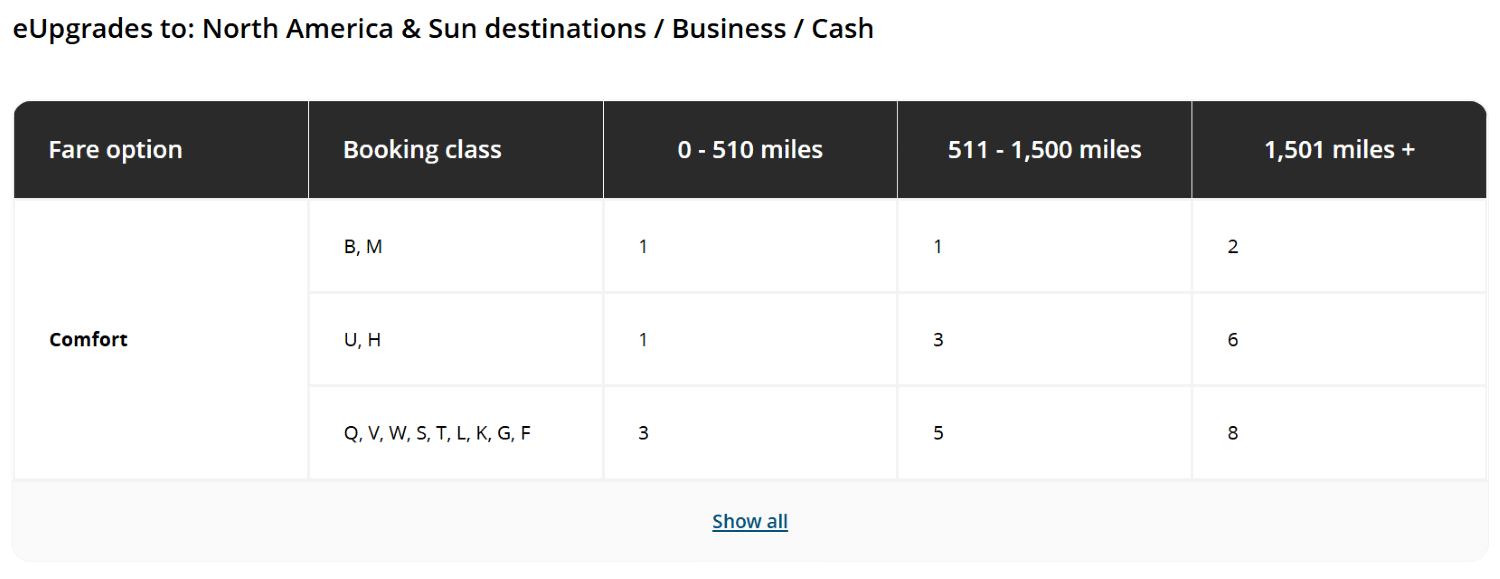
However, the price of Comfort class is usually pretty steep, oftentimes clocking in close to the price of business class. You get the free preferred seats, plus full refundability, so go ahead and use your e-Ups if you want, but it doesn’t seem like that much of an upgrade versus the price.
My argument would simply be that you shouldn’t book Comfort because of e-Upgrades. Instead, this fare class is for those who do want to be able to receive a refund to their original form of payment when traveling in North America or to the Sun belt, and are OK with enjoying a higher-end Economy experience. It’s also good for those status hunters who just need that extra 15% bump on a long leg to get to their next tier.
Economy (Latitude) Class: Is the Latitude Attitude Extinct?
Economy (Latitude) is Air Canada’s highest and most expensive Economy fare, a premium product offering the utmost flexibility on all routes worldwide. It is fully refundable, includes two free checked bags, preferred seat selection, and provides the highest accrual rate in Economy at 125% SQM and Aeroplan points. For the golfers or snowboarders out there, it also waives the $50-120 fee for handling your first piece of sports equipment per direction (so up to $100-240 on a round trip).
On the other hand, it’s expensive. Here’s a generic cost for it flying from my home of Edmonton to my birthplace of Toronto:
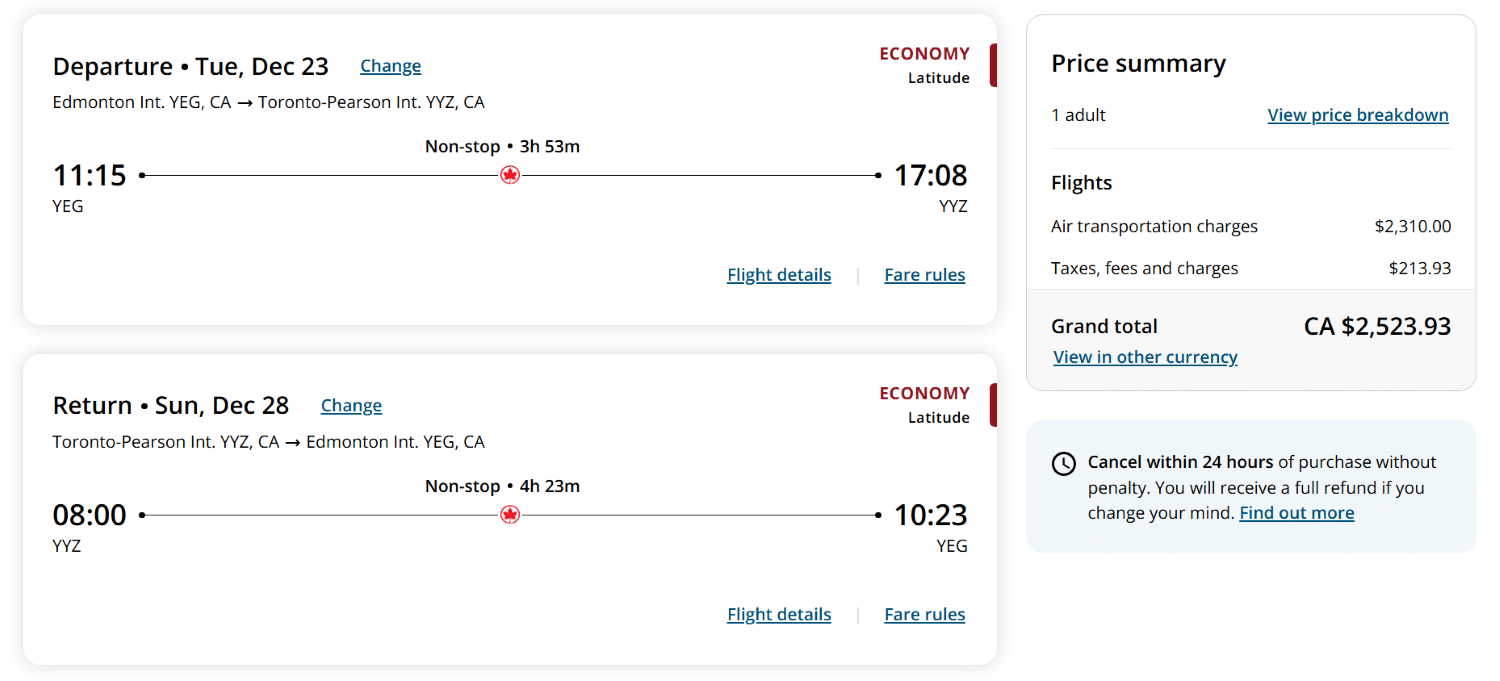
Ouch.
Historically, the premier benefit of the Latitude fare, which was fondly dubbed the “Latitude Attitude”, was the ability to instantly confirm an upgrade to Business Class immediately after booking. As per policy, this comes with no additional costs and is a very attractive reason to select the fare on cash or points:
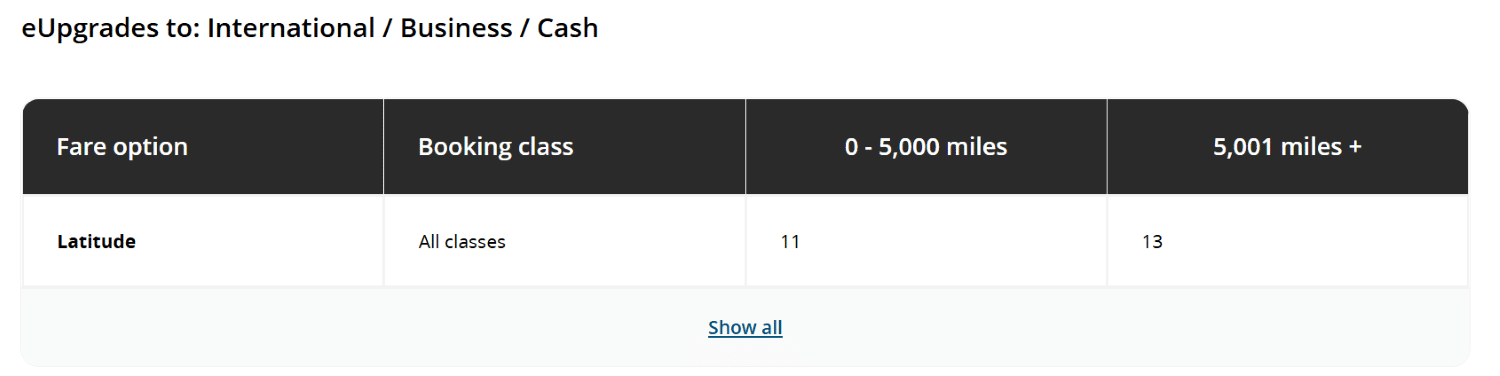
However, in recent years, Air Canada has significantly curtailed the availability of the “R” space required for these instant upgrades. This results in passengers who may have paid a lot for an economy fare waiting to compete at check-in with other elite members.
Even if you paid $2,000 for your flight, you’ll still lose to the 75k status member in the same situation if you’re only a 50K elite. The certainty that once justified the cost has largely evaporated, shifting the Latitude Attitude from a reliable strategy to a high-cost gamble.
From what I can tell, this fare’s modern existence seems primarily justified by the dynamics of corporate and government travel. Many large organizations, most infamously Amazon, have strict “economy-only” travel policies. When an employee needs to book a last-minute, essential business trip and all cheaper fare buckets are sold out, the only remaining option is often a Latitude fare.
This means that the airline’s yield management system prices this fare not based on its incremental benefits, but on what this captive market segment is forced to pay, explaining the often staggering price difference. Ironically, in some cases, Premium Economy or even Business may be available for less money…. But the company accounting department cares not one iota!

There are basically three use case scenarios for Latitude that I can think of under which you should consider them worth booking.
The first is the situation where you have to use a Latitude fare. What that means is that your company needs you to go somewhere, and this is the only option available. If so, go ahead, book without guilt, and enjoy the 125% Aeroplan points.
The second is where you cannot afford to get refunded in AC Wallet Monopoly money. For example, if you have to fly internationally and cannot take the risk of being dinged with the international cancellation fees on Flex, then Latitude becomes your only option by default.
The final use case I can think of is if you have, by some miracle, found the Latitude Attitude on a long-haul international flight and will now clear instantly. However expensive Latitude is likely to be, it is probably less than paying full-fare Business. Have fun, you lucky flyer you.
Conclusion
We hope we’ve demonstrated today that Air Canada’s tiered economy fares offer a clear, if costly, ladder of flexibility where each incremental dollar buys a specific and measurable increase in benefits. For the status-conscious traveler comfortable with travel credits, the Flex fare is the quintessential workhorse, providing a cost-effective path to 100% SQM/SQS accrual. It also works for those willing to accept refunds in the form of travel credits.
For those whose plans are uncertain, the Comfort fare is the undisputed champion of value within North America and the Sun destinations, offering true refundability and a bundle of perks that often justify its cost. It’s about as close to “Premium Economy” with the added benefit of being able to get your money back as can be found in a two-cabin aircraft.
The Latitude fare, however, now occupies a questionable position; with its primary eUpgrade benefit severely eroded, it has become a niche product whose exorbitant price is rarely justifiable for anyone but a traveler without a choice, or by a fare class lottery winner who has discovered a desirable route with miraculous R-Space.

Kirin Tsang
Latest posts by Kirin Tsang (see all)
- Scotiabank Amex Offers: Don’t Leave Cash On The Table - Oct 5, 2026
- EU261 Regulations: Know Your Air Passenger Rights - Oct 2, 2026
- BMO eclipse Visa Infinite Card Review - Oct 1, 2026
- Uber vs Lyft: Use Both Apps For Best Prices & Promotions - Sep 26, 2026
- Flying Blue Award Chart Changes: Your Next Redemption Is Now More Expensive - Sep 25, 2026