

One of the greatest appeals of points and miles is their ability to unlock extraordinary experiences that might otherwise be out of reach, such as an African safari, which are often prohibitively expensive.
In 2023, Marriott International made a notable entry into the luxury safari market with the opening of the JW Marriott Masai Mara Lodge, set within Kenya’s renowned Masai Mara National Wildlife Reserve, home of the famous “Big Five” animals. It also became one of the first safari properties in Africa to be available for a points redemption.
Since then, Marriott has expanded its presence in Africa with the addition of new luxury safari lodges in Kenya and Tanzania. While these properties require a significant number of points, our stay at the JW Marriott Masai Mara was nothing short of extraordinary. From the breathtaking landscapes of the Masai Mara National Reserve to the intimate wildlife encounters, it was a once-in-a-lifetime experience. For any serious points and miles enthusiast, a safari redemption like this should be at the top of your list.
Booking
The Masai Mara National Wildlife Reserve has two main travel seasons, both centered around the spectacular Great Migration, when over two million wildebeest, gazelles, and zebras migrate north and south between July and October. This high season brings peak pricing and limited award availability.
During this period, expect to pay around US$4,000 per night, or roughly 230,000 Marriott Bonvoy points per night. In the low season, rates dip to around US$2,800 per night, and award nights can be found for under 200,000 points. Since the JW Marriott operates on an all-inclusive basis, these rates are quoted for a double occupancy room.
Longtime members of the points and miles community are no strangers to devaluations, and unfortunately, the JW Marriott Masai Mara Lodge was hit hard in January 2025. Award pricing nearly doubled overnight, bringing us to today’s rates.
Luckily, we had booked our stay well in advance of this devaluation and secured four nights at rates between 100,000 and 135,000 points per night—an exceptional deal in hindsight, and a perfect reminder of the golden rule of this game: earn and burn. This is especially the case with Marriott in particular, which has become notorious for frequent no-notice devaluations.

While a redemption of 200,000-plus points per night may feel daunting, it still offers a value of well over 1 cent per point. More importantly, the JW Marriott Masai Mara delivers an unparalleled wildlife viewing experience that I’m certain will leave a lasting impression on anyone who visits.
Both Marriott Bonvoy redemptions and cash rates at JW Marriott Masai Mara Lodge are fully all-inclusive. This covers three meals a day, including alcoholic beverages, as well as the two daily game drives. It’s my understanding that most safari lodges operate as all-inclusive, so this isn’t unique to the JW Marriott Masai Mara Lodge, but does help bolster the overall value proposition of a stay here.
Although the all-inclusive package at the JW Marriott Masai Mara Lodge covers most expenses, a number of significant costs are not included in a points redemption or the cash rate. One key expense is the daily park fee, which is charged at US$100 per person per night during the low season (January to June) and US$200 per person per night during the high season (July to December).
I highly recommend paying the park fee in advance before your arrival. The hotel can arrange a secure online payment portal for guests to pay the park fee. While it’s possible to pay at the reserve using cash or card, some guests have reported issues with unreliable card machines, and I prefer not to travel with a large amount of cash, so settling this ahead of time offers extra peace of mind.

Another important consideration is simply getting to the reserve, which can be quite an ordeal. For us, traveling from Western Canada took a full 24 hours just to reach Jomo Kenyatta International Airport (NBO) in Nairobi. From there, we needed to arrange onward travel to the lodge, either by air or road.
Most guests opt to fly from Nairobi’s Wilson Airport (WIL) to Mara-Keekorok Airstrip, the closest landing point to the lodge within the reserve. Round-trip flights cost around US$400 per person, with several regional airlines offering multiple daily departures. We chose to fly and had the lodge make the necessary flight arrangements for us.
Alternatively, the lodge can organize a car transfer from Nairobi, which takes approximately 5–6 hours and costs US$400 each way.
As you can see, even if you book your stay at JW Marriott Masai Mara with Marriott Bonvoy points, you will still be on the hook for several thousand dollars in transfer and park fees. A good way to offset some of these out-of-pocket expenses is by using a card like the Scotiabank Gold American Express Card. This card lets you redeem Scene+ points toward any travel purchase at a rate of 1 cent per point, making it one of the best options available to help negate some of these extra costs.


The Scotiabank Gold American Express Card earns an impressive 6x Scene+ points at Empire-affiliated grocery stores, 5x at all other grocery stores and restaurants, and 3x on gas, transit, and streaming. Plus, the card offers no foreign transaction fees.
Scene+ points are redeemed at a rate of 100 Scene+ points = $1 against any travel purchase, making this a powerful everyday card for those who want strong earning rates without the complexity of transfer partners.

Earn when you apply through Frugal Flyer.
50,000 Scene+ points
$7,500
$700+
$120
No
Nov 1, 2026
Check-in
We opted to fly with AirKenya from Nairobi’s Wilson Airport (WIL) to Mara-Keekorok Airstrip (KEU). Several regional carriers operate flights to Keekorok from Nairobi throughout the day, often with multiple stops within the Masai Mara National Reserve. Our particular flight made three stops, with Keekorok being the final destination. The total journey took about an hour, including all stopovers.

If you’re planning to fly, be aware that these flights use smaller turboprop aircraft, which come with strict baggage limits of 15 kilograms per person. Travelers with excess luggage may want to consider ground transportation instead. That said, as I’ll explain in detail later, the JW Marriott Masai Mara offers a complimentary daily laundry service, making it easier to pack light.
Additionally, our hotel in Nairobi (JW Marriott Nairobi) offered to store any extra luggage for us while we were at the lodge.
Keekorok Airstrip is a simple gravel runway located in the heart of the reserve. On-site, you’ll find a few members of the local Masai community selling souvenirs, a small office for paying the park fees, and basic bathroom facilities.

Two members of the JW Marriott Masai Mara were awaiting our arrival immediately as we stepped off the plane and gave us a very warm welcome and escorted us to the vehicle.
The JW Marriott Masai Mara has a fleet of open-air Toyota Land Cruisers with elevated seating that makes for the perfect vantage point for viewing all of the natural beauty the Masai Mara Reserve has to see.

Before we set off, we were treated to some snacks and drinks while the staff members explained to us that we would have a roughly 45-minute drive to the lodge and that we could stop at any point along the way to view the wildlife, as our safari experience would begin immediately.

Once you’re seated, the elevated position offers a great vantage point in front and completely unobstructed views to both sides.

Within minutes of setting out, we encountered our first wildlife sighting—a herd of elephants peacefully grazing in the tall grass. We paused to watch as one of the guides shared fascinating facts and insights about the elephants of the Mara. The guides at JW Marriott Masai Mara are incredibly knowledgeable, always providing detailed information on everything from the region’s flora and fauna to its diverse wildlife.

Upon arriving at the entrance to the lodge, we were greeted by some members of the local Masai people. We were pleased to learn that many of the staff members at the JW Marriott Masai Mara Lodge were from the local community, and their spirit and hospitality were felt throughout our stay and we genuinely couldn’t have felt more welcome here.
The lodge is separated from the reserve by the Talek River, over which a bridge leads to the property.
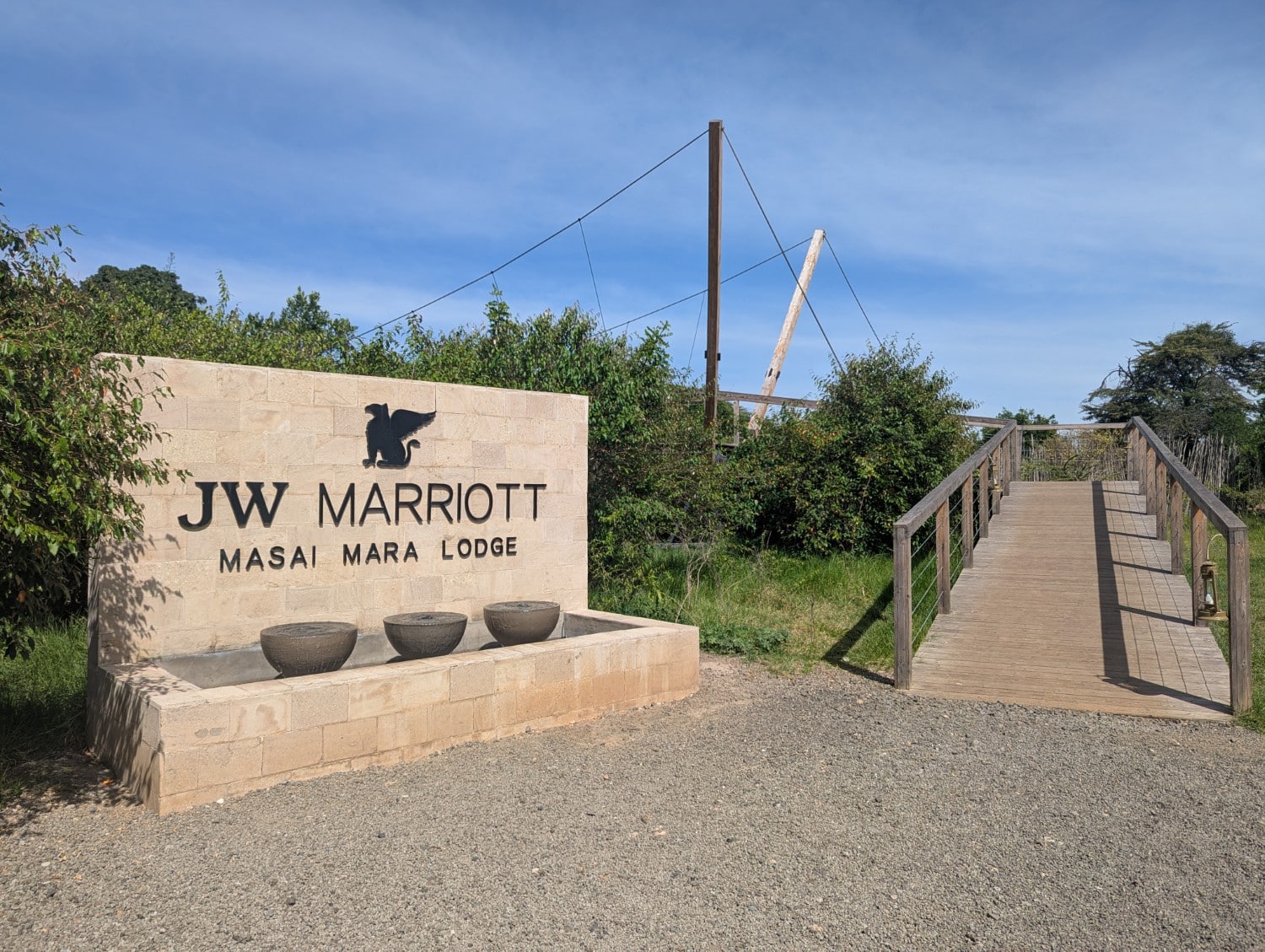
Crossing over the bridge leads directly to the main public spaces of the property. The main public areas consist of the Fig Tree Lounge, and the only restaurant, Sarabi. You’ll also find the gift shop and the camera studio here. This main space is open air, with one half covered to provide shade from the sun and heat while the other half remains fully open, offering views of the Talek River. A massive fig tree stands at the center and inspired the lounge’s name. In the evenings, a fire pit is lit and many guests gather there to share stories about the day’s events.


JW Marriott Masai Mara doesn’t have a traditional lobby; rather, it’s a welcoming area where we were greeted with a cold towel and a refreshing welcome drink. Our host informed us that our tent wasn’t quite ready, as we had arrived before noon, and invited us to enjoy lunch at the main restaurant while we waited.

In terms of elite benefits, there’s not much to highlight. As an all-inclusive resort, perks like the Marriott breakfast benefit are irrelevant, and all tents are essentially the same, aside from a two-bedroom suite and an Executive Suite that features a private plunge pool. All of the suites overlook the Talek River, with the only difference being whether you have a sunrise or sunset view.
Location
JW Marriott Masai Mara is located on the banks of the Talek River, within Kenya’s world-renowned Masai Mara National Reserve. The lodge is located on a plot of land inside the conservancy, offering guests a unique combination of seclusion and direct access to prime game-viewing territory.
It’s approximately a 30-minute drive from the Sekenani Gate and also accessible via a transfer from the nearby Keekorok Airstrip. Most guests fly in from Nairobi’s Wilson Airport to save some time, as the journey from Nairobi by road will take about six hours. Surrounded by the vast plains of the Kenyan savannah, the lodge provides front-row views of the Mara’s spectacular wildlife and natural beauty.
The Masai Mara National Wildlife Reserve, situated in southwestern Kenya near the Tanzania border, is one of Africa’s premier destinations to see the legendary “Big Five”: the lion, African elephant, black rhinoceros, Cape buffalo, and leopard. Staying at JW Marriott Masai Mara gives you an excellent opportunity to encounter these magnificent animals, along with many more, during your visit.
Parking
JW Marriott Masai Mara offers complimentary on-site parking to all guests. However, most guests will be arriving via a private car transfer or via airplane to Keekorok Airstrip.
Room – 1 King Deluxe Suite
As the property only has 21 suites, the design and placement of each tent are arranged with the utmost privacy in mind. From your suite, you can’t see or hear your neighbors.
We were assigned tent suite 14, the lodge’s base-level room. Despite being the base-level room, the suite is impressively spacious at over 1,000 square feet, with a large shaded patio and an outdoor shower.


As you enter the spacious living area, a beautifully appointed king-size bed is placed in the center of the room. The suite’s design incorporates natural elements and earthy tones, creating a visually appealing aesthetic that complements—rather than competes with—the stunning scenery outside.
While the suite is a permanent structure, its walls and ceiling are made entirely of tent fabric. Roll-up wall panels reveal mesh screens, seamlessly blending indoor comfort with the feeling of open-air living.

A welcome note greeted us on the coffee table, wishing us a pleasant stay at the lodge. Alongside it was the first of several thoughtful gifts we’d receive during our visit: personalized JW Marriott Masai Mara insulated bottles, each labeled with our names. We were encouraged to stop by the lounge before our early morning game drives to fill our bottles with a coffee to take along for the ride.

Along the wall is a desk and chair, accompanied by a binder containing all the essential information about the lodge’s facilities. You’ll also find a variety of reading materials covering much of the wildlife you may encounter during your game drives.

On the opposite wall is the minibar cabinet. The minibar is stocked with snacks, water, coffee, tea, soda, and a selection of spirits. All of the contents of the minibar are included for free with your stay, including the alcohol.

All minibar items can be customized by speaking with your room attendant. For example, while the lodge provides a bottle of gin and whiskey by default, you’re welcome to request a different liquor, and they’ll do their best to accommodate. The same flexibility applies to snacks and soft drinks as well.


On the bed waiting for each of us was a woven tote bag and two JW Marriott Masai Mara wool scarves, adorned with traditional Masai patterns. Both of which were ours to keep.
It’s the little touches like these that truly elevate a stay. The thoughtfulness and attention to detail made the experience all the more memorable, and having a few keepsakes to bring home, like a cozy scarf that’s perfect for Canadian winters, are a constant reminder of the amazing time we had here.

Although I can’t imagine many people will notice, the suite doesn’t have a TV. We were far too busy on game drives and enjoying the all-inclusive food and drinks to even miss it.
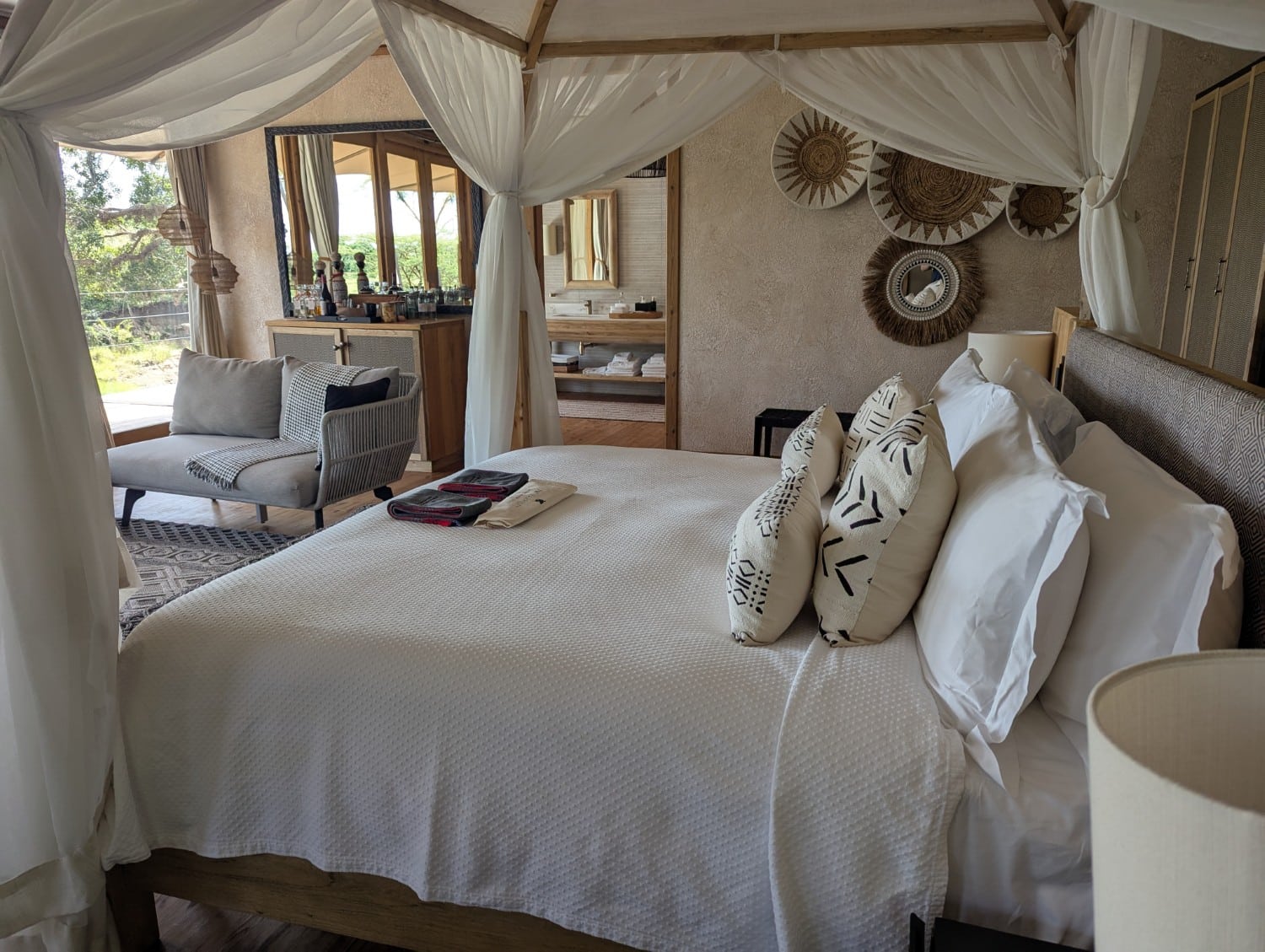

Each side of the bed features a full connectivity panel with controls for the suite lighting and ceiling fans along with a universal power outlet and a USB-A charging port.

Behind the bed is the wardrobe area, featuring a long bench and a closet on each side of the bed.

You’ll find a couple of robes in the closet along with the in-room safe, bug spray, and two laundry bags.
I want to highlight the laundry service because it’s easily one of the best and most generous I’ve ever experienced at any hotel. The lodge provides a complimentary daily laundry service for up to five items per person per day. This is almost unheard of in the hospitality industry. We made the most of this incredible perk, which let us pack light and enjoy the peace of mind knowing we’d leave the lodge with a full set of fresh, clean clothes for our next stop at The St. Regis Red Sea Resort.
Each morning, the housekeeping team collected our laundry during room service and returned it neatly folded with the evening turndown.


The bathroom is another highlight of the accommodations here, featuring a dual vanity setup along with all the amenities one could possibly need.

I especially appreciated the additional touch of each towel being embroidered with the JW Marriott Masai Mara logo, which is something that’s seen at only the highest-end properties.

None of the suites at JW Marriott Masai Mara have a bathtub; instead, each suite has a two-person jacuzzi tub on the deck just outside of the bathroom.

Bathroom amenities were provided by Rituals Cosmetics along with essentials like dental kits, lotions, and other bath items.


An enclosed toilet chamber and walk-in shower with an overhead rainfall head and handheld fixture complete the bathroom.


A side door in the shower opens up onto a private outdoor shower.

Lastly, overlooking the Talek River is the shaded deck that spans the entire length of the suite. A couple of armchairs are set out for relaxing while you take in views of the river and the monkeys and baboons that often frequent the far side of the riverbed.


At the far end is the two-person jacuzzi tub. It was the perfect spot to unwind after dinner. Our room attendant always had it prepared for us when we returned for the night and tailored the temperature to our liking.

For the turndown service, our room attendants lowered the covers for the screened wall panels and draped a sheer fabric canopy over the bed. You might think this is to protect against bugs but we never saw any during our stay so it is mostly just for looks.
Another nice touch was that our room attendant placed a hot water bottle between the sheets so you don’t have to climb into a cold bed.

One drawback of being off the grid and staying at a mostly self-sufficient, isolated camp is that you have to do without some comforts during your stay. The most notable is that there is no air conditioning anywhere on the property. Since the camp relies mostly on solar power, air conditioning isn’t feasible, which can cause the suite to become uncomfortably hot during the midday sun.
The suite is equipped with two large overhead fans and a floor-standing fan to help with this, but I found the only way to escape the heat was to take a dip in the refreshing swimming pool.
However, because the Masai Mara Reserve sits at over 5,000 feet in elevation, the temperature stays pleasantly cool overnight and into the morning, making it very comfortable for sleeping.
Overall, the suites at JW Marriott Masai Mara offer an indulgent blend of comfort and amenities in a breathtaking setting, providing all the modern conveniences you would expect from a newer property even though it’s situated miles from civilization.
Restaurants & Bars
Sarabi Restaurant is the only dining option on the property. Guests can enjoy their meals either at the restaurant or through in-villa dining.
As an all-inclusive property, all food and beverages are included in your stay. The only exception to this is that some select premium spirits and wines require an additional charge. However, we found the complimentary offerings of alcoholic beverages to be extremely generous and didn’t find a need to spend anything extra.
Sarabi Restaurant
Sarabi Restaurant is an open-air venue, offering indoor and outdoor dining tables overlooking the Talek River. The staff at Sarabi, who always addressed us by name, were incredibly accommodating and receptive to our every request. We genuinely felt as if we got to know them during our stay, as the same couple of team members were consistently assigned to our table. This added a memorable personal touch to the experience.


The restaurant rotates through a set of menus for lunch and dinner, offering one or two choices for each course, which usually includes a starter, main, and dessert. The breakfast menu was unchanged throughout our stay.
Breakfast
The restaurant doesn’t place a limit on how many items each person could order, so my wife and I decided to order a variety throughout our stay to share and try as many different things as possible.
The breakfast menu was quite basic and included all the usual staple breakfast items like eggs, pastries, yogurt, pancakes, and waffles.

We loved our breakfast each morning at the lodge and found both the presentation and quality to be excellent, providing a welcome change from the usual buffet-style setup that most hotels prefer.


If you want to extend your morning game drive and have breakfast to-go, your guide can pack breakfast for you and find a shaded spot to stop.
You can arrange this the night before with your guide, and it allows you to extend your morning game drive by about two hours.

At least once during your stay, the lodge will organize a bush breakfast for a small group of guests and set up a temporary restaurant and kitchen right in the middle of the park. The restaurant staff we had come to know, including the wonderful Elias, were all there waiting to welcome us when we arrived.

This was one of the highlights of our stay as we shared breakfast with fellow adventurers in the heart of the savannah while a herd of elephants wandered across the horizon and some curious giraffes stretched their long necks over the trees for a closer look.


Lunch
Lunch always included a starter of soup or salad, a choice of four main courses, and a few dessert options.
Sarabi Restaurant offered a nice variety of lunch options each day, with something new to try every afternoon. The lodge has its own garden and makes an effort to use as many locally sourced ingredients as possible when preparing meals. While the breakfast and lunch menus felt very Westernized, usually at least one dish with an international twist was available.
Lunch service always began with a basket of bread.

The first course offered a choice of either gazpacho or a cold salad each day, and it was nice to see that many of the garden ingredients came directly from the property.


Given that we were virtually in the middle of nowhere, we found the food to be consistently quite excellent. While nothing struck me as incredible and the meals were certainly not gourmet by any stretch of the imagination, which is something I would typically expect from a hotel charging over $3,000 per night, I’m willing to overlook that. The lodge operates with limited resources and relies on solar energy, which naturally restricts what the kitchen can offer. With that in mind, the quality of the food at lunch was very impressive.


I became quite fond of the milkshakes at the lodge and they quickly became my favorite dessert each afternoon as a refreshing treat during the midday heat.


Dinner
The lodge offers a unique dining experience at Sarabi Restaurant with different themed menus every night. For instance, one evening might feature Indian cuisine, followed by Thai, Italian, and so on.
While you receive a menu each night, you will be served everything on it unless you specifically ask to skip a certain dish. Many of the meals are served family-style at dinner.
If you aren’t happy with the chosen theme for the night, the kitchen will do their best to accommodate guests who want something different. However, in the spirit of trying cuisine we might not otherwise seek out, we decided to go along with whatever the restaurant had prepared for the evening.
Our first night was Kenyan night at Sarabi and we were thrilled to finally be in Kenya after such a long journey, ready to enjoy some traditional Kenyan cuisine.

Other themed nights during our stay were Thai and Indian, both of which we thoroughly enjoyed along with the themed night concept overall.


We found the food and drinks to be more than satisfactory for an all-inclusive property that felt all the more impressive given we were in the middle of a national game reserve.
Along with the great food, all of the staff at Sarabi were incredibly engaging and hospitable at every encounter, always asking how our day was and showing genuine interest in the fact that we were enjoying being in and experiencing their beautiful community.

Fig Tree Lounge
Directly adjacent to Sarabi Restaurant is the on-property bar called Fig Tree Lounge. This large open-air space serves as a communal gathering point where many guests meet in the evenings before and after dinner to chat and share photos about the day’s adventure over a few drinks.


The fire pit was undoubtedly the most popular spot for guests to gather around and enjoy an after-dinner drink.

Aside from select premium spirits and wines, all drinks are included with your stay. We found the included alcoholic beers, wines, and cocktails to be more than adequate and incredibly generous.
I’ve stayed at other secluded resorts like Al Maha, a Luxury Collection Resort & Spa, which was also all-inclusive but charged extra for alcohol. Staying at JW Marriott Masai Mara was a welcome change, since we didn’t have to worry about a sizable food and beverage bill at the end of our trip.

Facilities
Although we didn’t have much downtime at the lodge since most of the day was spent on the two daily game drives, we usually had a couple of hours in the afternoon to enjoy the lodge’s excellent facilities.
Fitness Center
The fitness center at the JW Marriott Masai Mara is a modest open-air facility with limited equipment, but it provides enough for an adequate workout.

I tried to get in a workout one afternoon but found it almost impossible due to the heat. The gym is completely open air, and while the garden views are pleasant, the conditions aren’t ideal for exercising. During our stay, there wasn’t even the slightest breeze to offer some relief, so I recommend working out in the early morning or evening when the temperature is more comfortable.

There’s also a bench, a couple of racks of free weights, and a wall-mounted interactive resistance machine.

Pool
In the same area as the fitness center and the spa is the infinity-edge swimming pool. About ten pool loungers are arranged around the deck, along with a few cabana-style daybeds that offer some extra shade.
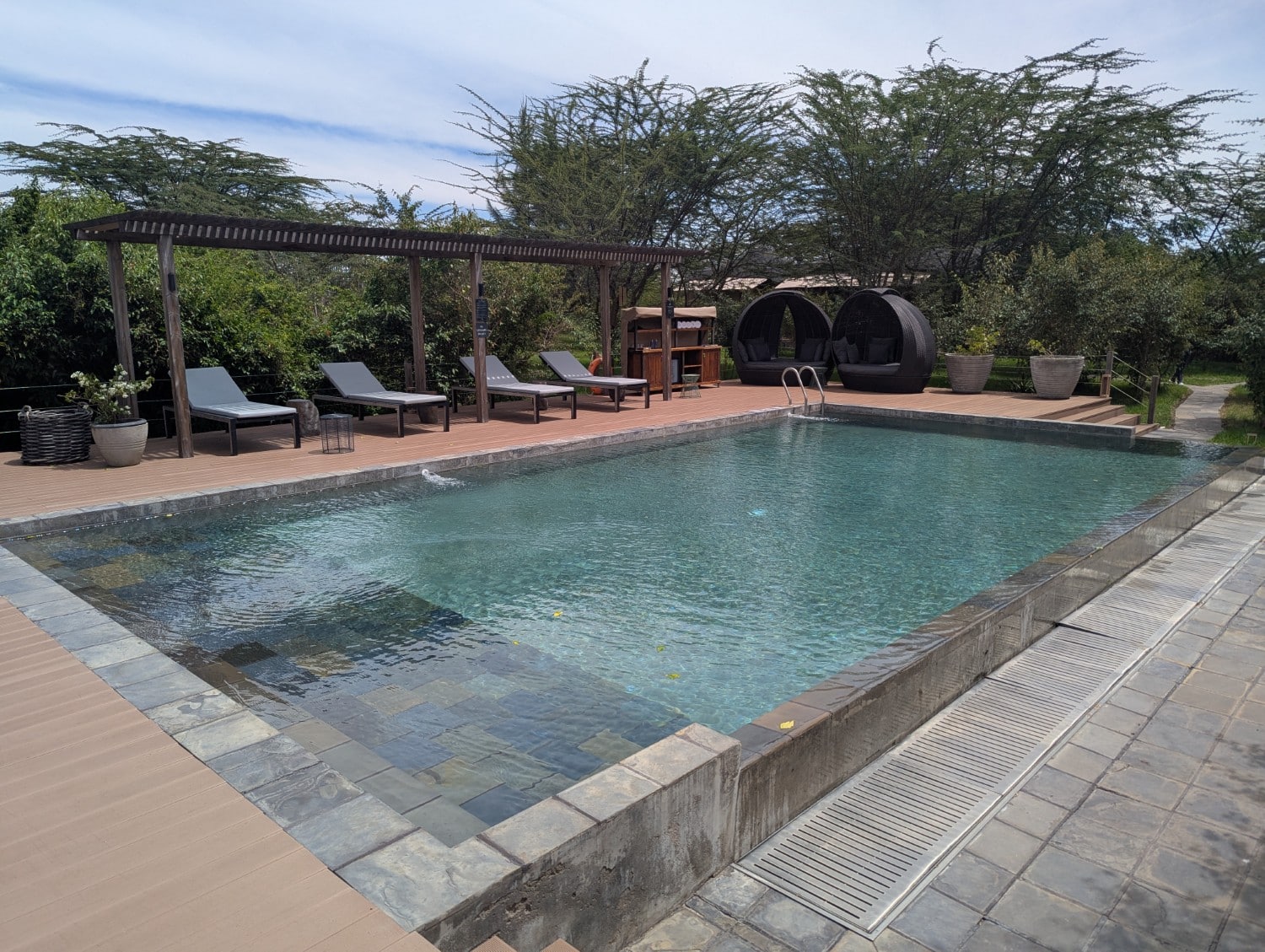
I found the pool to be one of the only places to cool down during the peak afternoon sun. Although it isn’t isn’t heated, the sun warmed the pool to a very refreshing temperature.


Spa by JW
The spa features two treatment rooms and a shared area with a relaxation room, cold plunge pool, steam room, and dry sauna.

Appointments are required for spa treatments and are not included in the nightly rate. However, all other spa amenities are complimentary for guests to use at their leisure. The staff simply ask that you let them know in advance so they can avoid overcrowding and have time to prepare the steam room and sauna, which are not kept at temperature constantly in order to conserve energy.


The spa has a single-occupancy treatment room and another for couples, with sixty-minute massages starting at around US$175. You can view the entire spa menu here.

Camera Studio
The inclusions never stop at the JW Marriott Masai Mara, and perhaps the best one is that the lodge provides guests with Canon cameras equipped with high-powered telescopic lenses at no additional cost during their stay.

Guests will be loaned a Canon EOS R6 Mark II along with a 100-500mm lens. Together, these two pieces retail for close to $10,000, so this is very powerful equipment and let us capture some seriously impressive shots that no smartphone camera could ever compete with.
Also included is a camera bag and an SD card so you can easily transfer your photos to a laptop.

As the cameras have a lot of advanced features, the two professional wildlife photographers on staff can provide a tutorial for operating the camera and can even provide some basic photo editing assistance on their workstations.

Activities
The primary activity at JW Marriott Masai Mara and the main reason for visiting a wildlife lodge are the daily game drives. In addition to the drives, the hotel offers a few other paid excursions for guests.
Game Drives
JW Marriott Masai Mara offers two daily game drives. One departs early in the morning before sunrise and returns around 10:00 AM. The evening drive leaves in the late afternoon, returning shortly after sunset. These are the best times for wildlife viewing since the animals are most active during these periods.

Masai Mara National Reserve spans more than 1,500 square kilometers and is home to hundreds of mammal, bird, and plant species. The landscape is diverse, with open plains, mountain valleys, and dense forested areas. Expect bumpy off-roading adventures, river crossings, up-close wildlife sightings, all with the company of a highly knowledgeable guide.

Every Land Cruiser is outfitted with a ton of supplies that you may need during your daily outings. This includes things like blankets (it’s rather chilly in the morning), drinks, snacks, binoculars, hand sanitizer, and sunscreen. The vehicle also has power outlets and USB-A charging ports.

Since the vehicles accommodate either four or six passengers, there’s a good chance you’ll be paired with another couple or group. If you prefer to have a vehicle to yourself, the lodge can arrange a private game drive vehicle for US$450 per day.
As mentioned earlier, you can request a full-day drive, morning drive, or evening drive depending on your preference, and this can be arranged with your guide. For the best wildlife viewing experience, the lodge recommends the early morning and evening drives.

We had Festus as our guide throughout our stay. Like many of the guides at JW Marriott Masai Mara, he has worked at other lodges and parks across Africa and brings a wealth of experience to craft an unforgettable daily game drive. He was constantly in touch with others in the park by phone or radio to stay updated on animal sightings and had an almost encyclopedic knowledge of every animal, bird, and plant we encountered.
Seeing the famed “Big Five” is a top priority for most safari goers, and Festus went above and beyond to ensure we checked everything off our list before we left.

As this was our first time on a safari to a national park, we had a general idea of what to expect from speaking with others who had already stayed at JW Marriott Masai Mara, but when it comes to wild animals, there’s no telling how much you will or won’t see.
Although we had frequent moments of downtime while driving through the park, we encountered an incredible amount of wildlife on every outing. Even between sightings of the more sought-after animals like lions and cheetahs, we constantly came across herds of gazelles, buffalo, ostriches, and a variety of birds. The landscape itself was also stunning and a joy to take in.

For lovers of big cats, Masai Mara is home to one of the largest concentrations of big cat predators in Africa, with a healthy population of lions, cheetahs, and leopards.
The leopard is by far the rarest big cat you might spot in Masai Mara. However, guides often focus on finding these harder-to-see animals and will go to great lengths to ensure you have the chance to see them.

Lions and cheetahs are in large abundance in Masai Mara and it’s common to have multiple encounters with both each day.


If you want to travel to Masai Mara outside of peak season (July to October), January and February are the best months to visit. During this time, thousands of baby animals are born, and we were fortunate to see several lion prides with dozens of two-month-old lion cubs.


Cheetahs were the other most common big cat we saw, and if you’re lucky, you might witness a hunt or even a kill. We came across the immediate aftermath of a kill by a trio of sister cheetahs, and it was quite a dramatic scene, drawing in scavengers like hyenas, jackals, and vultures hoping for scraps.
Keep in mind that these are wild animals, and there may be times when you see scenes that some might find unpleasant. It’s a good idea to talk to your guide about this in advance.


The rarest animal in Masai Mara is the black rhinoceros. Fewer than 40 remain in the wild across Kenya and Tanzania. We spent several days trying to track one down and finally succeeded. Our guide Festus heard of a sighting early one morning, and after nearly two hours of searching, we were lucky enough to get within 20 feet of a young male.
It was a rare and fortunate encounter, as many of the other guests we spoke with at JW Marriott Masai Mara only saw a rhino from very far away or didn’t see one at all.

Throughout the park we also saw plenty of other animals including zebras, warthogs, jackals, hyenas, hippopotamus, crocodiles, and elephants.


For those who love bird photography, the Masai Mara ecosystem has a population of over 100 different bird species, and we saw countless varieties of eagles, hawks, vultures, herons, quails, and many more.


Other Activities
In addition to the game drives, the lodge can arrange some other paid activities. The timing of these activities typically overlaps with game drive times, so you’ll need to decide if it’s worth missing a drive for one of them. The following activities are available at an additional cost:
- Hot air balloon safari: US$505 per person
- Cultural village visit: US$40 per person
- Rhino sanctuary visit: US$150 per vehicle
We chose not to take part in any of these extras, as we didn’t want to miss any game drives. That said, we saw plenty of hot air balloons each morning, so it’s clearly a popular activity in the park.
Conclusion
Our stay at JW Marriott Masai Mara Lodge was a magical experience that impressed us at every turn. The stunning tented all-suite property offered great food, flawless service, and a wide range of inclusions from meals and drinks to daily game drives, bush breakfasts, and even Canon cameras, making for the most spectacular safari.
While the JW Marriott brand is typically known for its large business-oriented hotels in major cities, at just 21 suites, the JW Marriott Masai Mara Lodge is quite the opposite. Of course, the wildlife undoubtedly take center-stage, but the human element is equally as strong thanks to the warm and welcoming staff that deliver a personalized and intimate stay in a stunning setting.
Although the significant devaluation that affected this property in January 2025 was disappointing for those hoping to book with points, it remains one of the few safari lodges in Africa where a redemption is possible, which still makes it a rare and valuable option for points and miles enthusiasts who are looking for a fantastic safari adventure.

Jeff Jamieson
Latest posts by Jeff Jamieson (see all)
- Review: Singapore Airlines First Class Suites (A380) - Sep 30, 2026
- Review: Alaska Airlines Business Class Suites (787-9) - Sep 23, 2026
- Chexy Plus: Does It Make Sense? - Sep 11, 2026
- Review: The St. Regis Al Mouj Muscat Resort - Aug 26, 2026
- Freedom Mobile Global Roaming: The End of Travel eSIMs? - Aug 17, 2026