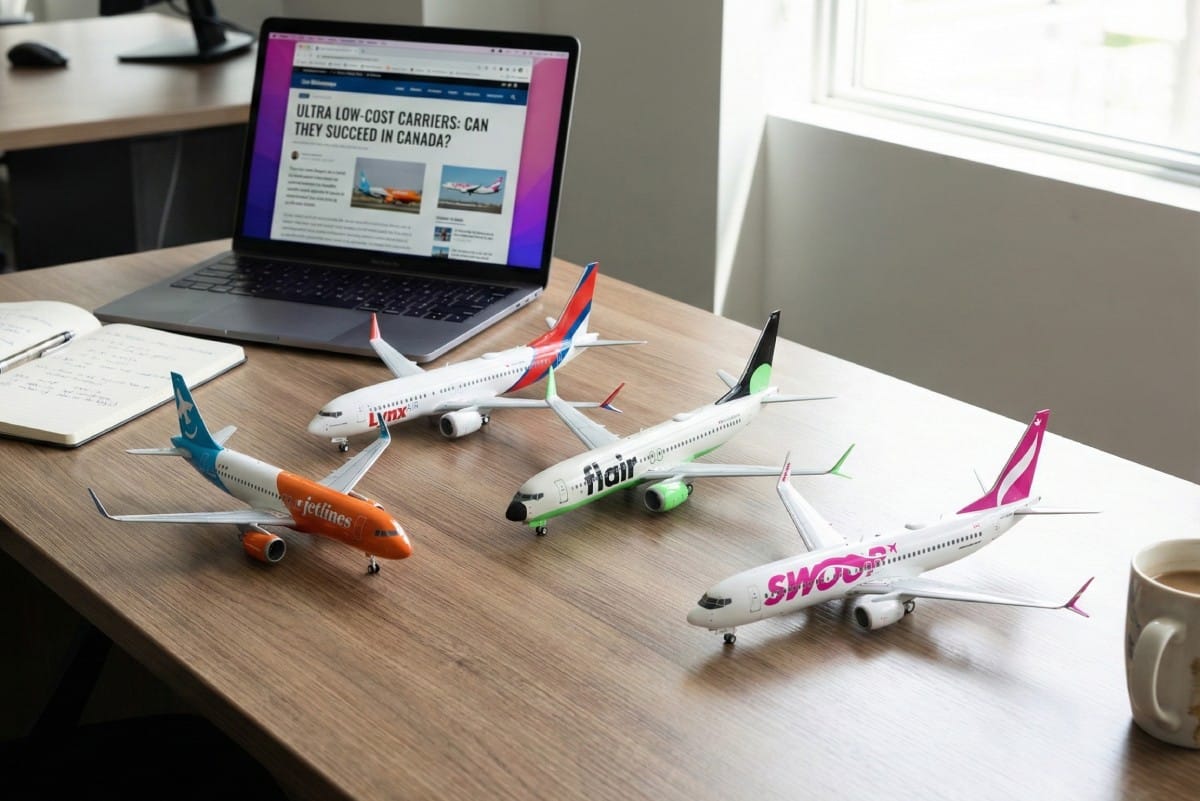
Many of us have heard of Ultra Low-Cost Carriers (ULCCs). These are famous in East Asia and especially in Europe, where airlines like RyanAir and EasyJet are used by the wealthy and the modest alike.
But what is this business model? Why does it work – if it works at all? And why does it seem to so consistently fail in Canada?
What is an Ultra Low-Cost Carrier (ULCC)?
So, what exactly is this business model? Is it just regular flying with less legroom and more sadness? Well, yes, but it is also a highly specific financial strategy known as unbundling – famously referred to as “give them the razors, sell them the blades.”
Tickets on legacy carriers such as Air Canada are more akin to a combo meal at a fast-food joint. You pay one price, and you get the burger, which is the seat, the fries, which is a carry-on bag, and (if you’re lucky or pay more) a drink, which is seat selection. McDonald’s isn’t the only place hit by shrinkflation!
The ULCC model does the opposite: it keeps the base fare ludicrously low, at the expense of any optionality. It buys you exactly one thing: the right to occupy a random seat on the aircraft from Point A to Point B. That is it.
Everything else is an extra cost, or what the number crunchers of the industry call ancillary revenue, and this is where the real money is made.
Want to bring a bag? That will be $60.
Want to sit next to your spouse? That is another $25.
Want a printed boarding pass at the airport? They might charge you for the paper.

The goal is to get you in the door with a shocking sticker price, before trying to upsell you (on things you probably need, such as hand baggage above the size of a purse) until your total bill looks a lot closer to a standard carrier’s fare.
To make this work, the airline needs volume, volume, volume. Their planes need to be full, and they need to be in the air constantly. A plane sitting on the tarmac isn’t making money; it is burning it. This is why ULCCs often fly dense configurations (read: tight knees) and operate on razor-thin margins. They are betting that if they fill the bus every single time, the math will eventually work out in their favor.
This is also because the one-cabin configuration leaves little room for error. When every seat is basic, there’s no way to squeeze extra revenue out of premium cabins. While you can fly planes that aren’t at capacity, it’s not ideal, as the empty space isn’t being subsidized by more affluent travelers.
Costs of Doing Business in Canada as an Airline
Before going further, we need to get something out of the way first: why are the costs of all airline tickets in Canada so high? How does this affect the industry more broadly, and especially ULCCs?
The answer is Airport Improvement Fees (AIFs). These are mandatory charges levied on customers but collected by the airline… on behalf of the airport. The carrier doesn’t really see a penny of that money; it winds up going toward the airport. These fees can range from $15 to $40+ per ticket, so they can add up quickly.
Does this model of levying taxes and fees succeed at actually improving local airports or the state of the Canadian airline industry? I’m not sure it is a surefire success to succeed, though I can see why it might be needed for smaller or lesser-served markets.
Regardless of the fees’ viability, this is an expense every carrier needs to put on its customers. It drives the prices up. A flight from YYZ-YVR, two of the main hubs of the country, will thus incur at least $60 in taxes and fees. On average, you’re looking at a cost north of $35 in AIF just per airport you land at, in addition to the fare cost and other taxes and fees.
This isn’t a backbreaking issue for ULCCs on its own, but it becomes one in combination with the other heavy pressures on Canadian aviation at large.
The first issue is regulation. We are a very large country that isn’t heavily populated, with most population centers being concentrated into pockets on opposite coasts. For the sake of safety, we should have regulations and procedures.
So, the distance adds costs. Strict safety measures add costs. Canada is also a wealthy G7 country. That means a more expensive labour force, and every carrier needs pilots, ground crew, and flight attendants. They’ll demand market rate, and that rate is not cheap.

A ULCC is at particular risk here because it cannot afford to have the highest wages. It needs to squeeze the margin somewhere. This means it could spend money training and investing in personnel, only to have those same employees walk to another airline and benefit a bigger airline at the cost of a ULCC’s training dollars.
Airlines in Canada also have to comply with consumer protections like the Air Passenger Protection Regulations (APPR). These add costs, as does the need to provide for irregular operations. Because ULCCs have smaller networks, fewer planes, and are trying to fly their fleet more often, it makes compliance with these regulations is even more difficult.
If Flair has to fly you on the next available flight due to a cancellation, and doesn’t have a plane ready to go, they have to dip into their cash reserves to get you a hotel or buy you another flight. That’s hard when the margins are already thin!
Can Ultra Low-Cost Carriers Be Successful in Canada?
Can ULCCs overcome the cost of doing business in Canada, comply with regulations, and still make some money while ferrying price-conscious customers?
Basically, they are going to need to overcome the high expenses. They will need to offer customers a unique value proposition that makes it worth choosing them over other options.

Let’s consider the graveyard of some of the more prominent fallen ULCCs in the last 20 years. Not a single one of these was able to balance the high cost of aviation in Canada with the business model of running a successful ULCC. Not one received a government bailout.
Jetsgo (Bankrupt 2005): This one I remember from when I was a kid. The airline offered prices that were too good to be true. That’s because they were. The airline’s fleet was seized on the tarmac and the company forced into liquidation by creditors during peak March Break season, leaving thousands stranded. The CEO was skiing.
Zoom Airlines (Bankrupt 2008): This was a ULCC trying to fly to and from Europe on Boeing 767s. This was probably a competitor to Air Transat. It went bust because of the 2008 recession and oil prices
Lynx Air (Bankrupt 2024): Started off properly with brand new Boeing 787-MAX 8s, an experienced CEO from Virgin Australia, and a base of operations in Calgary. It just couldn’t hack it and got bought out by Flair Airlines.
Canada Jetlines (Bankrupt 2024): A tiny airline based out of Toronto that went to the Sun destinations. It unironically served Boxer Lager, a budget brand beer made with fuel ethanol corn, aboard. That should have been an indicator of its future fate.
Sunwing and Swoop (Folded into Westjet 2023): A leisure carrier and ULCC, respectively. Both ended with the industrial action of the pilots’ union. WestJet had to fold them into the main operation in order to keep its pilots on board. Ultimately, that benefited the workers but removed competition.
I think we can all state with relative confidence a basic political reality: Air Canada or Westjet, if placed on the brink of bankruptcy, probably have the clout to receive some form of government assistance or even a bailout. These ULCCs? Not so much
So, who is the last carrier standing? Flair Airlines, of course. How are they doing? Not great, Bob!

You can see the stats at the Canadian Competition Bureau. This chart is based on available seat kilometers, but basically means one thing: Flair is losing market share. Despite trying to fill planes and service secondary markets, it’s losing ground to Porter.
To me, that says people would rather pay a bit more for an experience they consider to be better. Folks do like the optionality of smaller airports (which Porter Airlines services), but don’t like being charged for water.
So, can the model work? I think it’s possible, especially if airlines prioritize secondary markets with low AIFs. The issue is that the costs of running an airline in Canada are high. I think that the prices being charged by Porter, Westjet, and Air Canada, whilst more elevated than those of Flair’s basic offering, might be about the “sweet spot” to cover all costs and maybe make a few bucks.
Conclusion
Due to the size of Canada and the high cost of doing business, I don’t think that the ULCC model has found its footing yet.
The day may come when it does, but right now, it seems that the issues these airlines run into are the extremely high cost of doing business. Basically, many ULCCs have low prices on the surface, but need to overcharge for their amenities or bonuses. This results in a moderately lower price but a worse customer experience, seen by customers as more unreliable.
Any ULCC looking not to join its predecessors will need to overcome this. I hope one does: competition is good for aviation in Canada.

Kirin Tsang
Latest posts by Kirin Tsang (see all)
- Canada Post MyMail: Track Your Incoming Credit Card Mail & More - Oct 12, 2026
- Scotiabank Amex Offers: Don’t Leave Cash On The Table - Oct 5, 2026
- EU261 Regulations: Know Your Air Passenger Rights - Oct 2, 2026
- BMO eclipse Visa Infinite Card Review - Oct 1, 2026
- BMO Blue Rewards World Elite Mastercard Review - Sep 27, 2026