

Picture this: you want to take your significant other on the honeymoon you’ve been putting off for years. You have a variety of ideas, maybe Portugal? Or is a Thai getaway more to your style?
Now I have good news for you: AI assistants are here to help you achieve this. This needs to be stated with the caveat that anyone selling you an AI chatbot claiming their model can find Lufthansa First Class award availability if you pay them $30 a month is trying to sell you something.
That doesn’t mean the tools can’t help you a lot, but before we get into how it can help you, we need to address what artificial intelligence actually is, what it does, how to talk to it, and the common issues it often faces.
When we cover that, then Frugal Flyer is here to show you how to use AI like a pro to travel more and pay less.
Know Your AI Tools
Before we get into what these tools can do, it helps to understand what they actually are. When people talk about AI in the context of trip planning, they’re almost always talking about Large Language Models, or LLMs. These are systems that have been trained on enormous amounts of text and use that training to generate responses that are statistically likely to be useful.
While they do use thought patterns and a large database of data – including sometimes live-searching the internet – do not think of everything an LLM “knows” as being present, or being understood and retrieved the way a human would. This is important to keep in mind, because it explains both why they’re impressively good at some things and why they confidently get other things wrong (but more on that later)…

With that out of the way, there are three major platforms worth knowing about at the time of writing in early 2026:
ChatGPT is the one you’ve probably heard of. Made by OpenAI, it has the largest user base and the most name recognition. Its paid tier includes web browsing and a plugin ecosystem, which means it can look things up during your conversation rather than relying purely on its training data.
Claude is made by Anthropic. It’s strong at working through complex reasoning and comparisons, and it can handle a lot of context in a single conversation. If you want to paste in a few hotel options, a flight itinerary, and a rough budget and have it make sense of everything at once, Claude handles that well.
Gemini is Google’s entry, and the draw here is the integration with the Google ecosystem. If you already live in Google Maps, Google Flights, and Gmail, Gemini can pull from that context in ways the other two can’t.
There’s other models too. Grok and Perplexity are both big examples that come to mind, and DeepSeek has gotten some media coverage. But they aren’t the “frontrunners” right now. That being said, most advice we’ll provide here can be used on those models, too.Most AI models have free or paid tiers. The paid tiers unlock access to their more powerful models and the ability to ask more questions every day.
Does that mean you must pay? Not at all, but remember that you get what you pay for. Google Gemini is free because it’s advertising to you, and it gives a good service. It has five free Pro prompts a day. Claude and ChatGPT’s free models aren’t half-bad either; but for the best AI tools, you may need to open your pocketbook.
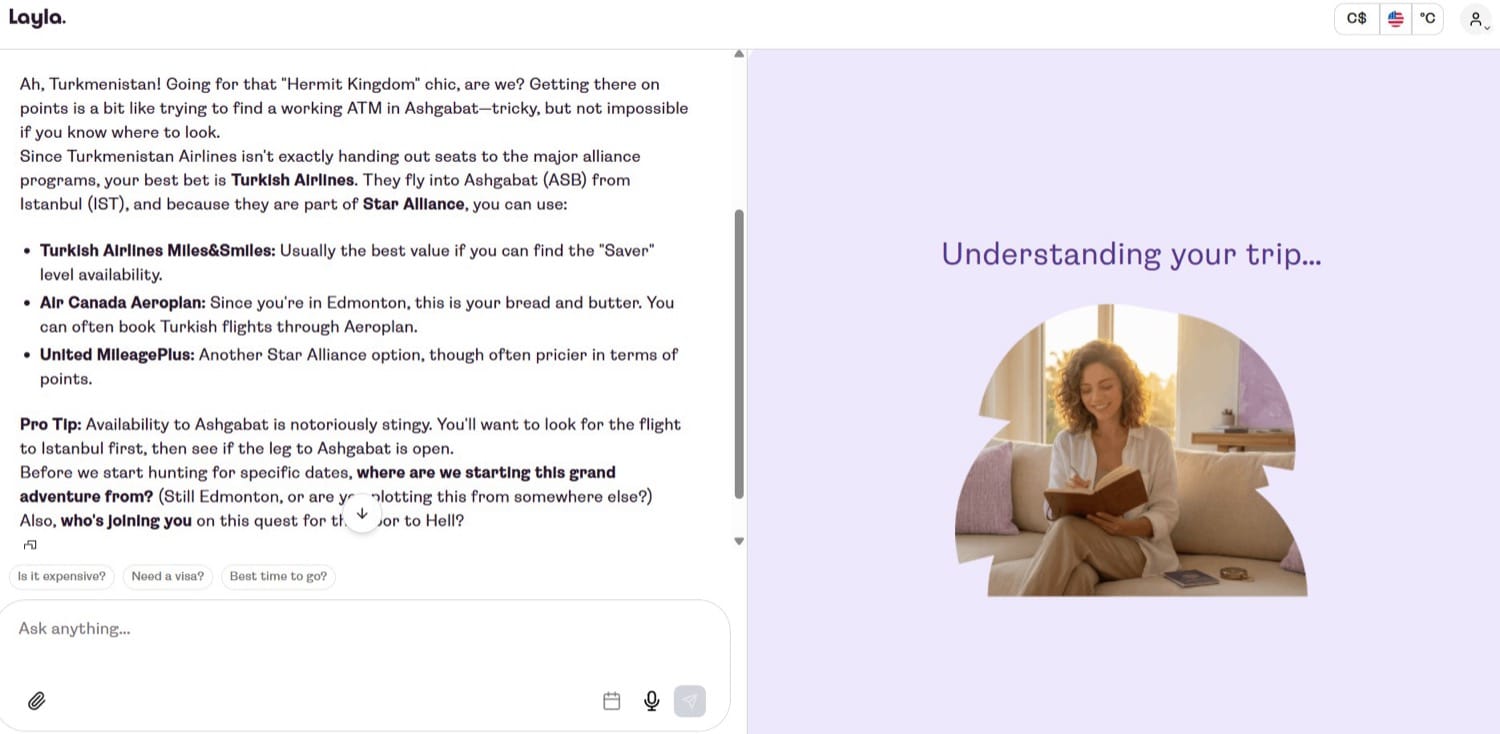
There are also purpose-built travel planning tools like TripAdvisor’s AI Trip Planner or Layla. These are built specifically for trip planning and offer a guided, polished experience. In my estimation, they are also worse than the major LLMs because the algorithms and training data on their back-end aren’t nearly as strong. For example, I posted a screenshot from Layla above, but really it was somewhat barebones: Claude Opus 4.6 (their most powerful paid model) gave a much more comprehensive answer.
Prompt Engineering 101: How to Talk to an AI
A “prompt” is what you type into the chat box to the AI. That’s it. It’s basically the instructions you’re giving the LLM, and it’s trying to give you a response that will be helpful to what you’re looking for.
If that’s too technical, think of prompting like asking for directions: “How do I get to Europe?” will get you a very different answer than “What’s the cheapest way to fly from YYC to Lisbon in the last two weeks of October for two people?” Instead of asking a person, you’re asking an LLM.
The anatomy of a good prompt comes down to four things: context (who you are, what you care about), constraints (budget, dates, preferences), format (do you want a ranked list? a day-by-day plan? a comparison table?), and specificity.
Bad prompt: “Plan my trip to Europe.”

Good prompt: “I have a $2,000 CAD budget for 8 days in October. I enjoy architecture, café culture, and mild weather. Suggest 5 cities ranked by affordability.” Most chatbots will be able to determine your location based on your IP, and attempt to interpolate from there. We saw Layla do it earlier.
But the reason the second prompt is better is because it’s more specific. It tells the AI the constraints, the needs, and a specific desired output. The great thing about LLM’s is that they don’t just give you a one-and-done conversation like the chatbots of old. Instead, you can iterate and bounce ideas until you’ve booked something you are satisfied with.
You can also consider asking the AI to give itself a role, for example, “you are a solo miles-and-points traveller going to Warsaw. How would you get there? What would you do with four nights in the city? Where would you stay?” Here’s an answer given by ChatGPT’s free version.
Now – is that information actually factual? That’s a big one. ChatGPT said that the Westin Warsaw costs 20,000 to 30,000 Marriott Bonvoy points a night. Does it?

Nope, 39,000 points. ChatGPT is like 30% off. But why is it doing this?
Where AI Hits a Wall – Especially for Points and Miles
So here’s where we need to talk honestly, because this is the part most “use AI for travel!” articles gloss over or stick in a disclaimer at the bottom that nobody reads.
AI will often overlook errors it makes, such as the above pricing ChatGPT got wrong. There might be articles it’s been fed in the past when the Westin Warsaw really did cost 20,000 Bonvoy points. But those times are now in the rearview mirror, and the model doesn’t know why. This ties back to what we covered at the top of the article – LLMs are generating statistically likely responses based on their algorithm and training data. This training data has a shelf life, and in a space where loyalty programs and fare structures change as often as they do, information that’s six months old can be completely wrong. In trying to be helpful, the AI will tell you something that may have been true once, or engage in a hallucination and assume that X hotel cost Y points. It doesn’t, but it thinks it does.
Now, what you can do is direct the LLM to search the web. This can sometimes be decent for cash fares, as you can see with this example prompt from Google Gemini looking up a flight in July 2026 from Toronto to Paris. Some of the other models’ search functions may even turn up fares that don’t turn up in Google Flights; as Google’s dedicated LLM, though, Gemini is excellent for quickly collating information you’d have to open 10 tabs to Google yourself.

The reason AI is bad at finding you specific Miles & Points routings?
AI cannot query backend award availability. It can’t log into your Aeroplan orMarriott Bonvoy account to see if there’s an Etihad First Class flight available. It cannot scrape inventory systems or websites like Expert Flyer to try and find which award seats have been released into which programs.
If you wanted to try your hand at coding with AI assistance, you could theoretically use a powerful AI tool to build a scraper, but we do not recommend that. Anything that happens after that is on you.
AI with web browsing can surface forum threads on enthusiast websites like FlyerTalk about potential mistake fares or flash sales, but evaluating whether what it found is legit requires enough background knowledge that a newcomer asking ChatGPT “find me mistake fares to fly Air France La Premiere” is going to get unreliable results more often than not.The short version: AI is pretty bad at always having real-time data. For things like hours, closures, visa requirements, transit disruptions, or the like, try and find that from official sources.
But AI is magnificent at a pile of other tasks, so let’s get into those.
Where AI Actually Shines
So with all those caveats firmly in place, let’s talk about what these tools are genuinely good at – because when they’re in their lane, they’re very good. For those of us interested in Miles and Points, the clearest place is that while AI can’t really pull current inventory, it can condense and give you a good summary of a program’s pricing structure. Here’s Gemini telling us all about the Aeroplan award chart pricing.
Destination brainstorming is another area where these LLMs earn their keep. Prompting by “vibe” works surprisingly well. Just for fun, let’s run a couple of example prompts through different models:
“I want to travel to a city that feels like a Ghibli movie but has the nightlife of Berlin.” (ChatGPT 5.1 free).
“Is there anywhere I can go that feels like Santorini but won’t cost me a kidney?” (Claude Sonnet 4.6).
“What’s the coolest place Elon Musk has been I can realistically visit as a broke 21-year-old engineering student based in Toronto?” (Grok 4.1 Fast).
This is a place where you can have as much fun as you want shopping around on different models, but asking the same prompts, and seeing what each model comes up with.

Another place AI shines is for comparison. This can be hit-or-miss, but: “would it be cheaper to fly into Milan and take the train to Rome instead of flying YEG-FCO direct?” is something Gemini Thinking 3.1 is able to give us a relatively decent picture of for this example. You could go and independently verify the prices, but based on how comprehensive the answer is I don’t think I’d begrudge booking a direct flight to Milan.
Beyond flights, AI is genuinely useful for the logistical grunt work of planning what you’re actually doing when you get there. You can ask it to cluster attractions by neighbourhood so you’re not zigzagging across a city, do a reality check on whether your day plan is physically possible given transit times, or compare your options for getting between cities on a deadline. It handles constraint-based planning well too – trip type, pacing, travelling with kids, all of it.
It’s also rare that we travel alone. Having a hard time getting your significant other or loved ones to understand the mad alchemy you’re doing on your trips? Most LLMs can concisely explain concepts like open-jaw routings, split-ticketing, positioning flights, and nearby airport strategies, and suggest how they apply to your trip (or any trip you’re dragging Player 2 along for).
Finally, consider ballparking your daily expenses in unfamiliar cities using AI. “Estimate total daily spend in Tokyo for mid-range dining and transit” won’t give you exact numbers, but ChatGPT did a pretty good job giving us general costs. It can also help you sort the relative expenses of various destinations.
Now, here’s one that matters for Frugal Flyer readers in particular: AI is surprisingly useful for planning your credit card strategy.

You can ask it to cross-reference the current welcome bonuses on cards like the American Express Platinum or the American Express Cobalt and verify them against the issuer’s website. It’s great for keeping up to date on the latest offers. It can also help you come up with a rough plan, though I definitely recommend not listening blindly to an LLM’s credit card maximization strategy.
For those of you in the US credit card game, it can also help you keep track of rules like Chase’s 5/24 or the American Express once-per-lifetime language, and plan around them. It can compare the Chase Sapphire Reserve against the Amex Business Platinum (US) for your specific spending profile rather than in the abstract. Just remember to verify the current bonus amounts and terms yourself – the AI might be working off slightly outdated figures.
Conclusion
AI isn’t going to book your flights, find you hidden award availability, or replace the hard-won knowledge that comes from actually doing this hobby – not yet, anyways. But it will save you hours of tab-hopping, help you think through routing strategies you wouldn’t have considered, and give you a solid starting point for everything from destination research to credit card sequencing. Sometimes, it may even find you something you hadn’t previously considered.
The key is knowing where the line is. LLM’s are generative and designed to help you, leading to them sometimes giving you outputs that are designed to make you happy but aren’t actually true.
Therefore, let AI brainstorm, compare, and organize for you. Let it make recommendations for you and cut your research time in half, just remember to verify anything specific before you spend real money or real points on it.
Until next time, prompt responsibly.

Kirin Tsang
Latest posts by Kirin Tsang (see all)
- All of Accor Live Limitless’ Hotel Brands Explained - Oct 26, 2026
- Canada Post MyMail: Track Your Incoming Credit Card Mail & More - Oct 12, 2026
- Scotiabank Amex Offers: Don’t Leave Cash On The Table - Oct 5, 2026
- EU261 Regulations: Know Your Air Passenger Rights - Oct 2, 2026
- BMO eclipse Visa Infinite Card Review - Oct 1, 2026



Great article Kirin 🙂