

Dynamic pricing on Aeroplan and hotel programs like Marriott Bonvoy means the old playbook of waiting for a fixed-chart sweet spot is increasingly unreliable. In this article, we’re walking through real travel situations to answer a question the community doesn’t like to address: when should you just book the trip and stop agonizing over the “maximum” cents per point (CPP)?
Imagine the following scenario: it’s cold in the Canadian winter, and you want to go somewhere warm. Or you just want to go to a concert or see your favourite sports team play. You open Aeroplan or another dynamically-priced program, plug in your dates, and… the number staring back at you is not what you were hoping for.
Here’s the question nobody likes to answer honestly: Should you just book it anyway? For many folks, in many cases, I’d argue the answer is “yes”!
Philosophy: What Do You Want When Traveling?
Before you open a single search engine, you need to answer a question that the Miles & Points community almost never asks directly: What is your actual goal when you travel? This might seem obvious, but it isn’t, because there are at least three very different philosophies floating around this hobby, and they lead to altering the way you travel in whole cloth.
Philosophy 1: Maximize the value of every point. This is the classic CPP optimizer. You want 2+ cents per point on every redemption, and if you can’t get that, you’d rather hoard and wait. This means emphasizing long-haul fixed-point redemption routes booked on partner airlines with a program like Aeroplan or British Airways Avios. For hotels, you want the most ludicrous over-water villa you can attain.

Philosophy 2: Fly premium cabins or not at all. You’re saving your points to fly in a premium cabin. This doesn’t necessarily mean lie-flat seats or business class, it just means you’re emphasizing getting out of the back of the aircraft, particularly on long-haul international flights. This is an understandable position because it places comfort at the forefront.
Philosophy 3: “I don’t want to pay”. This is where I sometimes fall, especially regarding hotels. I resent paying $400+ per night for a hotel where the service might be mediocre, which it often is in the developed Western world. Therefore, the goal here isn’t to maximize the value of each point redeemed, but instead it’s to bring your out-of-pocket expenses to $0 as fast as possible.
In this article, I want to play devil’s advocate and show why Philosophy 3 has its merits that could save you time, money, and sanity, at the opportunity cost of bigger, flashier redemptions.
When to Book the Flights You Actually Want
First up, let’s look at an example of a trip you may actually want to take because it fits your schedule. Part of growing up for me has been seeing many of my friends become increasingly devoted to their families, which is beautiful but takes away from their available vacation time.
Kids’ schedules are often pretty regimented. So we’ll look at a time when everyone is likely to travel: March break. What’s it cost to go from Vancouver to Cancun on cash on Air Canada? Remember: this may be the only window you can realistically get somewhere nice like the Westin Cancun with the family.
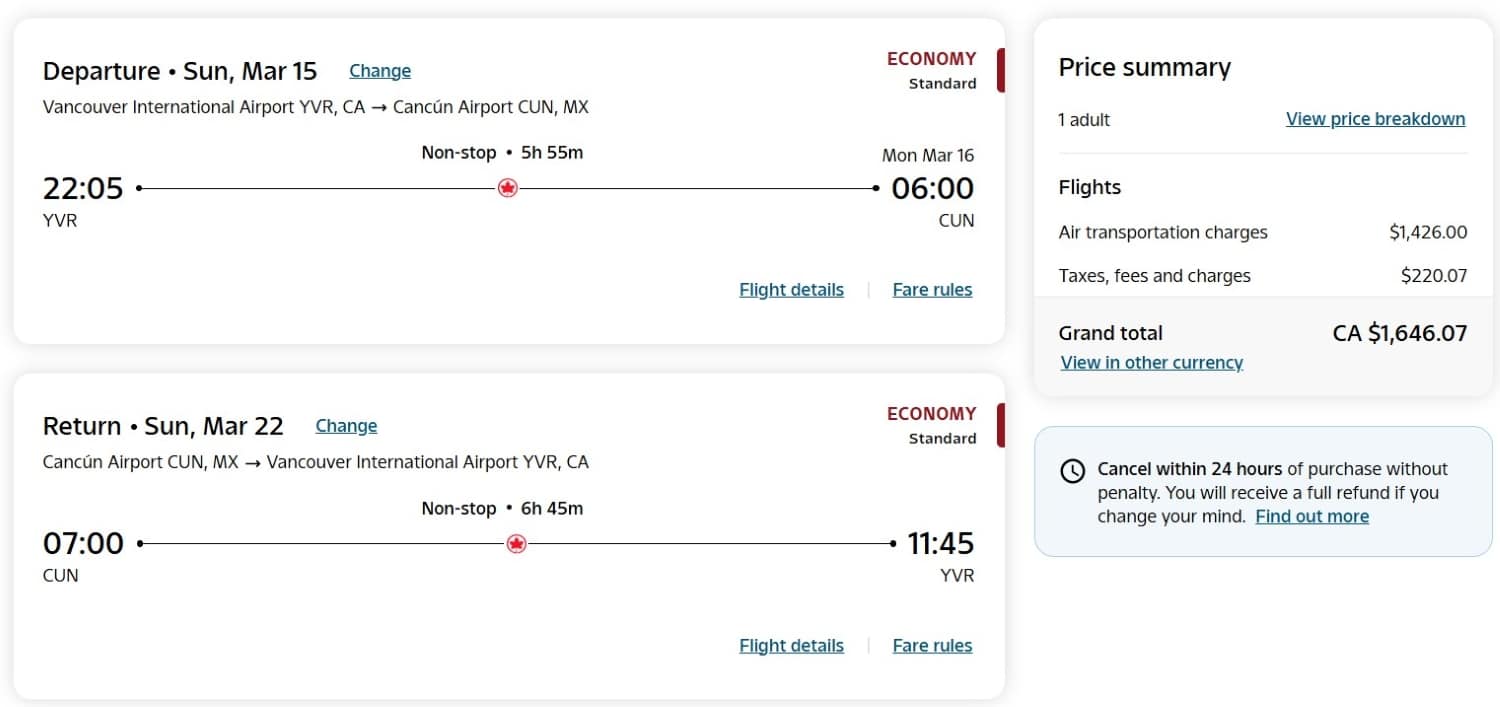
For a round-trip booking, you are looking at $1,650 per person. That’s intense. That’s $5,000 for two adults and a child. What about if you look at booking on Aeroplan points?


That’s 107,100 Aeroplan points per person, so about 1.5 cents per point. This isn’t any good when you consider the better value of Star Alliance partners on the fixed chart. This only matters if you’re able to use it, though. If you can’t book an aspirational business class flight in the future, and you need a vacation with you and your loved ones for your sanity now, I’d rather save $1,650 a head and burn 321,300 Aeroplan.
Once again: Is this an ideal use of your points? No. Is this something you should do on a regular basis? That’s not for me to say; we all have our own situations. What I do know is that expenses have never been higher for families, and in such circumstances, cash is king and points are ephemeral.
This line of logic, I think, applies to a variety of other circumstances. For example, if you have no children but your significant other is a schoolteacher, you will have no choice but to travel during the summer peak season. In such situations, yes, it helps to plan far in advance and to get the best deal you can.
But summer in Europe is going to be dynamically-priced to hell on flights, and hotels won’t be much cheaper. If you both really, really want to go to Europe, will you prevent yourselves from doing that?
When to Book the Hotels You Actually Want
Speaking of hotels, both Marriott Bonvoy and its main competitor, Hilton Honors, use modified forms of dynamic pricing. This means that the number of points needed to book a free night will rise or fall in tune with whether they expect to be able to sell it at a maximum cash price. However, properties may have a maximum number of points they can charge.
For example, in the last Stanley Cup finals, the JW Marriott Edmonton ICE District saw many rooms command prices north of $1,000 on game nights. The maximum points cost was 55,000 Marriott Bonvoy. Not a bad value! Now, let’s apply this logic to two situations where you might be better off following the “I don’t want to pay” school of thought when traveling.
The first is for redeeming points for travel surrounding major sporting events such as the FIFA World Cup in Toronto. They’re playing several matches in June of 2026, with the Canadian team playing on June 12.

Marriott hotels are owned by franchisees and are the official partner of the World Cup, so they may not even release rooms into award inventory. Let’s take a look at the Toronto Marriott City Centre Hotel, right next to the SkyDome (no, I will not call it Rogers Arena).
This is very close to BMO Field, where the game will be played:

This is the price for a two-night stay. Now, could you theoretically use 144,000 Marriott Bonvoy points for something better? Yes. You could definitely spend a week in a five-star hotel in Kuala Lumpur for that.
But there’s no Team Canada playing in the World Cup in Kuala Lumpur. This is, to me, a clear example of a place where I’d much rather burn 144,000 and get my two nights in Toronto over paying $2,000 CAD for a glorified place to sleep.
You can apply similar logic to other forms of events. Buying tickets for artists is at an all-time high, so don’t feel at all bad about just burning points to be able to stay close to a venue, even if you could theoretically spend the points on a redemption on, say, Thailand. There are lots of other cases where this can be worth it, especially if your redemption goal is just to minimize out-of-pocket costs.
Next, let’s talk about another situation that may be worth a “non-optimized” redemption. Hilton Honors has some of the most powerful free night awards on the market. That company is old school and, shocker, seems to think that a free night should equal a free night, thus it can be used on just about every property. I alluded to Thailand earlier, and the Conrad Koh Samui is a fantastic aspirational place to redeem one of these.

But what if you can’t get across the world? Remember: those awards have a 12-month shelf life from the date they are awarded. The benefits are “use it or lose it.”
Well, in such situations: is it really so bad to indulge your desire to go get raunchy in Las Vegas? The Waldorf Astoria Las Vegas is right there. Go to the giant sphere or watch the Golden Knights. There’s no reason not to.
A Changing Miles & Points Landscape
It’s been evident to everyone in the Miles & Points space that dynamic pricing is here to stay. Aeroplan’s been that way since 2022. Hotels, as we’ve established, might have “maximum” prices, but those seem to go up over time.
World of Hyatt is the last man standing when it comes to having fixed-price hotels by some semblance of an award chart “category”, which makes sense because there are fewer of them and they guard the ability to get more of their points like a dragon does its hoard (but even that is starting to slip away with recent changes).
Don’t worry about not getting the “best” value for your points by only booking the nicest flights or finest properties. It’s harder now than it has been.
It’s definitely still possible, but you’ll need a good deal of systems mastery, and the opportunity cost of that could be other trips you wanted to take, potentially more. Don’t give up on your dreams of hitting the St. Regis Maldives, but if your dream was more to see Team Canada play in the World Cup, why rob yourself of that opportunity in favour of an aspirational holiday that isn’t at the top of your bucket list?

This is where I get to one of my more heterodox recommendations: suggesting Canadians who have entered the US credit card market to get the Chase Air Canada Aeroplan Card. With this product, you can use the Pay Yourself Back to let you redeem Aeroplan points at a guaranteed 1.25 cpp against travel purchases. This is valid on up to 200,000 points per year through at least December 31, 2026.
That’s equal to $2,500 USD, not life-changing money, but it’s probably enough for economy-fare airfare for a family of four during the busy season. Whether you’d rather have the cash or 200,000 Aeroplan points is up to the individual travel needs you have.
Conclusion
For better or for worse, dynamic pricing is here to stay. The trend across the loyalty industry is toward more flexibility for the program and less predictability for you because, let’s be honest, they don’t want to be gamed. This doesn’t mean your points are worthless, but it does emphasize that the best use case scenario often isn’t a theoretical valuation for a hypothetical trip that hasn’t materialized.
There are some of you who do care about maximizing every last cent out of every last point. That’s valid. But for many of you, that’s not a great place to start. You’d be better off asking “what’s a trip I actually want to take,” and then letting your Miles & Points work for you toward that objective over trying to fly to Malta just to burn a $300 Amex Fine Hotels and Resorts credit.
Until next time, don’t be a slave to optimization.

Kirin Tsang
Latest posts by Kirin Tsang (see all)
- Canada Post MyMail: Track Your Incoming Credit Card Mail & More - Oct 12, 2026
- Scotiabank Amex Offers: Don’t Leave Cash On The Table - Oct 5, 2026
- EU261 Regulations: Know Your Air Passenger Rights - Oct 2, 2026
- BMO eclipse Visa Infinite Card Review - Oct 1, 2026
- BMO Blue Rewards World Elite Mastercard Review - Sep 27, 2026



Great article Kirin.
I was just wondering for the Chase Aeroplan card. Using the Pay Yourself Back feature can you do the refundable hotel trick for this?