
Everyone loves a good beach day, but not everyone loves the crowds, the parking wars, or the fight for a patch of sand.
This summer, something different is happening. Instead of heading to the usual hotspots, Americans are rediscovering the quiet charm of their local, quieter, lesser-known shores.
Based on our survey of 3,002 locals, we reveal the top hidden beaches across the country.
Key Findings
These picks tell a bigger story – about how people actually want to travel now, what kinds of escapes we’re really craving, and how much peace can be found just off the beaten coastal path.
Here are some of our observations:
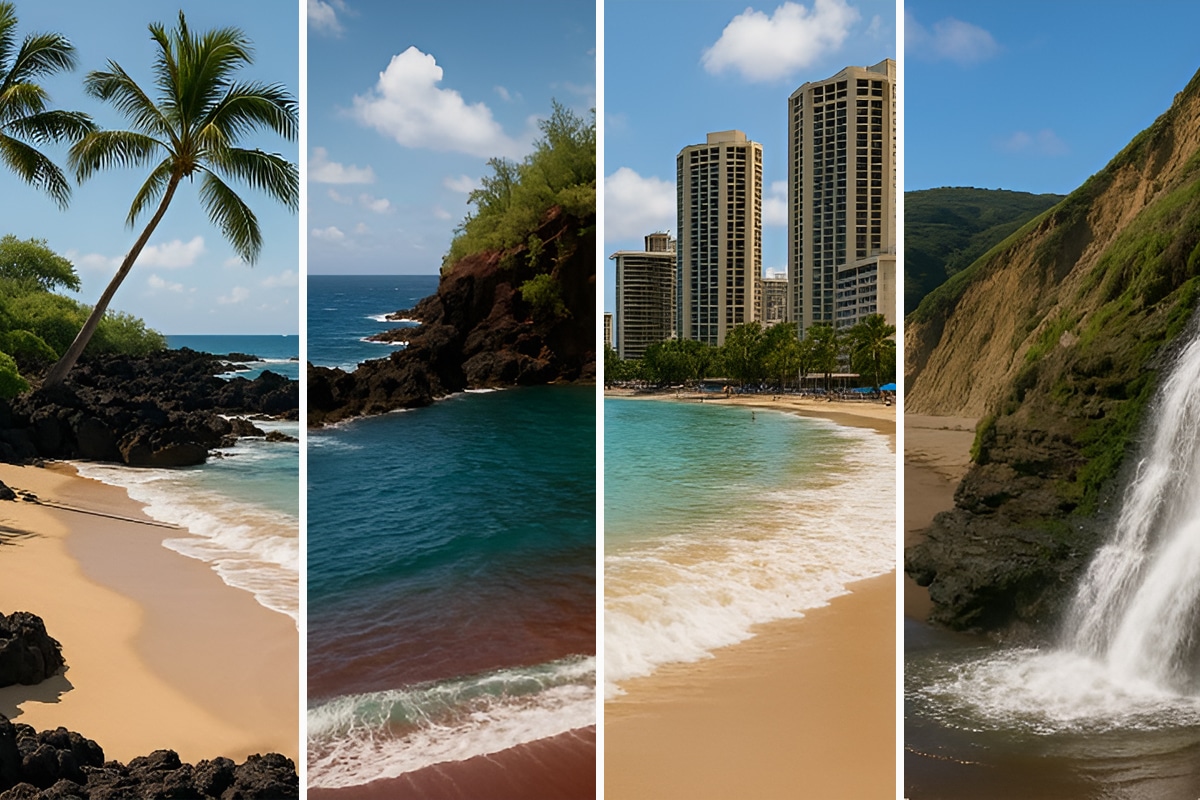
- Hawaii’s beaches aren’t just popular – they’re sacred, remote, and revered. Hawaii claimed four of the top six slots, and that’s no accident. Awahua Beach, Pa’ako Cove, Gray’s Beach, and Kaihalulu (Red Sand Beach) all represent something more than just pretty views – they’re immersive experiences tied to culture, history, and natural awe. Getting to them often involves hikes, steep trails, or unmarked turn-offs. The message? Hawaii’s most loved beaches are the ones you earn.
- California is a state of contrasts – popular, yet private. You’d expect California to be beach-heavy, but what’s interesting is which ones made the list. Wildcat Beach, Gray Whale Cove, Bowling Ball Beach – they’re all relatively hard to access, whether by hike or minimal signage. These aren’t Malibu or Santa Monica – they’re for the travelers who value nature over scene, and seclusion over selfies.
- The Southeast doesn’t do beaches – it does islands. Daufuskie Islan, Edisto, Harbor Island, San Jose Island, Dauphin – the South prefers its hidden escapes offshore. These places are accessible only by ferry or winding causeways, often with minimal development. It’s not just about sun and sand – it’s about slowing down, unplugging, and often stepping into a world that feels a generation behind (in the best way possible).
- Lakes are taking back summer. When Crystal Lake in Vermont cracked the top 10, it signaled a shift. People are starting to realize that lake beaches – especially the quiet, glacial-fed, or high-altitude ones – offer serenity you just can’t get on the coast. From Lake McConaughy in Nebraska to Leigh Lake in Wyoming and Iona’s Beach in Minnesota, these freshwater escapes are becoming the new darlings of summer travelers who want calm water, loons at sunset, and zero crowds.
- Some states are quietly outperforming expectations. Delaware is a great example. Three hidden beaches made the top 100 – Slaughter, Broadkill, and Pickering – which is remarkable for a state that’s usually overshadowed in travel chatter. Similarly, states like Alabama, New Jersey, and even landlocked Kentucky all snuck in entries that locals swear by, but outsiders rarely hear about.
- Beach popularity doesn’t always mean overrun. Take Oregon’s Secret Beach or Florida’s Shell Key Preserve. Both are getting more attention (and more Instagram photos), but locals still consider them hidden thanks to tricky access points or minimal development. What counts as “hidden” is shifting – it’s less about zero visitors, and more about whether a place still feels personal.
- States without coastlines still showed up – with pride. Arkansas, Iowa, Missouri, West Virginia, and South Dakota all had entries. Some are lakes. Some are tucked away state parks. But they matter. In fact, the sheer spread of submissions shows that the desire for a peaceful, beautiful place to swim, picnic, or just stare at the horizon isn’t limited to the coasts.
- A strong preference for effort over ease. Whether it’s hiking to Wildcat Beach, kayaking to Shell Key, or ferrying out to Cumberland Island, a lot of these beaches require a bit of work to reach. That’s not a deterrent – it’s part of the appeal. In a travel culture obsessed with instant access, this trend hints at something deeper: people are craving intentionality, even in how they unplug.
Final Thoughts
In the end, this list isn’t just about geography – it’s about values.
When Americans think of the perfect beach escape, it turns out they’re not looking for beachfront bars or massive boardwalks.
They want stillness. They want space. And they want to feel, just for a moment, like the beach belongs to them alone.
Methodology
Online panel survey of 3,002 respondents based on age, gender, and geography. Internal data sources are used to obtain population data sets. We used a two-step process to ensure representativeness through stratified sampling and post-stratification weighting.
Respondents are carefully chosen from a geographically representative online panel of double opt-in members. This selection is further tailored to meet the precise criteria required for each unique survey. Throughout the survey, we design questions to carefully screen and authenticate respondents, guaranteeing the alignment of the survey with the ideal participants.
To ensure the integrity of our data collection, we employ an array of data quality methods. Alongside conventional measures like digital fingerprinting, bot checks, geo-verification, and speeding detection, etc. each response undergoes a thorough review by a dedicated team member to ensure quality and contextual accuracy. Our commitment extends to open-ended responses, subjecting them to scrutiny for gibberish answers and plagiarism detection.

Josh Bandura
Latest posts by Josh Bandura (see all)
- Scotia Momentum Visa Infinite + Card Review - Oct 15, 2026
- Review: KLM Business Class (A330-300) - Oct 7, 2026
- American Express Aeroplan Reserve Cards: Changes Inbound - Sep 29, 2026
- New Tangerine Credit Card Offers – Up to 60,000 Scene+ Points! - Sep 25, 2026
- WestJet Points: Variance In Redemption Value - Sep 21, 2026



DuBois Beach in CT is the size of the back of cargo van, with very strict beach pass access.