
Most of us think of our points as money we haven’t spent yet. A bank account, a TFSA, a car: these all pass to your heirs through your estate. Points don’t work that way. Legally, they’re closer to a perk the program lets you use while you’re a member, and when the member dies, the program’s terms and conditions decide what happens next, not the will.
That can go very well or very poorly. Some programs have formal processes for moving a late member’s points to a beneficiary. Others (ruthlessly, I might add) stipulate that the points are forfeited. Credit card programs often give the estate a short window to redeem, anywhere from 60 days to a year, and then cancel whatever is left.
This guide walks through the rules for the programs Canadians use most. It covers what to do right now if you’re settling an estate, and what you can do today so your own points don’t disappear. Program rules change, and everything here reflects published terms as of late 2026, so always confirm the details with the program before you act.
Legal Note: This article is general information, and not legal advice. For anything involving a large balance or a complicated estate, consider an estate lawyer.
What is the Legal Framework for Inheritance of Loyalty Points?
From a purely legal standpoint, in almost every program you don’t own your points. The terms and conditions you agreed to when you joined typically say the points have no cash value, aren’t your property, and can’t be sold, assigned or passed on. While many programs have guidance and allow transfers of points from deceased members’ accounts, it is up to their discretion as to how this takes place.
That has three practical consequences.
1. The program’s terms usually beat your will. Even if your will says “my Aeroplan points go to my daughter,” the program isn’t bound by it. For example, Aeroplan says openly that points can’t be willed, though it will let a beneficiary named in the will request a transfer. In other words, the will works as evidence of who should receive the points, but not as a legal order.
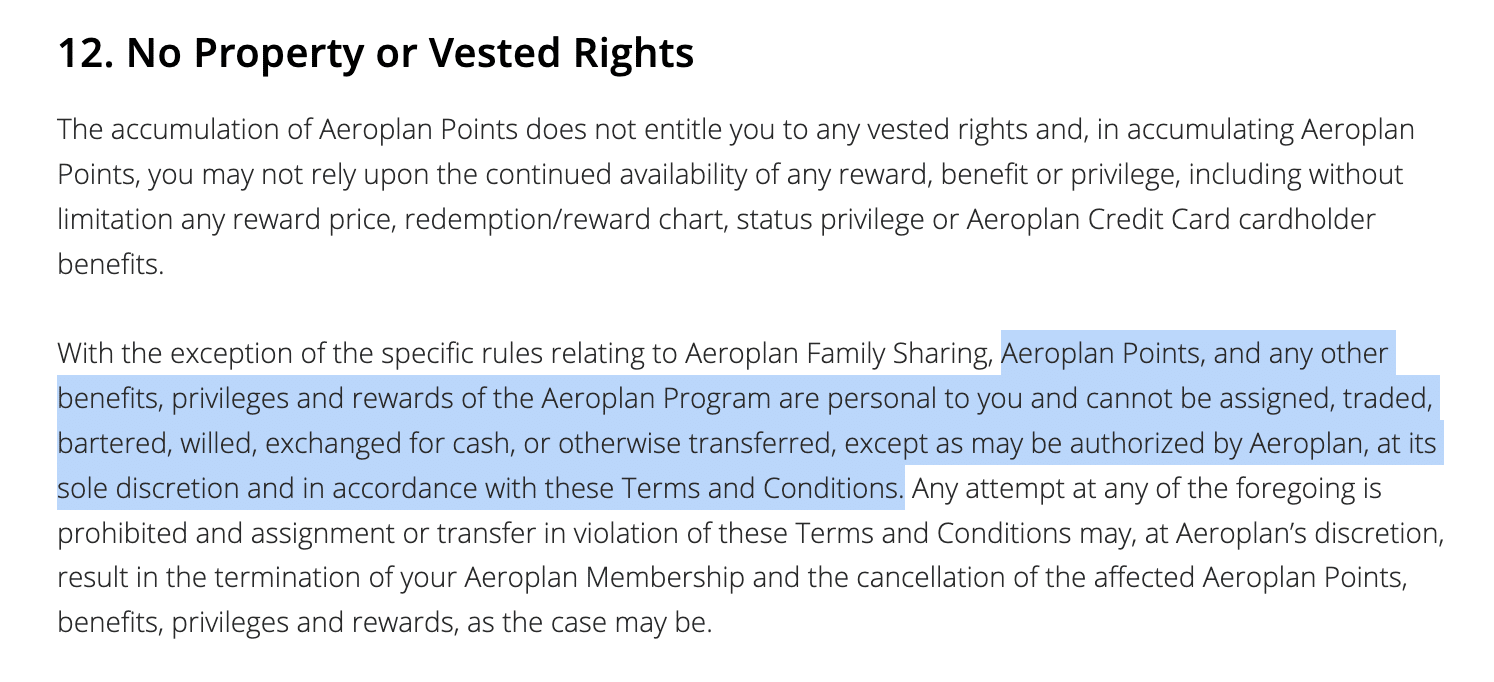
2. Many programs give the estate a favour, not a right. Marriott, for instance, can approve a one-time transfer, but at its own discretion. Hilton’s own wording says its decisions on these requests are final. If a program says no, there’s rarely a legal route to force it. Lawyers who write about this area have noted that there is very little Canadian case law on points in estates, so the contract language is what you have to work with.
3. Timing matters more than usual. Because many programs close the account the moment they learn of a death, and some only give you 60 or 90 days afterward to redeem, the order in which an executor does things can decide whether points survive.
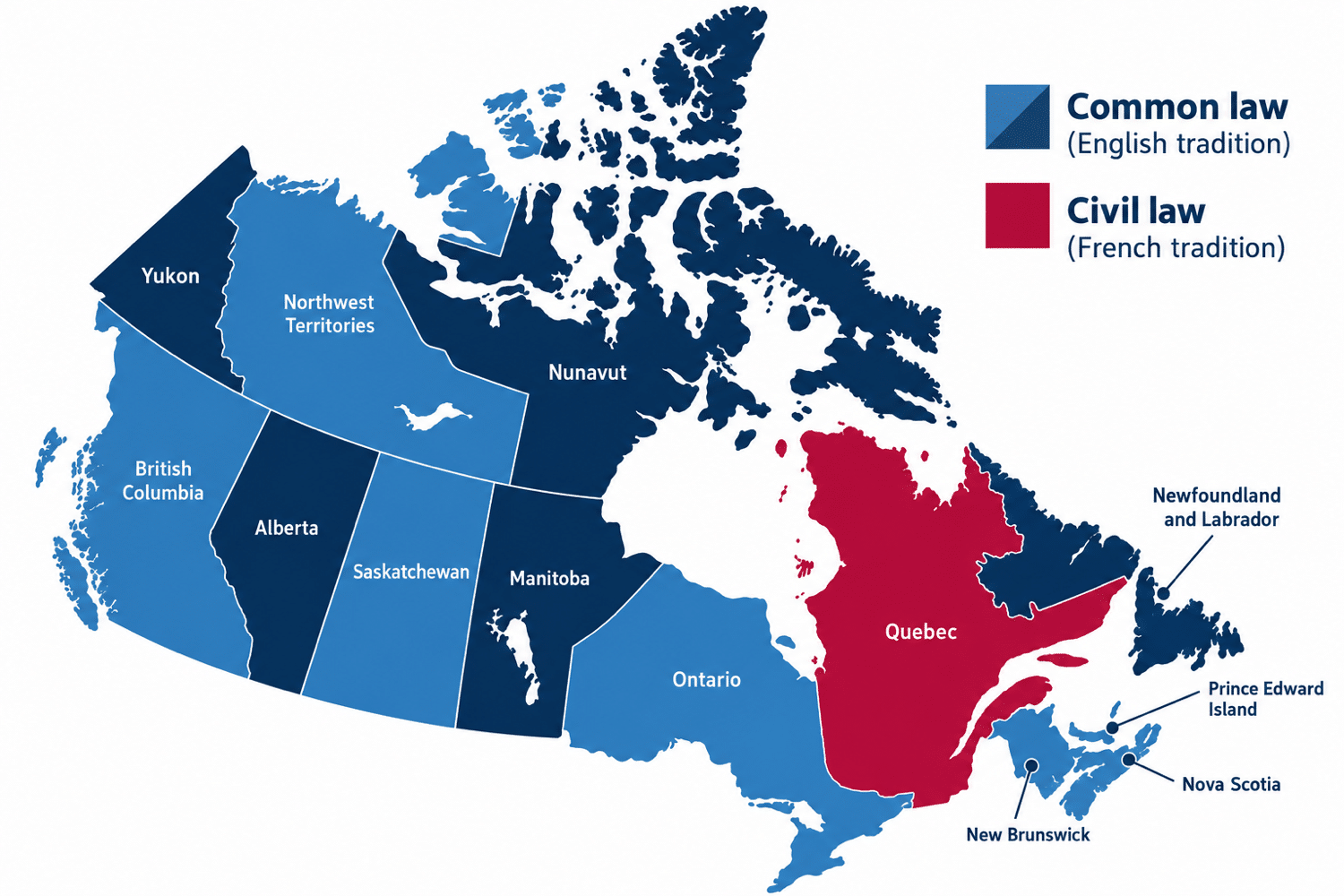
A note on Quebec. Quebec’s private law is based on civil law rather than the common law used in the rest of Canada. The estate vocabulary differs (a liquidator handles the estate rather than an executor, and notarial wills follow different procedures), and the paperwork a program asks for may look different. The basic reality for points is the same, since the program’s terms still control, but a Quebec notary can tell you what documents will be accepted.
While context is important with this difficult topic, the above is as much legal background as you should need. For the rest of this guide, we’ll focus on actual program terms and how you can act on them.
How Each Canadian Program Handles Inheritance of Points
Unfortunately, every program in Canada is individualized in how they handle points for deceased members. One program will hand your points to a beneficiary for free, and another will cancel them the day you die (or at least when they find out…). They also have different requirements for what documents or proof must be provided for death and beneficiary designation.
The table below shows where each stands, covering the main Canadian programs plus the U.S. hotel programs many Canadians belong to (Marriott Bonvoy, Hilton Honors, and World of Hyatt). Note that in this context, “transfer” means points move to an heir’s account and “redeem” means the estate or beneficiary can spend the points but not move them.
| Program | Can Points Go To An Heir? | Account Closure / Deadline | What You’ll Typically Need | Notes |
|---|---|---|---|---|
| Airline & Hotel Programs | ||||
| Aeroplan | Yes, transfer to a beneficiary named in the will | Normal 18-month expiry rules still apply; if points expired after death you can ask within 6 months | Death certificate, the portion of the will naming beneficiaries, contact details for the late member and each beneficiary | Multiple beneficiaries split equally unless one waives in writing. No direct donation from the late member’s account. |
| VIPorter | Yes, estate can redeem or transfer the points | Account closed on notice; unclaimed points cancelled 90 days after closure | Proof of death and authority to act for the estate | Points also expire after 24 months without qualifying travel. No cash value. |
| WestJet Rewards | Yes, estate can transfer WestJet points and name a beneficiary | Account closed on notice; unclaimed points cancelled 12 months after closure | Death certificate, proof the person is executor or administrator, scanned copy of will naming beneficiary | WestJet points can’t be converted to cash.Unclear process for multiple beneficiaries. |
| Marriott Bonvoy | Discretionary, one-time transfer to a single recipient (beneficiary or spouse) | No published deadline; the 24-month inactivity rule keeps running | Death certificate, will, marriage certificate for spousal claim, and two forms of legal identification | Elite status and night credits don’t transfer. |
| Hilton Honors | Yes, to one or more existing members | Request must be made within 1 year of death | Declaration form, death certificate, proof of authority over the estate | Free. Recipient must already have an account. Elite status doesn’t transfer. |
| World of Hyatt | Limited: one-time transfer to one member at the same home address | No deadline published | Documented death certificate, proof of shared address, proof of identity | Terms otherwise bar inheritance. Competing claims can void the points. |
| Retail & Coalition Programs | ||||
| Blue Rewards (formerly AIR MILES) | Yes, to beneficiaries who are already Blue Rewards members | Not specified; act promptly. The 24 month inactivity rule still applies. | Blue Rewards Estate Matters form plus proof of death; an estate administrator’s certificate may be required | Renamed from AIR MILES on June 1, 2026. Ask about any fee. |
| PC Optimum | No, per the terms | Account closed on death | N/A | Terms leave a narrow door open for discretionary exceptions. |
| Scene+ | Yes, to heirs and beneficiaries who are existing members or eligible to join | No death-specific deadline published; the 24-month inactivity rule applies | Whatever documents Scene LP considers necessary (not listed) | Transfers otherwise need Scene LP’s consent. Scotiabank cardholders’ points are Scene+ points. |
| Triangle Rewards | No, per the terms | Membership ends on death and eCTM is cancelled | N/A | Worth asking customer care |
| Bank-Issued Points Programs | ||||
| American Express Membership Rewards | Estate can request a one-time redemption, or apply to take over the account if eligible. | Points are lost when the card is cancelled, including after a death | Notice of death; proof you’re appointed by the will or a court, or handling the estate; a credit review for a takeover | Ask about points before choosing between cancelling and taking over. Guidance is from Amex’s U.S. site, so confirm with Amex Canada. |
| BMO Rewards | Redeem only, by the beneficiary the executor designates in writing | No deadline published | Written designation from the executor | Confirm the deadline with BMO. |
| CIBC Aventura | A spouse or partner can keep them by becoming the new primary cardholder; otherwise the estate can redeem | Estate must redeem within 12 months after the account is closed, or the points are forfeited | Estate documents; new cardholder must qualify to take over the card | Estate can only redeem for lifestyle rewards, payment with points or shopping with points, in a single transaction. No travel rewards. |
| RBC Rewards | Co-applicant can take over the card, redeem, transfer or convert the points. Otherwise the estate can redeem only. | Within 12 months after the card account is closed | Estate documents; a co-applicant must qualify to take over the card | A shared account is treated differently from a single owner account. |
| TD Rewards | Yes, transfer to a TD Rewards-linked account where the beneficiary is primary cardholder, or redeem for a statement credit | Within 1 year of death or the points are forfeited; statement credit must be redeemed within 90 days of notice | Executor must call TD; additional documents may be required; the receiving account must be open and in good standing | Only the executor or an authorized representative can give instructions. |
Airline and Hotel Programs
Air Canada Aeroplan
Aeroplan has the clearest process of any Canadian program. Its published estate policy says points can’t be willed, but a beneficiary named in the will can ask for them to be moved into their own Aeroplan account (a beneficiary who isn’t a member can join first). The executor can also make the request on the beneficiaries’ behalf.
Submit the request by email ([email protected]) with the late member’s name, address, phone, email and Aeroplan number if you have it, a scanned death certificate, and a scan of the part of the will that names the beneficiaries. Each beneficiary’s details are needed too. One beneficiary receives everything, and several beneficiaries split the points equally unless someone waives in writing.
Two things can catch families off guard however. Aeroplan’s normal expiry rules still apply after death, so a balance that lapses because of inactivity doesn’t get a free pass. And you can’t donate points to charity directly from the late member’s account. They have to move to a beneficiary first.
VIPorter
Porter’s VIPorter terms deal with death directly. Once Porter learns of a member’s death, it closes the account, and the estate can redeem or transfer the points. Porter may ask for a death certificate and proof that you’re the executor or administrator. The executor or administrator then tells Porter who the beneficiary is and gives that person’s VIPorter account number. If the beneficiary doesn’t have an account, Porter opens one for them.

Points that haven’t been claimed 90 days after the account is closed are cancelled and can’t be redeemed, transferred or exchanged for cash. VIPorter points are otherwise not transferable between members, and they expire after 24 months without qualifying travel, so a balance can disappear sooner if the account sits idle.
There is no form to initiate an estate claim, so I would start with simply contacting them via the Porter Call Centre at 1-888-619-8622.
WestJet Rewards
According to the WestJet Rewards Terms & Conditions, upon receiving notice or becoming aware of a WestJet member’s death, the membership is immediately terminated and the account is closed. However, the points in the member’s account become available for transfer by the member’s estate to the beneficiary for a period of 12 months after account closure. A copy of the death certificate and proof of executor or administrator, satisfactory to WestJet, may be required.
WestJet has a dedicated contact form for estate claims. For balances over 10,000 points, the form must be completed and the following must be provided:
- a scanned copy of the late member’s death certificate and;
- a scanned copy of the section of the will that names the beneficiary
The beneficiary’s WestJet Rewards number must also be provided, or a new account will be opened for them.
It is unclear how claims are handled if multiple beneficiaries are named or entitled to points from the deceased member’s account.
Marriott Bonvoy
Marriott allows, at its discretion, a one-time transfer of unredeemed points from a deceased member to a single recipient. No split transfers are allowed. Under the current terms, that recipient is the member’s legal spouse or someone named in the will.
Required documentation can include:
- (1) the will of the deceased, or an attorney’s attestation that there is no will,
- (2) the death certificate of the deceased,
- (3) a marriage certificate evidencing the marriage if the requestor is the spouse, and
- (4) two forms of legal identification of the requestor
Marriott doesn’t publish a deadline, but points can still expire after 24 months of inactivity, so don’t wait. Elite status and Elite Night Credits don’t transfer.
Earlier versions of the terms were looser, mentioning any family member or friend, so older articles may describe a more generous rule than the one now in force. Also keep in mind that Marriott Bonvoy members can transfer up to 100,000 points per calendar year to other members at no cost. So an executor may not need to go through all the hassle above for a small balance of points.
Hilton Honors
Hilton has a defined process outlined in the Hilton Help Center for transferring points from a deceased member’s Hilton Honors account. The executor or authorized person completes Hilton’s declaration form and emails it to Hilton ([email protected]) with a death certificate (a certified copy isn’t required) and an official document showing legal authority over the estate. The request has to be provided within one year of the death.
The points can go to one or more existing Hilton Honors members, but an individual declaration form must be completed for each claimant. Hilton says there is no fee, and recipients should see points within about five business days of Hilton receiving a complete request. Elite status doesn’t pass on.
There is an interesting point in the terms that states the member receiving points must have an existing account, and “a new account can’t be created just to receive these points.”

This seems slightly ambiguous to me, but it is perhaps another case for aging your loyalty program accounts including Hilton Honors, even if you don’t collect but have a family member who does.
World of Hyatt

World of Hyatt’s Terms & Conditions say points can’t be transferred through inheritance, but they carve out one exception: after a documented death, points can move on a one-time basis to one person who shares the deceased member’s home mailing address and who is already a World of Hyatt member. Elite status and awards are not transferable.
To initiate a transfer, call World of Hyatt Member Services at 1-800-304-9288 (U.S. and Canada) to start the deceased member points transfer. Be prepared to provide the following:
- Death certificate
- Proof that recipient shares the deceased member’s residential mailing address
- Recipient’s World of Hyatt membership number
- Proof of identity for the requesting party
It’s honestly kind of odd that Hyatt makes the determination based entirely on home address, but it is a perfect example of how a legal will can be superseded by program terms.
However, Hyatt’s terms also specifically state that if two people at the same address both make requests for points, and Hyatt can’t sort it out, they will refuse both requests and void the points. So if more than one household member wants a share, agree on one recipient before anyone calls. Also remember that World of Hyatt allows points transfers between members with very few restrictions.
Retail and Coalition Programs
Blue Rewards (formerly AIR MILES)
Blue Rewards is the new name for AIR MILES. The program was renamed on June 1, 2026, and existing balances were converted to Blue Points.
Its estate process works like the old one: complete the Blue Rewards Estate Matters form and send it, with a death certificate or statement of death, to Blue Rewards Customer Care by email ([email protected]) or fax (1-888-378-2332).

The form lists each beneficiary’s member number and how many Points each should receive, and notes that a certificate appointing an estate administrator may also be required for points balances over 320,000. Beneficiaries must already be Blue Rewards members. Blue Rewards’ transfer terms say completed transfers are final, so check the beneficiary details before you submit. Transfer requests are processed within 15-20 business days.
There is no stated deadline for claiming points for the deceased, but I would assume the 24 month expiry period for Blue Rewards still applies and act promptly.
PC Optimum
PC Optimum’s terms and conditions say the account closes on a member’s death and any remaining points are forfeited. The same terms allow points to be transferred to another member at the program’s discretion. A polite call to customer service could produce fruit before writing the balance off, but don’t expect a yes.

Keep in mind that since most redemptions with this program are a flat rate, it’s best to just not let an account balance build up.
Scene+
Scotia Rewards merged into Scene+ in December 2021, so Scotiabank cardholders now earn Scene+ points. Scene+ terms and conditions say points are personal and can’t be sold, exchanged, given, assigned or otherwise transferred without Scene LP’s written consent, except as the terms allow. However, the terms do allow a transfer on death: points can go to heirs and beneficiaries who are existing Scene+ members or who are eligible to join and open an account to receive them.
To initiate a transfer, start by contacting Scene+ Member Services, by phone at 1-866-586-2805 from 7:00 a.m. to 11:00 p.m. EST, or by email ([email protected]). Scene LP can ask for any documents it considers necessary, and it doesn’t list them, so ask what they need when you contact them.
Scene+ points linked to a Scotiabank product don’t expire as long as the product stays open, and a standalone Scene+ account can be closed after 24 months without activity. However, there are no published details about the timeline for making an estate claim, so act promptly.
Triangle Rewards
The Triangle Rewards Program Rules state that Canadian Tire may end a membership when the member dies, which closes the account and cancels the Canadian Tire Money in it without compensation.
As with PC Optimum, you can ask for an exception. The terms don’t promise one, but they certainly aren’t as strongly phrased as with PC Optimum, so it may be worth a try.
Bank-Issued Points Programs
Bank programs are different from airline and retail programs because the points are tied to a credit card account. When the card is cancelled, the points are often cancelled with it. Most issuers give the estate a limited window, and most only let the estate redeem, not transfer.
American Express Membership Rewards
American Express is a little vague on this subject. There is a guidance page for managing deceased accounts which says anyone can notify Amex of a death. Someone appointed by the will or a court, or who is handling the estate, can then ask to cancel the account or, if eligible, apply to take it over. Taking over requires a card that can be transferred, an account that hasn’t been closed for more than a year or fallen 30 or more days past due, and a credit review. The new cardholder becomes responsible for the balance.

However, that guidance page doesn’t mention points. Membership Rewards terms say points are lost when a card is cancelled for any reason, including death, but let the executor request a one-time redemption. So ask about the points before you choose between cancelling and taking over the account. The guidance page mentioned above is on Amex’s U.S. site, so confirm the process with Amex Canada.
BMO Rewards
The BMO Rewards terms and conditions say that when the primary cardholder dies, points may be redeemed by a beneficiary the estate trustee or executor designates in writing. We couldn’t find a stated deadline, so ask BMO directly rather than assuming you have unlimited time.

CIBC Aventura
CIBC says unredeemed Aventura points are cancelled within 12 months of the primary cardholder’s death. Treat the year as the outer limit and move sooner. Voluntarily closing an Aventura card also starts a 60-day countdown on the points, which matters if you’re tempted to cancel the card early.
CIBC’s Aventura terms say points are not transferable, though a spouse, common-law or civil union partner can keep them. If the partner is an Authorized User on the card and is approved as the replacement Primary Cardholder, all the points stay in the account.

Otherwise, CIBC closes the Aventura account and the estate can redeem the points, but no later than 12 months after the account is closed. From the date of death until that deadline, the estate can only redeem for
- Lifestyle Reward (excluding Specific Merchants)
- Payment with Points or Shopping with Points.
Airline travel rewards, flexible travel rewards and Specific Merchant redemptions aren’t available, and everything must be redeemed in a single transaction unless CIBC advises otherwise.
Points not redeemed by the deadline are cancelled for any reason, including a dispute among the estate’s legal representatives, so settle who is acting for the estate early. For a business card, the terms move the points automatically to the new Rewards Officer the business appoints, if applicable.
RBC Rewards
RBC Rewards’ terms, which are verbose and 27 pages long, treat a card with and without a co-applicant differently. If the card isn’t shared, RBC closes the account on the primary applicant’s death, and the estate can redeem the points within 12 months after the card account is closed. If the card has a co-applicant, ownership of the card may pass to them if they qualify, and they become the primary applicant. If they don’t qualify, the account is closed and the co-applicant can redeem, transfer or convert the points within the same 12 months.
Some older guides describe a 90-day window for RBC, but the current terms say 12 months.
TD Rewards
TD’s terms spell out the process quite clearly. Only the executor, or a representative the executor authorizes, can direct what happens to the points, and they must call TD to do it at 1‑800‑983‑8472.
The executor names a beneficiary, who has to be a natural person (the terms also refer to a trustee or, in Quebec, a liquidator). If TD is notified within one year of the date of death, the executor can have the points redeemed for a statement credit to the account within 90 days of notification, or transferred to a TD Rewards-linked account where the beneficiary is the primary cardholder, as long as that account is open and in good standing. This makes TD essentially the only bank-issued points currency that can be directly transferred (without taking over the card account).
If TD is notified more than a year after the death, the points can’t be redeemed and are forfeited. TD may ask for additional documentation at its discretion.
For Families & Executors: What to Do When Someone Has Just Died
If you’re reading this after a death in your family, my condolences to you. Remember to take a breath. You don’t need to resolve every program this week. It’s best to be organized and prioritize programs that have the shortest window to make a claim.
Claiming Points: A Step-by-Step Approach
1. Find out which programs the person belonged to. Search their email for words like “points,” “miles,” “rewards” and “statement.” Check wallets, key tags, phone wallets, and credit card statements. Look for annual fees tied to rewards cards.
2. Rank by deadline. As a rough guide based on the published terms above:
- 90 days after account closure: VIPorter
- 6 months after expiry: Aeroplan
- 12 months after death: TD Rewards, Hilton Honors
- 12 months after account closure: WestJet, RBC Rewards, CIBC Aventura
- No stated deadline: Marriott Bonvoy, Blue Rewards, Scene+, World of Hyatt, BMO Rewards
3. Gather the paperwork once. Nearly every program asks for some combination of the following, so order several copies:
- A death certificate
- Proof you’re the executor or administrator
- The part of the will that names beneficiaries
- The late member’s account number, name and address
- The beneficiary’s own account number, since many programs won’t create a recipient account for you
4. Decide who gets what. If there’s more than one beneficiary, agree early. Aeroplan splits equally by default, and Hyatt can void points if two household members both claim them.
5. Contact each program and ask about options, if required. Ask whether the points can be transferred or only redeemed, what the deadline is, and whether anything should be done first. Keep a note of who you spoke to and when. This is especially pertinent for programs that have a less defined process or claim form.
Credit Card Points: Don’t Cancel the Card First
This is the most common mistake. Many issuers wipe out unredeemed points when the card account is cancelled, and the cancellation is the natural thing for an executor to do early on. Before you close any rewards card:
- Find out what the issuer’s terms say about points after death, and what the deadline is.
- Ask the issuer whether the estate can redeem points before the account closes. With American Express, for instance, the one-time redemption has to be requested before the cancellation.
- Remember that points earned by supplementary cardholders usually belong to the primary cardholder’s account, so they don’t survive on their own.
- Check whether the points can go to a travel partner, and whether that’s allowed for the estate.
- Keep paying attention to the account’s balance and any annual fees while you sort this out. Making new purchases on a deceased person’s card isn’t appropriate.
Once the redemption is requested and confirmed, then you can close the card.
For Points Users: What to Do Before You Die
As you can see from the previous sections, the rules around points inheritance for deceased program members are exceedingly patchy. However, some good news is that a little planning ensures your beneficiary can either recover points from most programs or access your accounts to utilize the points before they are lost forever.
Name Beneficiaries of Your Points in Your Will
It’s worth doing, but go in with the tapered expectations. As covered in the legal section, the program isn’t bound by your will, and many programs will ignore it. However, a clause in your will at least gives your executor clear authority and evidence of your wishes, which helps when a program like Aeroplan asks for the part of the will naming beneficiaries or when Marriott wants to see evidence of who you intended to receive the points.
A short, specific clause is enough. Name the programs, name the beneficiary, and say your executor is authorized to contact each program and request a transfer or redemption. Then treat that clause as a request, not a guarantee. Your lawyer can word it properly, and a Quebec notary can do the same for a Quebec will.
Create a “Dead Box”
The Dead Box is a simple idea I read about on Personal Finance Club: put the key information about your financial life in one place your family can find, so they aren’t left to act as a forensic accountant after you’re gone. Personal Finance Club sells a ready-made template, but you can easily build your own.
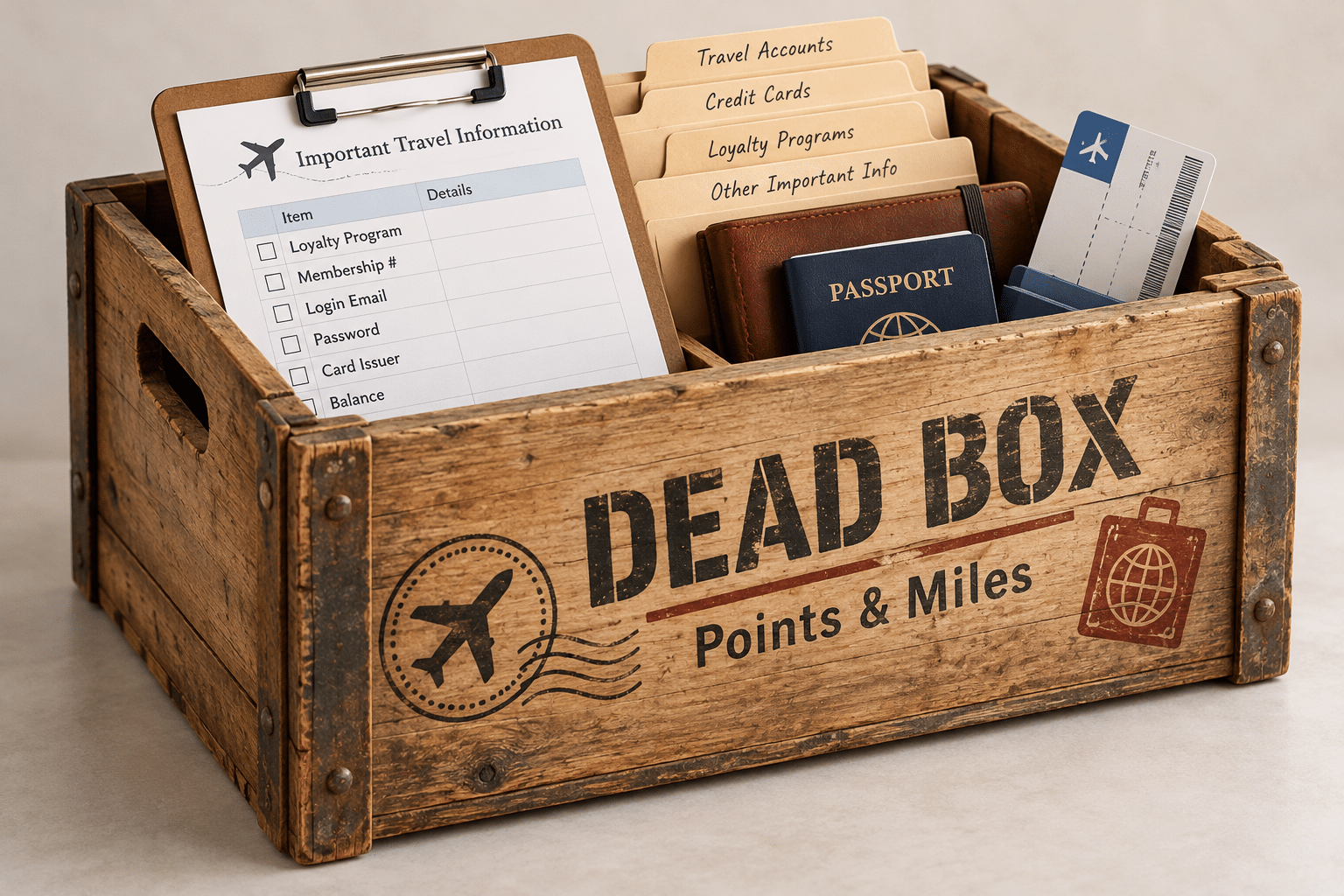
For points, the Dead Box is a master list of every loyalty program you belong to, with the membership number, the login email, and the password. Add the card issuer and a rough balance, and update it once a year.
A caveat about terms of service. Most programs’ terms say the account is personal and logins shouldn’t be shared, and using a deceased member’s account after death may break those terms. That’s a risk worth considering. But for many programs it’s also the only practical way a family can get value, particularly where the terms say points are forfeited and there’s no transfer process (Canadian Tire, PC Financial, etc). Access also lets the person settling your affairs see what you have so they can decide what’s worth pursuing. For programs with a formal estate process, like Aeroplan, Blue Rewards and Hilton, the official route is straightforward, so there’s no reason to rely on a login. Your executor should get advice if the balances are significant, and should remember that an executor’s duties still apply however the points are used.
Here are three practical ways to store the list:
- A Google Drive folder, encrypted. Store the list as a password-protected, encrypted file (a zip with a strong password works). The weak point is the password. Don’t keep it in the same place as the file. Put it in a sealed letter kept with your will, in a safety deposit box, or with your lawyer, with instructions on how your executor can retrieve it.
- A USB drive in a safety deposit box. This avoids cloud storage entirely. Make sure the person who will need it is authorized to open the box, and update the drive each year. Safety deposit boxes can be hard to access after a death, so check with your bank about how that works.
- A password manager with emergency access. Several password managers offer an emergency access or legacy contact feature that lets a trusted person request access, often after a waiting period. It’s the most secure option because nothing is written down in plain text. Set it up now, and test it: confirm your contact actually receives the request and understands what to do. A feature nobody has tested can fail when it’s needed most.
Once your beneficiary has the list, they can decide what’s worth doing. For a program with a clean estate transfer, they might go through the proper process. For a program that forfeits points at death, using the account directly may be the only way to get any value, and that choice, along with its risks, is theirs to make.
Conclusion
Points are a strange kind of asset. They can be worth thousands of dollars, but they aren’t yours in the way a bank balance is, and when you die the program’s rules take precedence over your will.
Here’s a comparison that helps me think about it. With ordinary money, a trust is a way to hold assets outside your estate so they pass directly to a beneficiary without court-supervised probate. Although points usually can’t be put in a trust or willed, including them anyways and having a “Dead Box” together act as a do-it-yourself version of that. They give your heirs access and clear instructions without relying entirely on the program’s inheritance rules and processes (or lack thereof).
If you’re settling an estate, find the programs, rank the deadlines, and don’t cancel a card until you’ve asked about the points. If you’re planning ahead for yourself, update your will, build the Dead Box, and test it with your executor.
Frequently Asked Questions
It depends on the program. Aeroplan, Blue Rewards and Hilton Honors have formal processes for moving a late member’s points to a beneficiary or another member. Marriott can approve a one-time transfer to a spouse, and Hyatt allows a one-time transfer to one person at the same address. PC Optimum and Triangle Rewards say points are forfeited. During your lifetime, some programs let you transfer or pool points with family, which is often easier than waiting until after death. Remember the old adage: “earn and burn”.
Often, yes, and sometimes quickly. Aeroplan’s regular expiry rules still apply and VIPorter points expire 90 days after account closure. Most bank programs set windows of up to a year, including CIBC, RBC, and TD. PC Optimum and Triangle Rewards end the account at death with no option for transfer or redemption. Check each program’s terms for the deadline.
In Canada, you often can, with Aeroplan being the clearest example. A beneficiary named in the will can ask for the points to be transferred to their account, and the executor can make the request. The program isn’t legally bound by your will, so what you inherit depends on the program’s terms.
Usually the issuer closes the card, and unredeemed points are lost unless the estate acts within the issuer’s window. Some allow the estate to redeem for a limited time, and some allow a one-time redemption if you ask before the account is cancelled. Don’t cancel the card until you’ve asked about the points. See the credit card section above.
For a small balance, usually not. Programs like Aeroplan, Blue Rewards and Hilton publish simple processes you can follow with a death certificate and proof of your authority. If the balance is large, the estate is complicated, or there’s a dispute among beneficiaries, a lawyer is worth the cost. In Quebec, a notary can advise.

Reed Sutton
Latest posts by Reed Sutton (see all)
- What Happens to Your Points When You Die? A Guide for Collectors, Executors and Heirs - Oct 16, 2026
- Rogers Red Credit Cards: Changes Inbound - Aug 18, 2026
- Review: The Brown Palace Hotel and Spa, Autograph Collection - Aug 12, 2026
- Earn up to 70,000 WestJet Points & $125 FlyerFunds! - Aug 9, 2026
- LIMITED TIME OFFER: BMO Ascend World Elite®* Mastercard®* - Aug 2, 2026