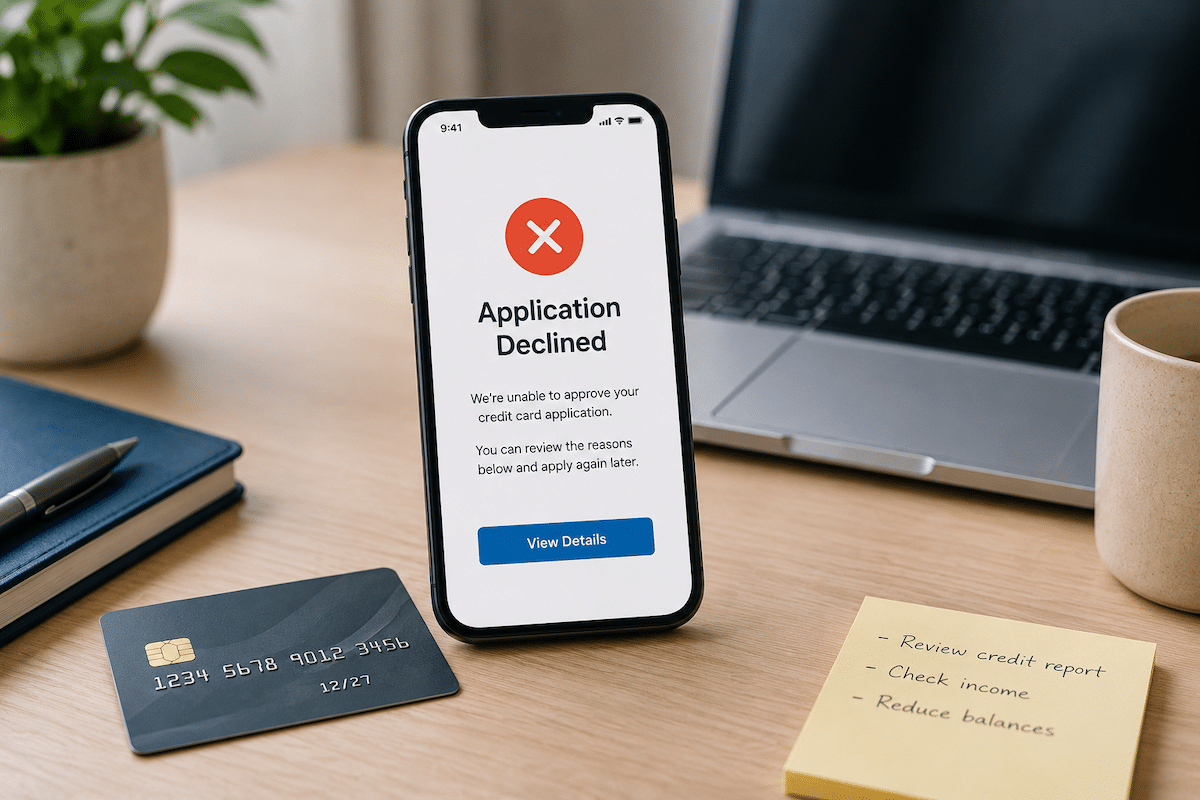
Alright, so it happened. You’ve filled out the credit card application form, triple-checked your details, hit submit, and the screen goes into that agonizing loading wheel only to spit back the one word you didn’t want to see: declined.
Whether you’re a miles and points fanatic or this is one of the first credit cards you’ve attempted to get, a declined application is never fun. Though for the newbies in the audience, let me say: it’s also a bit of a rite of passage.
To quote the immortal Douglas Adams’ Hitchhiker’s Guide to the Galaxy: DON’T PANIC.
While the sting might feel fresh, there are a couple of immediate actions you can take immediately after being declined for a credit card to check if this was a mistake, a situation that you need to fix, or the wrath of the approval algorithm gods.
Why Was I Declined For a Credit Card?
Every financial institution and credit card issuer has its own proprietary approval criteria, and they’re generally not eager to tell you exactly which factor tripped you up. You’ll usually get a vague letter citing “one or more of the following reasons” alongside a laundry list of possibilities, which isn’t exactly helpful.
That said, there are a few common culprits.
Your credit report might have something unfavourable on it. These can include missed payments, collections, or simply a credit history that’s too short for the issuer’s comfort level. Some lenders are notoriously more stringent than others when it comes to what they’ll tolerate on your file, and while I won’t name names, the community knows who tends to be pickier.

The number of hard inquiries on your credit report is another big one, especially inquiries within the past 90 days. Issuers can interpret a flurry of recent applications as credit-seeking behaviour, and that makes them nervous. The total number of accounts you hold may also be viewed as a liability, particularly if you have a significant amount of unsecured revolving credit already extended to you.
But perhaps the most misunderstood factor is utilization. Most people think of credit utilization as a single number – the percentage of your total available credit that you’re currently using.
While that overall figure matters, issuers also look at utilization on individual credit lines. Even if your aggregate credit utilization sits at a comfortable 10%, having a single card maxed out to 90% of its limit can raise flags. It looks like you might be overly reliant on one credit line, and that’s the kind of thing that can quietly sink an otherwise strong application.
Next Steps After Being Declined For a Credit Card
Ensure Your Credit Report Is Good & Accurate
Before you do anything else, pull your credit report and actually read it. Don’t just look at the score, but review the full report. Services like Credit Karma and Borrowell make this free and painless, and between the two, you can cover both major credit bureaus in Canada, TransUnion and Equifax.
If you’re not already monitoring both bureaus, our Borrowell vs Credit Karma comparison is a good starting point, as both of those free services are must-haves in the modern Canadian economy.

Errors on credit reports are more common than you’d think. Old accounts that should have been closed, incorrect balances, incorrect personal information, or even accounts that aren’t yours can all drag down your profile.
If something looks wrong, don’t just shrug it off. Take the time to go through the dispute process with the relevant bureau. It can be tedious, but it’s absolutely worthwhile, and we cover the nuts and bolts in our guide on how to build or repair your credit score in Canada.
A clean credit report won’t guarantee approval, but a report with inaccurate negative information can almost guarantee a decline.
Ask For An Application Reconsideration
This is a step a lot of people skip, and that’s a mistake. Most issuers will let you request a second review of your application, and the key difference is that a reconsideration often involves a human being rather than just an automated system.
Call in, be polite, and plead your case. If you suspect the issue was too many recent inquiries, explain that you’ve been evaluating different credit card products. If your total credit-to-income ratio was the concern, point out that your actual spending is well below your credit limits. A human can see nuance that an algorithm can’t.
Sometimes you simply aren’t the customer the issuer is looking for right now, and no amount of persuasion will change that. The point is: don’t go down without at least asking. The worst they can say is no again.
Now, I won’t pretend this works every time. With some issuers, the reconsideration process is more like a polite runaround. Your mileage will vary, and it’s worth knowing when to drop it. For some of you, it will be when the first phone rep tells you “no.”
For some folks, it’s when an in-branch meeting with paystubs is requested. Personally, I’d say taking the time and going in-person is worth it if the credit product you are applying for is good… but let’s be real, many of us aren’t in the miles and points game alone. Many people are guiding a Player 2, who may have taken some convincing to get started with miles and points, and is likely less than ecstatic about going to a bank branch during regular business hours.
Take Advantage of Two-Player Mode
If you’re earning points as a household, a decline for one player doesn’t mean the other will face the same fate. Different people have different credit profiles, and what tripped you up may not be an issue for your partner at all.

Having a Player 2 is one of the most underappreciated force multipliers in the miles and points world. Beyond just doubling your application and welcome bonus earning capacity, credit card referral bonuses are a powerful tool that can scale your earnings quickly when used properly.
So if your partner picks up the card you got declined for, you might still benefit from a referral bonus on top of their welcome offer. That said, always do the math to see whether a referral bonus or a FlyerFunds rebate is the better play.
Just Wait & Try Again In The Future
Sometimes the best strategy is patience. If you’ve been declined and a reconsideration didn’t work, give it some time and try again down the road.
As a general rule of thumb, you want at least 60 days between hard pulls on your credit file, though 90 days is better. To be extra cautious, I’d wait 61 or 91 days, respectively, because there’s no reason to find out the hard way whether the issuer counts day 60 or day 61 as the threshold.
In the meantime, make sure you’re tracking your credit card applications. Note the date you applied, the issuer, the result, and any context around why you were declined. Throw a calendar reminder in for three months out so it doesn’t slip your mind entirely. Future you will thank present you for keeping organized records, especially once you’re juggling applications across multiple issuers and both credit bureaus.
I Wasn’t Declined, But My Credit Card Application Went Pending; What Next?
A pending application is a different beast from a decline, and generally a more optimistic one. In my experience, pending applications resolve to “approved: status more often than not. Usually, I’ve seen this be automatic, but I’ve also seen the credit department reach out for more information
That said, don’t just sit on it. Call the issuer’s application status line and ask if there’s any additional information they need. Nine times out of ten, you’re going to end up on the phone with someone anyway, so you might as well be proactive about it rather than waiting for them to reach out.

Just to illustrate this: when I applied for the BMO VIPorter World Elite Mastercard, I was initially declined. When I called in, I was told that, as a new product, the card had heightened verification requirements. So I wound up having to schedule a time to speak with an underwriter, who was more than amenable to listening to my side of the story and sending my card for approval.
Another common situation is simply needing additional verification to push the pending through. For example, you might need to provide a copy of your ID, and once you do, they will approve the card. You never know what might be holding the application in a “Pending” status, so a quick phone call can get you on the right path.
In my opinion, it’s better when lenders get around this laborious process by engaging in a practice called “credit splitting”. Say you already have $20,000 in credit extended to you from that issuer. Rather than decline your new application outright, they’ll take $10,000 from your existing product and allocate it to the new card. You end up with two products, but the bank’s total exposure to you stays the same. A win-win, all told.
Conclusion
Getting declined for a credit card feels lousy at the moment, but it’s far from permanent. A decline is a data point, but not the end of your miles and points journey. Check your report, ask for reconsideration, lean on your Player 2 if you have one, and if none of that works, set a reminder and try again in a few months.
Follow these steps, and you’ll have a better relationship with your financial institutions… and be flying in style.

Kirin Tsang
Latest posts by Kirin Tsang (see all)
- Canada Post MyMail: Track Your Incoming Credit Card Mail & More - Oct 12, 2026
- Scotiabank Amex Offers: Don’t Leave Cash On The Table - Oct 5, 2026
- EU261 Regulations: Know Your Air Passenger Rights - Oct 2, 2026
- BMO eclipse Visa Infinite Card Review - Oct 1, 2026
- BMO Blue Rewards World Elite Mastercard Review - Sep 27, 2026