Vanity of vanities, all is vanity. There is nothing new under the sun.
But is that the case with credit cards? I may be an old man yelling at a cloud here, but I need to go on a diatribe today: whilst we are very blessed by the present Miles & Points credit cards system, it is not as lucrative as it once was. I’m hardly alone in this sentiment; the entire Frugal Flyer team recorded a podcast episode on how miles and points have changed in recent years from sunny Las Vegas.
This isn’t just a question of issuers devaluing their respective programs; this is about a fundamental shift in business mentality. Many credit card issuers want to extract value rather than provide it, and we have seen many excellent credit cards fall to the wayside over the years.
So please join me today as we take a trip down memory lane to the greatest credit cards in Canada that are no longer amongst us, and why so many are either discontinued or no longer accepting new applications.
The Greatest Canadian Credit Cards No Longer Issued
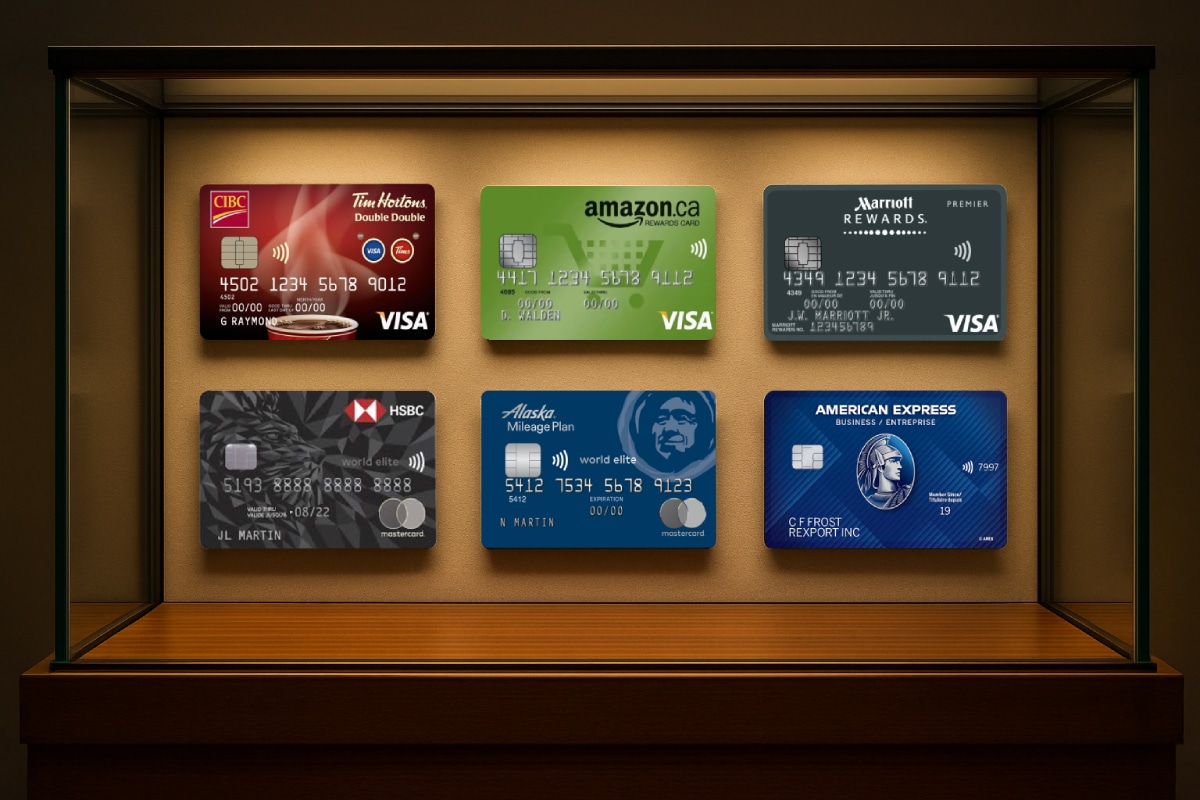
American Express Business Edge Card

First up on our list is the American Express Business Edge Card, which is no longer available for new applications. I can confirm that the card still works; I, in fact, still have one.
This card was excellent because it had a clear business-oriented identity. For only $99 a year, it offered 3 Membership Rewards points per dollar spent on dining and food delivery, gas, rideshare and taxis, transit, office supplies (like Staples), and electronics (I bought a PS5 with this card for 3x points).
It also offered you an opportunity to get an additional 1,000 Membership Rewards points for every $3,000 you spent in a single monthly billing cycle.
This card had no reason not to succeed. It was excellent, even if it didn’t have any airport lounge access or fancy travel amenities. Its idea was clear: provide good value to businesses in a variety of categories in which they are statistically likely to spend.
So why has it gone the way of the dodo? I will speculate on it later, but I think it was either too unprofitable for Amex Canada or it just never found its specific market niche because business owners preferred the stability and elevated perks of cards like the American Express Business Platinum Card.
Chase Canada Marriott Rewards Premier Visa

Next up is a real blast from the past: the Chase Canada Marriott Rewards Premier Visa Card, whose glorious 2012-era website is still online. It gives us an excellent snapshot both into the great value this card offered, as well as a nice connection to a time when JPMorgan Chase was still in business in Canada, outside of its credit card payment terminal business.
So the reason this was so good was that it charged only a $120 annual fee (which was often waived in the first year), paired with an outsized welcome bonus and free night certificate for a category 1-4 Marriott hotel.
I am aware that pre-COVID, this welcome offer was worth a lot more, but this was also prior to Marriott’s merger with Starwood Preferred. That meant the 30,000 Marriott points welcome bonus, or often 50,000 Marriott points via an elevated welcome bonus, offered outsized value.
Prior to the discontinuation of this card in 2017, this was still the good old era of Marriott fixed-category hotels. That meant your Marriott points from this welcome bonus went very far, and you could book up a Category 5 hotel, which encompassed a lot of hotels all around the world, and not just those confined to poorer countries with perhaps less Marriott presence.
As if that wasn’t enough, it also didn’t charge any foreign exchange (FX) fees.
So why did this go bust? Frankly, I think Canadians were just too weirded out by any bank outside the Big Five (RBC, TD, Scotia, CIBC, and BMO) or American Express, and just didn’t back it. The worsening of the Marriott program probably didn’t help, but Amex was there to pick up the slack when Chase decided to get out of the Great White North.
Chase Canada Amazon.ca Visa

Speaking of Chase and its exit from the Canadian market, it actually wiped all consumer debt on its way out. This was remarkably charitable for a bank of its size, though I do cringe a little at how much interest some of those cardholders must have been paid.
As part of its blanket amnesty, there was another card than the Marriott offering, which trundled out of Canada: the Chase Canada Amazon.ca Visa. I remember ordering stuff on Amazon back in 2015 and being absolutely bombarded with offers to apply for this card… I couldn’t, though. I still erroneously believed that new credit cards would ruin my credit score.
Regardless, this card was awesome. It easily could hold its own on the modern market because it charged 0% FX fees, and it earned 2% cashback on Amazon transactions with 1% on everything else. And this was at the cost of no annual fee.
What a card. It’s a shame that it’s gone because, to be frank, the modern version, the MBNA Amazon.ca Rewards Mastercard, while similar, isn’t nearly as good. Weird how that worked out….
CIBC Tim Hortons Double Double Visa Card

The CIBC Tim Hortons Double Double Visa Card is probably the single most novel and unique on this entire list.
Why is that? It had a built-in LED that let you switch between using a Tim’s gift card or your actual Visa card. Just click a button to switch between the two. This is the type of transitional credit card tech that could have only existed back in 2014 when this was launched. Annual fee? What the heck is that?
Its original spokesman was actually former Toronto Maple Leaf and noted NHL tough guy, Tie Domi. This makes the card the single most Canadian credit card in history.

And I’ll be real: the card was cool because it had benefits done in a way I’ve never heard of them being done anywhere else, ever. It had a 1% earn rate on your Tim’s card on all transactions, but the real key was the bonuses tied to the number of transactions.
50 transactions in a single statement period? That meant you got 50 free Timbits. That is a benefit I think many Canadians can understand more intuitively than points. Five Visa and five embedded Tim’s card transactions were good for a free baked good, like a donut or apple fritter.
I miss this card for no other reason than it’s now a lost piece of Canadiana. If you still have one, hold onto it dearly, as its successor, the Tims Mastercard, does not live up to its illustrious legacy at all.
I’m sure that a signup bonus of free Timbits would get way more signups today than a whole pile of other options.
HSBC World Elite Mastercard
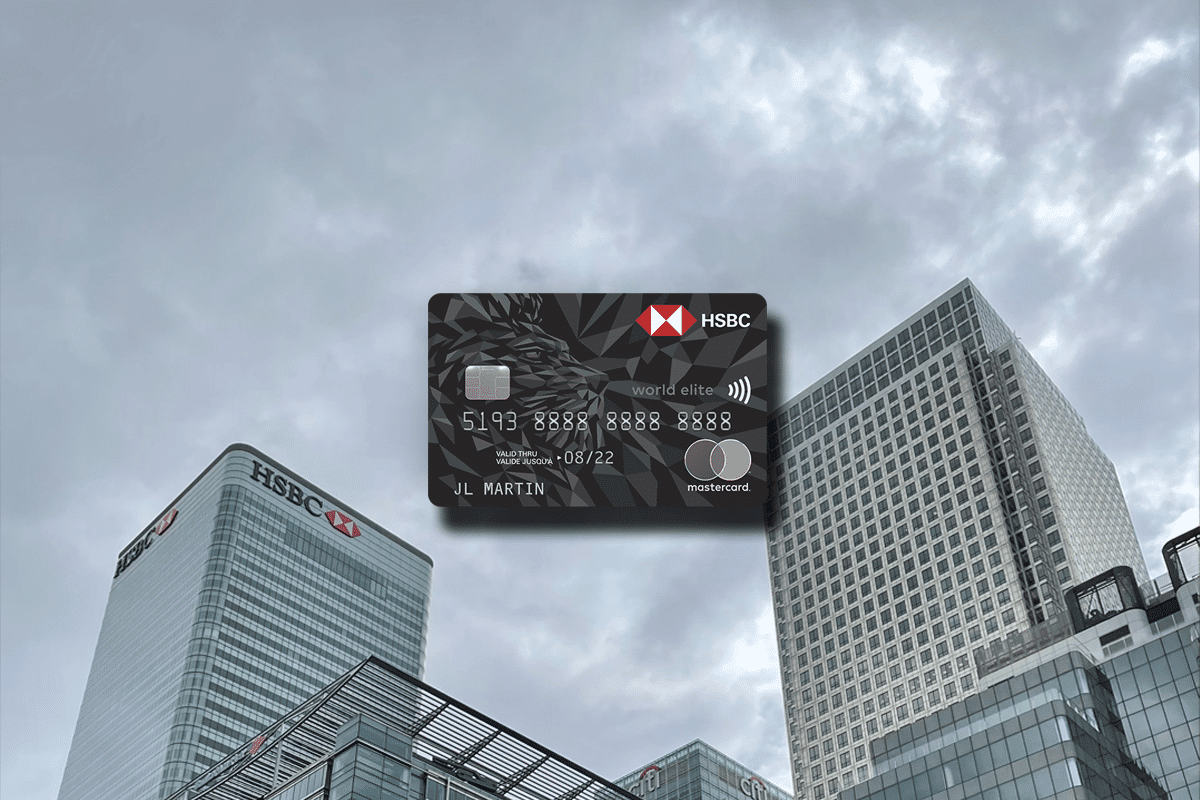
Next up is another blast from the past, one which shall return no longer. HSBC, the venerable banking stalwart of Hong Kong and Asia, has sold its assets in Canada to RBC and will not rise again.
Its card, the HSBC World Elite Mastercard, was amazing when it was still available. This was because it was another offering that offered no FX fees. It also came with a $100 Travel Enhancement Credit, which, in theory, could only be used for amenities like seat upgrades, but in practice could be used against just about any travel purchase, including the refundable hotel trick.
It also had a relatively arcane points system called HSBC Rewards, but these were great because they could be redeemed as cash against travel purchases or, better yet, transferred to partners (including the elusive Cathay Pacific Miles) at the following rates:
- 25,000 HSBC Rewards points = 10,000 British Airways Executive Club Avios
- 25,000 HSBC Rewards points = 9,000 Singapore Airlines KrisFlyer miles
- 25,000 HSBC Rewards points = 8,000 Cathay Pacific Asia Miles
This wasn’t bad when one considers the average welcome bonus exceeded 35,000 HSBC Rewards Points.
Ultimately, this product was discontinued when HSBC was acquired by RBC. Cardholders were transitioned to a special RBC Avion Visa Infinite Card that does not charge FX fees. How long that particular benefit continues to survive is anyone’s guess.
MBNA Alaska Airlines World Elite Mastercard
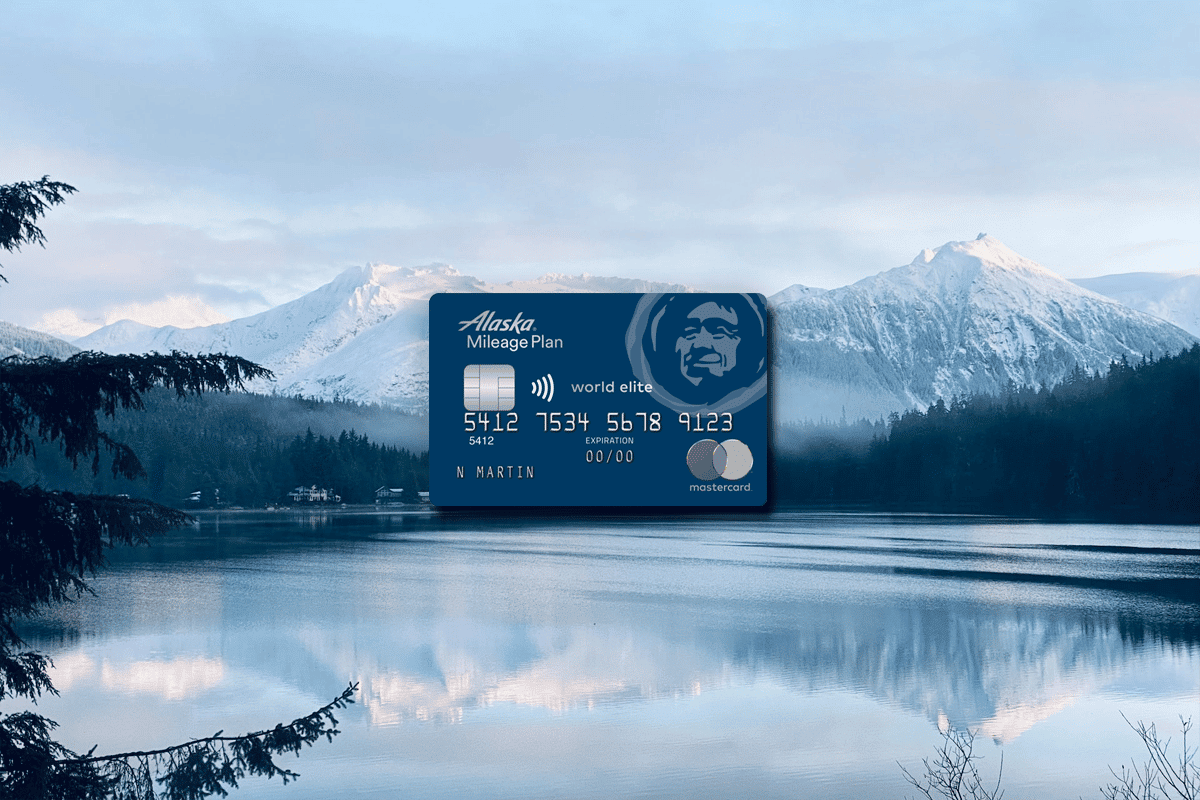
So we come to our final card on this list. One whose loss still stings Canadian credit connoisseurs in a personal way: the MBNA Alaska Airlines World Elite Mastercard. At $99 a year, it offered some of the most lopsided value in the Canadian market.
The insurance on this was standard World Elite territory: decent-to-good. The earn rates? Pedestrian at a mere 1 Alaska Mile per $1 spent, or $3 per $1 spent on Alaska Airlines. The spread on this alleged 3x was bad due to the 2.5% FX fees on USD transactions, the card cost… and as a US airline, guess what Alaska charged in?
But why was the card dope? Well, it offered 30,000 Alaska Miles after spending $1,000 in 3 months for the majority of its existence. Even under the new Alaska Atmos Rewards program, this is basically worth a king’s ransom.
Why is that? Simply put, Alaska Atmos is the last of the Mohicans. It’s a program that still has fixed flight redemption costs in business class, with a decent amount of business class actually being released by partners. In short, this credit card bought you 50% of a business class flight just about anywhere, so long as you were cool with flying from Seattle, and that is a sacrifice I’m sure many were willing to make.
Its untimely demise in 2022 brings me to my next point…..
What Undid These Credit Cards?
OK, so real talk: why do half these cards not exist anymore, and why do the half that do not accept new applicants anymore?
Personally, I think it’s a combination of two factors which are linked at the hip: how profitable is the card, and how much demand for the product is there? These may seem like the same thing, and they are connected, but they aren’t identical. A popular product may not turn a profit. Similarly, a product that individually does make money may not have any mass appeal.
I think some cards, the Chase Marriott card, simply fell into not having enough demand in Canada during the time frame in which it launched. I would ascribe this to Canadian consumer habits. Up here, about 80% of all banking is handled by the Big Five banks. Most consumers are loath to switch outside their childhood institution, and there is a general mentality of risk aversion.
This makes newcomers like Chase, who pour hundreds of millions into marketing and visibility, operate at a disadvantage even if their products were bloody fantastic. It was just hard to get enough people to sign up and retain their credit cards.
This gets into the second: profitability. When it comes to gaining customers and keeping them, many of these products were fantastic. In fact, I’d argue that outside of exceptional products like the Scotiabank Passport Visa Infinite + Card, all these discontinued cards are at parity with the current market’s offerings, if not significantly better than them.
The issue is that, like all businesses, credit card companies want to make money. They primarily make money off a combination of annual fees and especially swipe fees. That means they had to get a certain number of customers.
If they paid out more benefits than they took in via revenue, it was only sensible to shutter the offerings. Larger banks like HSBC probably had other business reasons to leave, like wanting to get out of Canadian consumer banking, but overall, I suspect my estimate here is about correct.
In particular, I think Tim Hortons and its Brazilian private equity owners hated giving out too many free Timbits. May its Double Double Visa rest in peace.
Conclusion
So there we have it: a trip down memory lane to a different era of credit card rewards. It’s always a bit bittersweet to look back at the truly great products that are no longer with us. From free Timbits to hotel nights tied to price-controlled categories, these cards were the real OGs.
While the market has certainly changed, and maybe isn’t as wildly lucrative as it once was, it’s fun to pour one out for the cards that got us hooked on this hobby in the first place. They may be gone, but for those of us who had them, they’re certainly not forgotten. I’ll pop free St. Regis 6 PM champagne to toasting the many more hopefully on the way.

Kirin Tsang
Latest posts by Kirin Tsang (see all)
- Could Your Airline Go on Strike? Important Dates to Know - Sep 14, 2026
- United Airlines MileagePlus Pooling: How It Works - Sep 7, 2026
- Credit Freezes in Canada: How They Work & Where They’re Available - Aug 24, 2026
- To Transfer or Not To Transfer Points: That is The Question - Aug 21, 2026
- Airport Lounges: Should You Visit or Skip? - Aug 14, 2026