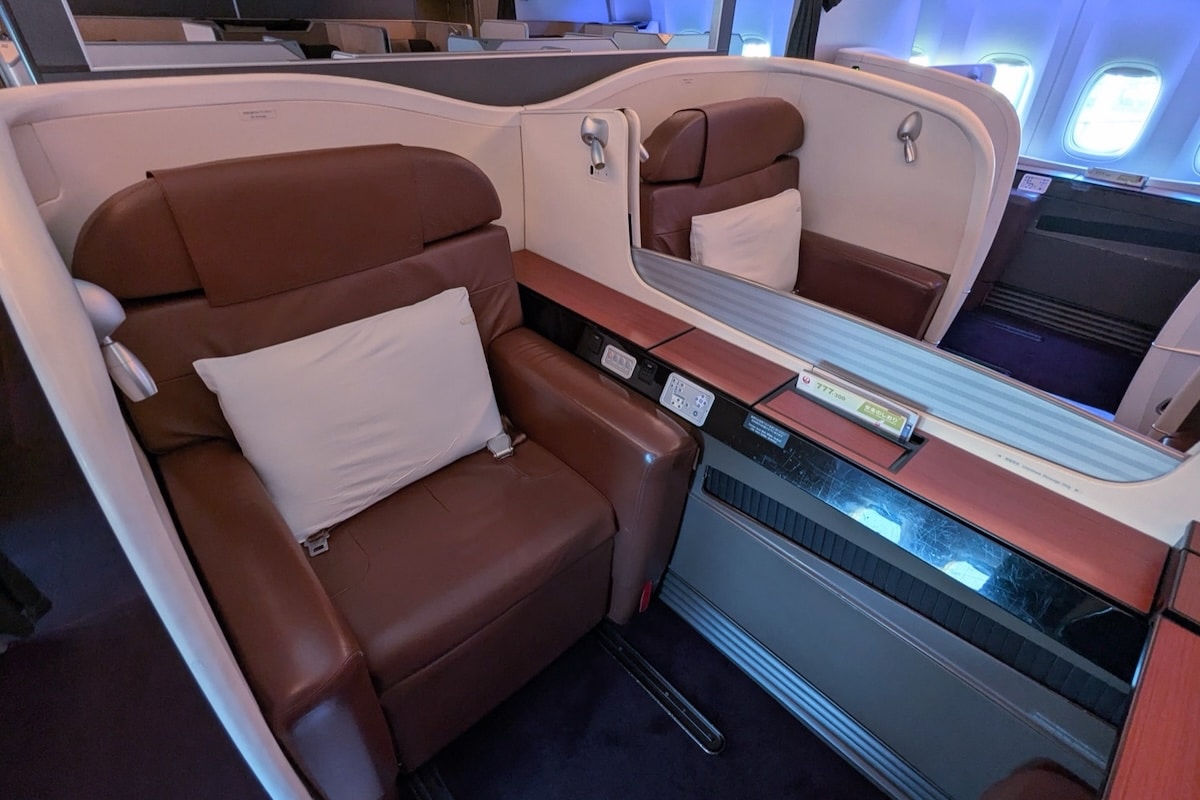
To conclude my round-the-world trip, I couldn’t think of any better way to end my time in Japan than with a flight in Japan Airlines First Class. While the airline has recently introduced a brand-new first class suite on its Airbus A350-1000, the Japan Airlines Boeing 777 now features the airlines’ “classic” and outgoing version of first class.
Even though it’s the older product, Japan Airlines’ First Class on the 777 is an incredibly comfortable experience. It offers outstanding Japanese cuisine, an extensive drink selection, and the signature warmth and attentive service the airline is known for.
Although this aircraft and cabin will eventually be phased out, the Boeing 777 still operates many of Japan Airlines’ long-haul routes, so there’s a good chance your first class flight may be aboard this aircraft.
Here’s a look at what you can expect when flying Japan Airlines First Class on the Boeing 777.
Booking Japan Airlines First Class on the Boeing 777-300ER
| First Class | Aircraft | Route | Flight Duration |
|---|---|---|---|
| JL 2 | Boeing 777-300ER | Tokyo–Haneda to San Francisco | 9 Hours 20 Minutes |
I booked this first class flight using British Airways Avios for 103,000 Avios plus CA$294 in taxes and fees.
While this wasn’t my preferred booking method, I had originally hoped to redeem through the Alaska Airlines Atmos program, which would have required fewer points and less cash. However, the first class availability shown through British Airways wasn’t appearing on Alaska’s site. Not wanting to risk someone else claiming the single seat that was available, I decided to secure the seat while it was available using Avios.
The majority of the points used to book this flight were transferred from RBC Avion Rewards to British Airways Avios. RBC Avion typically offers a 30% transfer bonus to British Airways Avios at least once a year, making it a great opportunity to maximize the value of your RBC Rewards points. Thanks to that bonus, the total cost of this flight came to just 80,000 RBC Avion points once the transfer bonus was factored in.
Cards such as the RBC Avion Visa Infinite Card often feature a welcome bonus of up to 70,000 Avion points, which is a great starting point toward a redemption like this. See our RBC Avion Visa Infinite Card review for more details.


The RBC Avion Visa Infinite Card earns flexible Avion points that can be transferred to British Airways Avios, Cathay Pacific Asia Miles, American Airlines AAdvantage, WestJet Rewards, or used against travel purchases via the fixed-rate Air Travel Redemption Schedule.
70,000 Avion points
$5,000
$1,330+
$120
Yes
Nov 25, 2026
Ground Experience
First class passengers departing from Tokyo–Haneda are granted access to the Japan Airlines First Class Lounge in Terminal 3. This is a massive lounge spread across two floors, and designed to accommodate hundreds of passengers. The lounge wasn’t even remotely busy during my visit, and as you would expect being in Japan, was as quiet as a library.

The first class lounge is divided into several distinct seating areas, each designed with a specific purpose in mind, whether it’s enjoying a meal before your flight, sipping a cocktail, or simply relaxing while watching the aircraft activity outside the windows.

The main seating area of the lounge, known as JAL’s Table, is situated on the main floor and features a combination of dining tables and comfortable armchairs for a more relaxed experience.


A small self-serve area is located at one end of the lounge, where guests can help themselves to coffee, tea, soft drinks, and a selection of spirits and wines.

Each seat has a QR code that could be scanned with your mobile device to access the first class lounge’s web portal. From there, you could order food, reserve a shower suite, and view an interactive map of the lounge.
Since I was expecting an extravagant first class meal once on board, I decided to have just a small plate of sushi to hold me over until the flight.

I used the shower facilities in the lounge, and each room was well-appointed with everything needed to freshen up before a flight.


The upper level of the first class lounge, known as JAL’s SALON, doesn’t serve food. Instead, it features a bar-style atmosphere where guests can enjoy cocktails, sake, and a selection of teas.

On the lounge’s upper level, there is a row of individual pods, each furnished with a massage-function chair.

Another section of the lounge is a sushi restaurant called Sushi Tsurutei, but it only operates in the mornings. Since my flight departed in the afternoon, I unfortunately did not get the chance to visit.
The JAL First Class Lounge at Haneda International Airport may not be the flashiest or most extravagant first class lounge, but it excels in the essentials. It offers a solid selection of food and drinks, convenient amenities such as a shower room, and most importantly, a quiet, uncrowded space to relax for a few hours before a long flight.
Cabin Arrangement
The first class cabin on Japan Airlines Boeing 777-300ER is configured with eight seats arranged in a 1–2–1 layout. All seats provide direct aisle access, so there really isn’t a bad option. If you’re traveling with a companion, the middle pair of seats are ideal for easier conversation. Solo travelers will likely prefer the window seats for added privacy.

The middle seats feature a divider that can be raised or lowered for added privacy if desired. While this is an older seat without a sliding door, the seat shell still offers a good degree of privacy, and with only eight seats in the cabin, disturbances should be minimal to begin with.
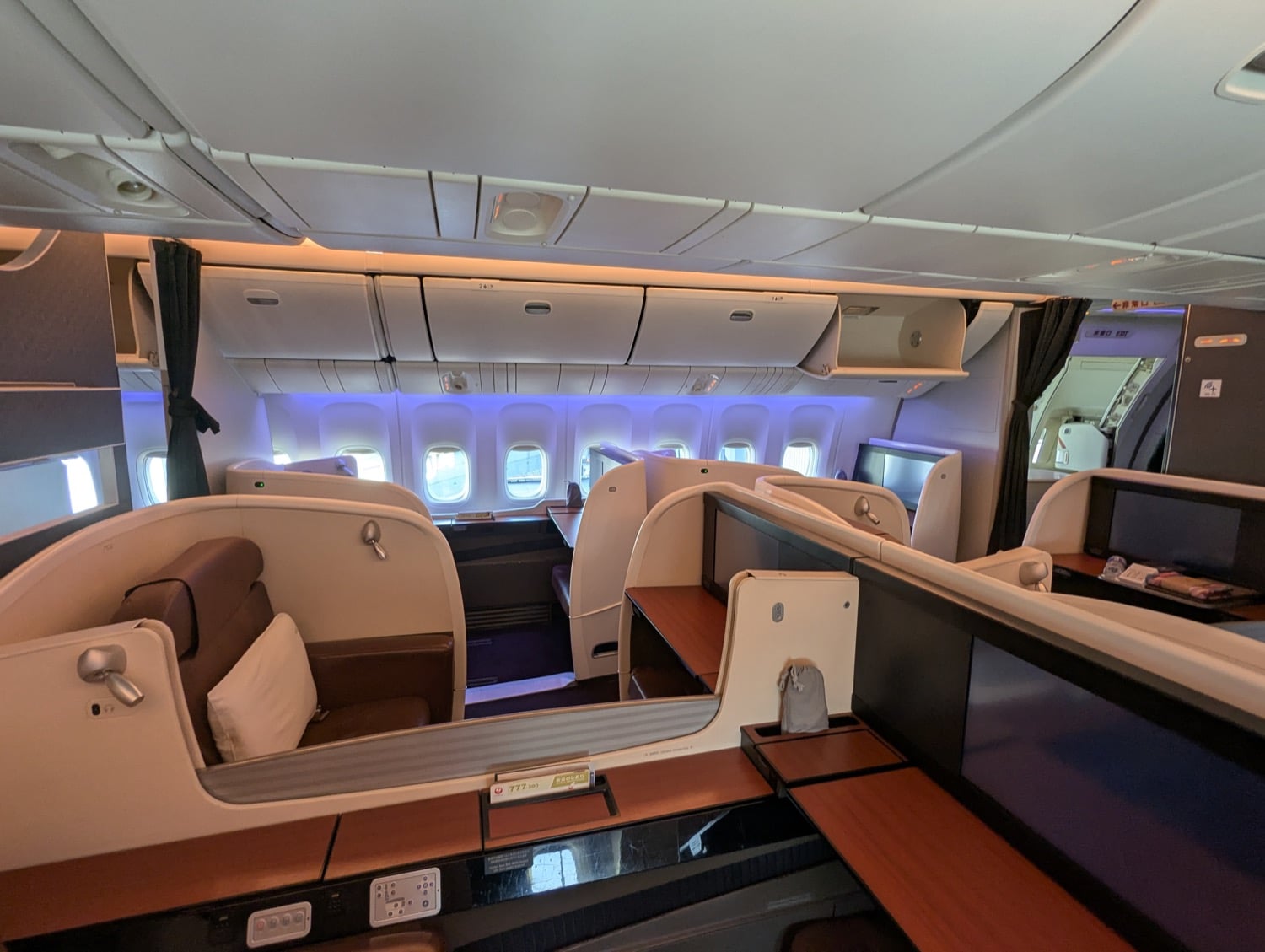
I chose seat 2K, a window seat on the right side of the aircraft. There was only one other passenger in first class, who was seated across the cabin, which meant I had the entire right side completely to myself.
Although these aircraft are nearing the end of their lifespan and are largely outdated by today’s standards, I found the cabin remarkably well kept. Aside from the older technology, the Japan Airlines 777 first class cabin is a very comfortable environment for a flight.
Seat
The suite is long and spacious, perfectly suited to a first-class experience, and includes a large brown leather armchair, ample storage, a full-size ottoman, and a 23-inch display.


The armchair-style seat was exceptionally comfortable. Although the seat is showing some signs of wear, I was impressed and genuinely enjoyed the classic, old-school aesthetic.

Between the seat and the windows runs a flat surface spanning the full length of the suite, featuring several storage compartments. It’s also worth noting that each window seat provides access to four windows, a feature not commonly found on newer-generation aircraft.

The two storage compartments provide plenty of space to place a few personal items. Inside each storage bin is a handheld controller to operate the entertainment system.
It’s unclear to me why there are two entertainment controllers, but I suspect the cabin was retrofitted at some point, and the updates to the cabin fixtures likely included a newer touchscreen controller.

A panel above the armrest housed controls for adjusting the seat recline, along with preset buttons for bed mode, relax, and upright positions.

Across from the seat is a 23-inch display, a literature pocket, and a universal power outlet.
Beneath the tray table is an ottoman with a seatbelt that can extend to form a second seat, allowing another passenger to join for meals so you can enjoy dining face-to-face with a partner.

As I’ll discuss later, the entertainment system is laughably outdated and easily the weakest aspect of the seat. Aside from that, however, I found everything else more than adequate, including the spaciousness, comfort, and storage.
Bed
Since there was only one other first class passenger on board, there were plenty of open seats. When the flight attendant came by to offer turndown service, she suggested setting up the bed on the seat across the aisle so I could easily switch between my main seat and the bed whenever I wanted.
The airline provides a choice of soft or firm mattress pads, along with a substantial pillow and a comfortable duvet.

Thanks to the seat’s generous width and length, along with a wide, unobstructed footwell, this is one of the best sleeping setups I’ve come across on any flight. I had no trouble getting comfortable and dozing off for a brief nap partway through the flight.
Amenity Kit
The amenity kit was provided by Japanese brand Heralbony. The contents of the amenity kit were an eye mask, a moisture mask, lip balm, hand cream, a packet of tissues, a hair brush, ear plugs, a dental kit, mouthwash, and a USB cable.


Along with the amenity kit, I was handed a Shiseido skincare kit during the pre-departure service.

First Class passengers are also provided with a set of sleepwear, which I found to be very comfortable. If I’d had more space in my luggage, I definitely would have taken them home with me.

Finally, a pair of slippers completes the impressive set of amenities, more than enough to be comfortable during the flight.

Bathroom
The two first class bathrooms were standard in size but included a few noteworthy features. As is typical on a Japanese airline, each bathroom was equipped with a Japanese-style toilet featuring a bidet function.

Additionally, two foldable benches that can be extended out from the wall, providing a spot to stand and place your clothes while changing. This way, you don’t have to stand on the bathroom floor in your socks or bare feet.

Some additional dental kits and mouthwash are also available in each bathroom.

Dining
Japan Airlines offers a dine-on-demand service, letting passengers order any item from the menu whenever and wherever they wish. After taking my seat, I received the food and drink menu, presented in a leather folder, and confirmed with the cabin crew that I would like to eat immediately after takeoff.

An international menu is also available, but since this was Japan Airlines First Class and the airline is renowned for its exceptional Japanese cuisine, I opted for the Japanese set menu as my meal choice.
The beverage menu in Japan Airlines First Class stands out for several reasons. Flights departing from Japan feature 2013 Salon Champagne, the most expensive champagne served on any airline, with a retail price of over $1,000 per bottle. Additionally, the airline offers Queen of Blue Tea, considered one of the finest and most luxurious teas in the world.
First Meal
The meal service started with an amuse-bouche and a serving of caviar. While caviar is always a welcome treat in first class, I found Japan Airlines’ offering slightly underwhelming compared to my experience in Etihad Airways First Class.
I was particularly excited to try the Queen of Blue Tea, which I found absolutely delightful. I loved that the tea is served in a wine glass, and I ended up drinking nearly two bottles on my own.

As someone with limited experience in Japanese cuisine, I found many of the dishes to be quite experimental from my perspective. The ingredients, flavors, and textures were almost all new to me, yet nearly everything I tried was fantastic.

Following the five-course seasonal delicacies, the next dish was a clear soup with lotus root and sea urchin. This was probably my least favorite course, as I had a really difficult time getting past the texture and didn’t particularly enjoy the flavors.

The next course was wagyu beef, accompanied by another serving of caviar. If there was ever an indulgent and rich dish, this would be it. Perfectly epitomizing what a first class meal should be.

Finally, this brought us to what I guess would be considered the main course, which was a steamed rockfish and tofu, with a side of ginger rice, and a bowl of miso soup.
Everything here was solid, but after the exceptional wagyu, nothing else quite stood out as remarkable.

Because of some allergy concerns, I opted for the dessert from the Western menu, a coconut and pineapple gâteau. It was a delightful way to conclude what I found to be a very extensive, satisfying, and excellent meal.

Second Meal
About an hour before landing, my flight attendant stopped by to ask if I wanted anything to eat. I was still quite full from the previous meal, so I asked for something light, and she suggested the pork cutlet sandwich.
I’m glad she did, because it’s not something I would have chosen on my own, and it turned out to be excellent. She also brought me a plate of fruit and a glass of orange juice. It was the perfect portion to hold me over for the rest of the flight.

I found the service during the meal to be among the best I have ever experienced in first class. With two flight attendants assigned to just two passengers, each of us effectively had our own dedicated crew member.
As a result, the service was extremely attentive and genuinely friendly, with no hint of being rushed or pulled away by other passengers. Plates were cleared promptly, and my drink was refilled almost immediately. The flight attendant looking after me even had some time to chat about my travels, asking where I had been and where I was headed. It struck a perfect balance between being proactive and knowing when to give me some quiet time to unwind.
Entertainment
Entertainment Console
The entertainment system is the main aspect of the aircraft that really shows the age of the cabin. It might be the worst system I’ve used on any airline and in any class of service. It feels extremely outdated, it’s frustrating to navigate, and the content selection is disappointingly limited.
The screen is a reasonable 23 inches, but its resolution and brightness are very poor. There isn’t even a proper graphical interface. When nothing is playing, the screen is simply off.
All browsing of the entertainment library must be done through a handheld touchscreen remote, which is used to select movies and TV shows or access features such as the in-flight map. Unfortunately, the remote is slow, laggy, and generally unresponsive to touch inputs.


I didn’t end up watching anything on the entertainment system. Instead, I left the screen on the in-flight map and used my laptop to get some work done and watch a few shows I had downloaded beforehand.

The airline provides a high-quality pair of Panasonic noise-canceling headphones to first class passengers. I didn’t try them myself, but they seem to be among the better airline-provided headphones I’ve seen recently.
Wi-Fi
Japan Airlines provides a voucher code to first class passengers, granting access to complimentary Wi-Fi for the full duration of the flight. As this is an older aircraft equipped with previous-generation satellite connectivity, Wi-Fi speeds are generally only sufficient for some light browsing and messaging but nothing much beyond that.

All passengers can enjoy a free one-hour session, and additional plans are available for purchase. Every plan comes with unlimited data and no caps.
Conclusion
While some aspects of the Japan Airlines 777 first class experience are undoubtedly outdated, it’s still an entirely comfortable and enjoyable way to fly. The food, beverages, extensive amenities, and outstanding service are what set Japan Airlines apart from most other airlines.
Although the new first and business class cabins on the Airbus A350 are expected to become more common in the coming years, this older-style cabin will likely remain in service for some time. If you can find availability and have the points to use, it’s a fantastic experience that I would wholeheartedly recommend.

Jeff Jamieson
Latest posts by Jeff Jamieson (see all)
- Review: Singapore Airlines First Class Suites (A380) - Sep 30, 2026
- Review: Alaska Airlines Business Class Suites (787-9) - Sep 23, 2026
- Chexy Plus: Does It Make Sense? - Sep 11, 2026
- Review: The St. Regis Al Mouj Muscat Resort - Aug 26, 2026
- Freedom Mobile Global Roaming: The End of Travel eSIMs? - Aug 17, 2026