Toward the end of a qualification year, airlines sometimes send targeted status buy-up offers to select members, inviting them to pay for an upgrade to a higher elite tier if they appear likely to miss qualification. A targeted status buy-up can offer an attractive shortcut to a higher tier of status. You pay a flat fee that often matches what you might have spent on the additional flights you need to requalify, without needing to complete a last-minute mileage run at the end of the year.
Let’s break down how these offers work, who typically gets targeted, and whether paying for an elite status buy-up makes sense.
Airline Status “Buy-up Offers”: What Are They?
Airline status “buy-up” (sometimes referred to as “buy-back”) offers are targeted promotions sent to select members. They give members the option to retain their current tier if they are at risk of dropping multiple levels or losing status altogether, or to move up to the next tier if they narrowly miss qualifying organically. These offers are almost always time-limited and allow payment in either cash or miles.
The most important aspect to understand about status buy-up offers is that airlines do not make them publicly available. If you are targeted for a status buy-up offer, the airline will either send you an email letting you know an offer is attached to your account or display a notification directly in your member dashboard when you log in.
These offers are usually sent out to targeted members in January or February, which coincides with the rollover period to a new qualification year for many frequent flyer programs. Furthermore, because these offers are targeted, the cost may fluctuate based on how close you are to the next status level.
Airlines don’t disclose the criteria that is considered for who receives targeted buy-up offers. However, by looking at data from members who have received an offer, we can get a sense of what an airline looks at to determine the types of travelers who are likely to receive these offers.
Airlines appear to base targeted status buy-up offers on a mix of factors, including your current status, spending patterns, and program engagement. In general, these offers tend to go to members who have made significant progress toward the next elite tier but will come up just short. Airlines may also include members who contribute reliable revenue through ticket purchases and other ancillary fees, and are actively engaged with the program, whether through the airline’s partners or spending on a co-branded credit card.
Geography may also play a role in it too. For example, Air Canada may wish to target travelers in Calgary, where WestJet has a significant foothold, by extending status incentives designed to grow its loyalty base in certain regions and draw members away from competing carriers.
A Closer Look at “Buy-up” Offers
A buy-up offer is simple and clear. The airline presents you with an opportunity to move up to a higher status tier for a set price, and you can choose to accept or decline before the stated deadline.
Let’s have a look at a couple of offers I’ve received and explore whether any of them are worth considering.
Aeroplan “Buy-up” Offer
This past year I held Air Canada Aeroplan 25K status, which I obtained through a perk with my Marriott Bonvoy status, which grants automatic 25K status to Marriott Bonvoy Titanium Elite members. I had no intention of pursuing Aeroplan 35K status; however, through some regular flying activity I came close to qualifying (well over 50% of the way there) for Aeroplan 35K status, but came up just short.
Related: The Complete Air Canada Aeroplan Status Guide

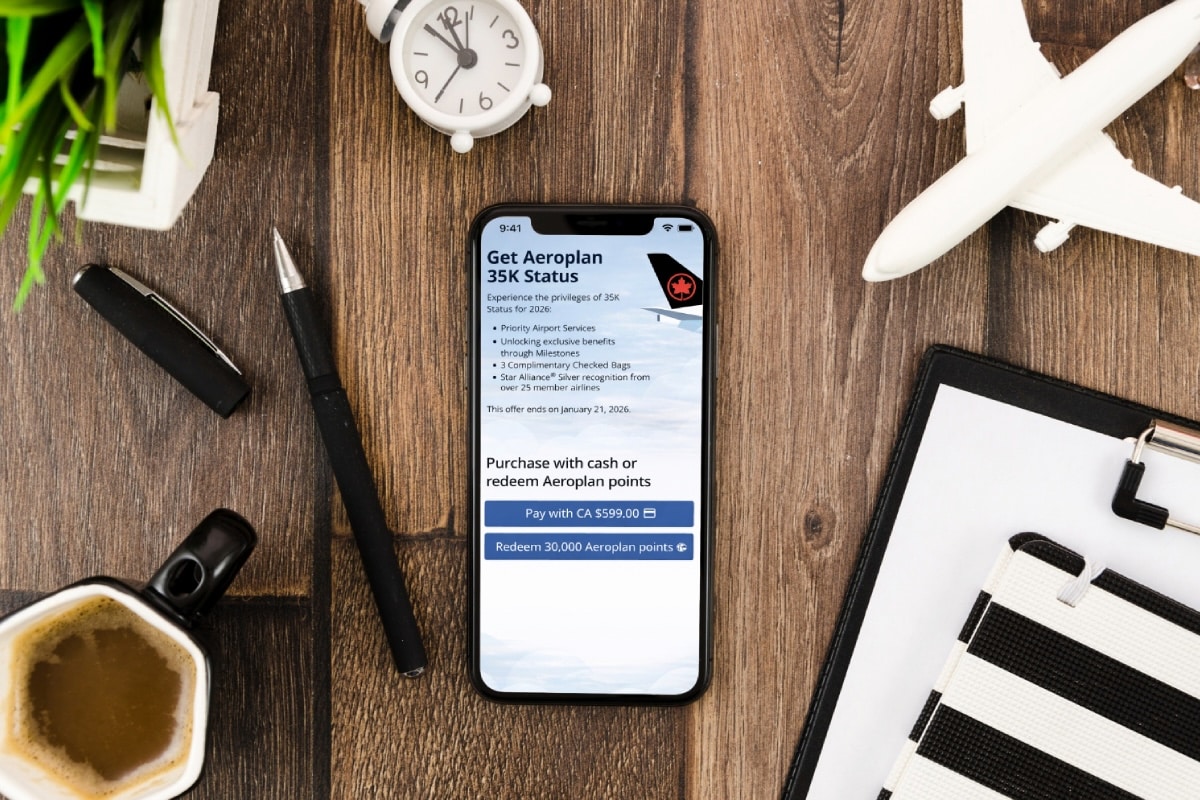
I was offered a buy-up to 35K status for either CA$599 or 30,000 Aeroplan points. I chose not to accept this offer, as the incremental benefits of 35K status don’t justify the cost for my travel habits. For example, I never check bags, so many of the perks wouldn’t apply to me. I’ll still hold Aeroplan 25K status, which I’m happy with for now.
We value Aeroplan points at roughly 2 cents per point, which is exactly what Air Canada has assigned the value at for the purposes of this offer. I think the 30,000-point offer is especially attractive, since it guarantees a solid fixed redemption rate without any out-of-pocket cost and the likelihood that those points were earned at a rate well below 2 cents per point.
American Airlines “Buy-up” Offer
I earned American Airlines AAdvantage Gold status in 2025 by leveraging a status match from World of Hyatt. Because the status match was a one-time promotion, it meant that I would have to requalify for Gold status the normal way if I wanted to keep it, which I had no desire to do.
However, I did accumulate a substantial amount of qualifying activity through spending on my Citi AAdvantage Platinum Select World Elite Mastercard over the year. This ended up placing me well over halfway to requalifying for AAdvantage Gold, which is likely why I received a buy-up offer from American Airlines.
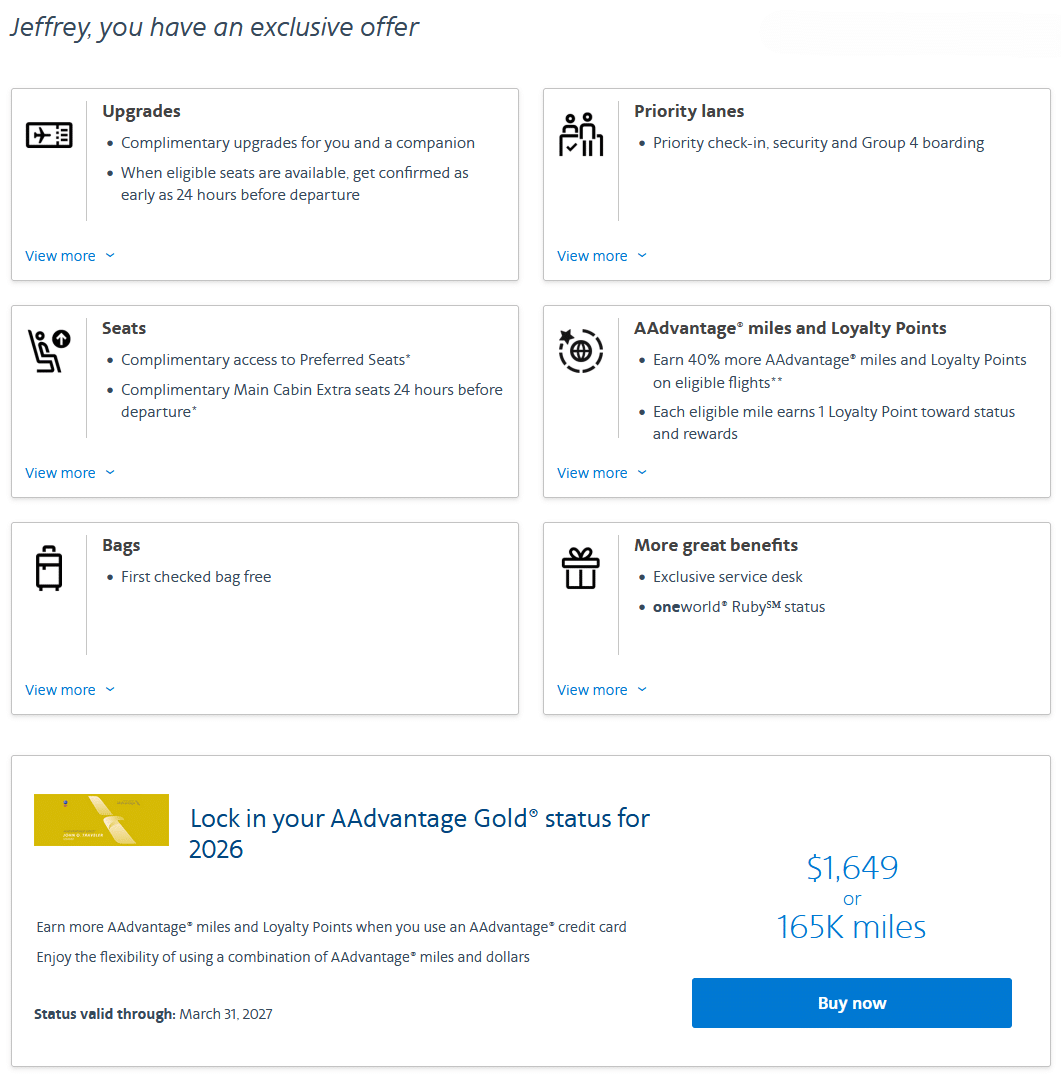
Since my status would be expiring, American Airlines extended an offer to buy-back Gold status for the full year at a price of US$1,649 or 165,000 AAdvantage miles.
This offer wasn’t very appealing. AAdvantage Gold is American Airlines’ entry-level elite status, and paying US$1,649 (CA$2,250) for it is extremely steep. I wouldn’t fly enough on the airline to make the benefits worthwhile. Plus, I already have a co-branded AAdvantage credit card, which provides some status-like perks such as checked bags and priority boarding.
The option to purchase using miles makes no sense whatsoever. American Airlines is valuing its miles at 1 cent per mile in this scenario, which is a dreadful valuation. AAdvantage miles are difficult to earn in large numbers and extremely valuable thanks to American Airlines’ wide range of excellent airline partners.
Needless to say, I won’t be pursuing this offer and my elite status with American Airlines will come to an end for the time being.
Are Airline Status “Buy-up” Offers Worth It?
Whether a buy-up offer makes sense depends on your travel habits and how much you value elite perks, even if you only fly a handful of times each year. Benefits such as complimentary checked bags, preferred seating, and cabin upgrades can quickly exceed the cost of the offer.
However, many of these same perks often come with an airline co-branded credit card, including free checked bags and sometimes lounge access. In plenty of cases, opening one of these cards costs far less than paying to move up a status tier.
The specific tier you are being offered to buy-up also matters. For example, moving from no status to entry-level status with Air Canada can provide meaningful improvements, even for occasional flyers. Perks like complimentary preferred seats at check-in, free checked bags, and eUpgrades can noticeably enhance the travel experience.

Threshold tiers such as Aeroplan 50K and Super Elite deserve serious consideration if you receive a buy-up offer at those levels. Aeroplan 50K is where many of the most valuable benefits begin to kick in, including improved Priority Reward access and Maple Leaf Lounge privileges. The same can’t be said for mid-tier levels such as Aeroplan 35K and Aeroplan 75K, as these status levels tend to deliver fewer meaningful incremental benefits, which makes the value proposition less compelling.
Airlines have always been very hesitant to outright sell status directly, and these highly targeted offers may be as close as we ever get to being able to “buy” status. If you’re on the fence about forking out the cash but hold a large balance of points and feel comfortable redeeming them at 2 cents per point, upgrading your status without any out-of-pocket spend may be the best option.
Conclusion
Airline status buy-up offers are a last-ditch attempt to extract more money from members by tapping into our sense of FOMO and keeping us on the elite status hamster wheel. In most situations, paying for a higher tier doesn’t make much sense. You should only consider it after exhausting every other way to qualify organically and only if the lift in status delivers meaningful benefits that cannot be replicated with a co-branded credit card.
Keep in mind that if you flew often enough to get worthwhile use of these elite perks, you likely would have qualified the traditional way in the first place. The only exception to this might be that you had a slower travel year which resulted in missing your usual status and are confident that your upcoming travel plans will allow you to extract value from a higher status.

Jeff Jamieson
Latest posts by Jeff Jamieson (see all)
- Review: W Macau – Studio City - Oct 14, 2026
- Review: Singapore Airlines First Class Suites (A380) - Sep 30, 2026
- Review: Alaska Airlines Business Class Suites (787-9) - Sep 23, 2026
- Chexy Plus: Does It Make Sense? - Sep 11, 2026
- Review: The St. Regis Al Mouj Muscat Resort - Aug 26, 2026