There’s nothing worse than flying back from a holiday in Europe on a red-eye flight when all of a sudden your late departure’s status switches from “delayed” to “we’ll update you shortly.” Who knows how long this delay might be?
And then when you get back to Canada, it turns out your bags never followed you across the Atlantic, so in addition to arriving late and exhausted you also don’t have toiletries or underwear
In Canada, this is where you’d start bracing for all the ways the airline will absolutely insist that none of this was within their control. Maybe you even start dipping into the baggage delay benefits available on select premium credit cards such as the no foreign transaction fee Scotiabank Passport Visa Infinite+.
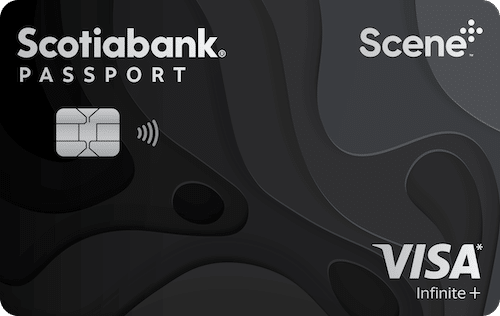

The Scotiabank Passport Visa Infinite + Card is one of Canada’s best all-around travel cards, offering no foreign transaction fees and six complimentary airport lounge passes through the Visa Airport Companion Program.
Scene+ points are easy to earn on everyday spending and can be redeemed flexibly for travel, groceries, and more, making it a strong everyday carry for travellers who want simplicity and real value for $150 per year.

Earn when you apply through Frugal Flyer.
35,000 Scene+ points
$40,000
$475+
$150
No
Nov 1, 2026
The good news is if you were on a flight that originated in Europe, or on a flight to Europe on a European carrier when this misfortune occurred, this is where the airline owes you money.
This is because of Regulation (EC) No 261/2004, better known as EU261, which governs compensation for air travelers in the entire Schengen Area. Every Canadian flying to, from, or within Europe should know how it works – and know where to use credit benefits (such as for delayed baggage) where EU compensation might be slow in coming.
EU261: Comprehensive Air Passenger Rights with Teeth
EU261 has been law since 2005, and unlike Canada’s Air Passenger Protection Regulations (APPR), it’s very hard for the carriers to ignore, and its compensation is much more generous: payments of between €250-600, and that’s just for flight delays.
The law includes every flight departing an EU airport, whoever operates it, plus every flight arriving in the EU and Schengen Area on an EU-based airline. Iceland, Norway, and Switzerland are in, though it must be noted that the UK runs a near-identical clone, UK261, that pays in pounds and runs on separate claims infrastructure.
Remember to take note of that: EU261 protects you only if the operating airline is an EU carrier. Air Canada from Toronto to Paris? Not covered on the way over (that’s APPR territory), but covered on the CDG-YYZ leg home, because it leaves the EU.
The same goes for Air Transat, WestJet, and all other non-European airlines. On the other hand, flights operated by Air France, KLM, Lufthansa, or TAP departing to or from Canada? Those are covered in both directions.

Don’t forget that this two-way protection is priced in: the airline lobby’s own estimate pegs EU261 compliance at over €8 billion a year, and it’s one reason an EU carrier’s cash fare can often run higher than the Air Canada or Transat flight beside it. This isn’t the sole reason, but when you pay up for a European airline on the way over, you’re basically buying state-backed insurance.
Now for some more EU261 fine print you may not have considered: only the operating carrier that counts, so a Lufthansa flight booked via Air Canada’s website and listed as an AC flight number is covered inbound to Europe, but the reverse is not.
Similarly, a round trip is treated as two separate flights, even on one ticket. And finally, an itinerary booked as one ticket that starts and ends outside the EU with only a connection in Europe (YYZ-FRA-DEL on Lufthansa, say) falls outside the regulation entirely.
You’re also not supposed to claim APPR and EU261 for the same flight disruption, so plan accordingly.
Where EU261 grows its teeth is in what airlines can and can’t blame. Weather, air traffic control, security threats, and political instability are “extraordinary circumstances” that excuse compensation. Mechanical problems generally are not, and neither is a strike by the airline’s staff. European courts put the burden of proof on the carriers and not the customers, with payouts matching.
Best of all, as of July 2026, a variety of reforms to strengthen EU261 have been passed. Starting in 2027, eligible customers who experienced a flight delay must receive a link to apply for compensation within 96 hours of arrival.
Airlines are obligated to answer every claim within 30 days, and rerouting is to be offered to delayed flights within three hours. Customers not accommodated are entitled to compensation, and apparently there is now a ban on “no-show” clauses that cancel your return trip when you miss your outbound flight (we’ll have to see how this last one stands up).
Types of Compensation with EU261
Flight Cancelation, Delay, or Re-Route
The first and most obvious way to collect your cash is via flight cancellation or delay. The good news is class of service doesn’t matter for flight delay compensation so a €39 euro Ryanair seat pays the same as Lufthansa First Class.
Here’s what the EU says about it:

| Amount in EUR | Flights distance | Delay in reaching final destination |
|---|---|---|
| 250 | 1 500 km or less | 3 hours or more |
| 400 | More than 1 500 km within the EU and all other flights between 1 500 and 3 500 km | 3 hours or more |
| 600 | More than 3 500 km | 3 hours or more |
You read that right. At least €250 in compensation up to €600 for flights delayed over 3 hours! The distance band makes it very simple to understand, and due to the reforms, airlines must provide you with the complaint form to collect.
When it comes to cancelations, there are a few things to be aware of. If your flight is canceled for any reason, you are entitled to a refund to your original form of payment. No travel bank or travel credit nonsense that Canadian carriers often try to pull (and hope will expire).
EU261’s fixed payout is compensation, not reimbursement, so it stacks with your credit card’s flight delay insurance.
If your schedule gets involuntarily rearranged by the airline, you are still likely eligible for compensation if it’s within 14 days of travel.

The only way the airlines can avoid this are as follows:
Within 14 days and 7 days of departure, they don’t owe you euros if you are departing no later than 2 hours after your original time, and arriving no later than 4 hours after the originally-booked arrival.
Within 7 days of departure, those limits halve and the airline will owe you money if the new itinerary is not within 1 hour of your original departure time or 2 hours of the original arrival.
Every transatlantic flight from Canada sits in that bottom bracket. A YUL-CDG flight that lands 3.5 hours late is worth €250; four hours late and it’s €600 per passenger.
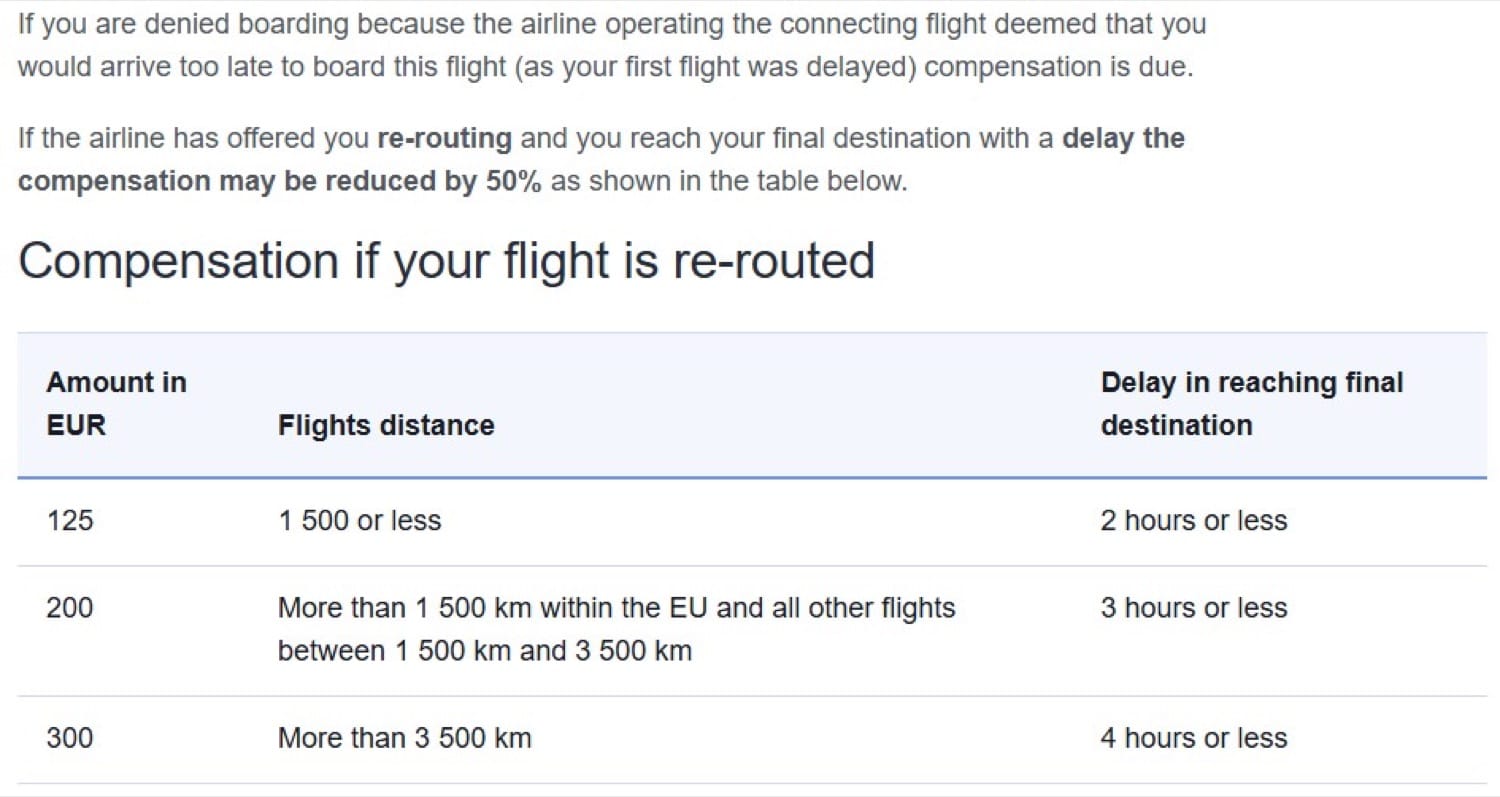
Now let’s think about something: maybe you miss your connection on a Lufthansa YYZ-FRA-ATH itinerary booked with Aeroplan points. EU261 has an answer and schedule for compensation for that, too:
This brings us to the next point: denied boarding.
Denied Boarding
If you’re bumped involuntarily from an oversold flight, you’re owed the same fixed compensation of €250-600 depending on distance band – as for a delayed flight, on the spot, plus a choice of refund or rerouting.
You’re also entitled to meals, phone calls, and other standards of fares we’ll get into in a while.
Lost/Damaged Luggage
EU261 itself repeated the provisions of the Montreal Convention, which Canada has also signed, and which makes airlines liable for lost, damaged, or delayed checked luggage up to €1300 in value.
The issue is you need to file within 7 days of baggage being lost or 21 days of it being delayed for compensation. If you’re a luxury traveler, there’s also a good chance your effects were worth more than the maximum compensation.

This is why Frugal Flyer always recommends having credit card baggage insurance such as that available on the National Bank World Elite Mastercard, which will apply if you charge even $1 of taxes and fees to the card.
FYI, you’re not supposed to apply for both credit card insurance and compensation from the airline according to your issuer’s fine print…
Hotels, Meals, and Communications
The right to care kicks in during the wait, whatever the cause. After a delay of two hours (short-haul), three hours (medium-haul), or four hours (long-haul), the airline owes you meals and refreshments in proportion to the wait, plus two phone calls, emails, or, for those still communicating like it’s 1985, faxes or telexes. .
Delayed overnight? Hotel and transport to and from it, on the airline. If nobody offers, don’t sit and stew: buy reasonable meals and a reasonable room, keep every receipt, and claim it back. Care is owed even in extraordinary circumstances, so keep your receipts.
Which brings us to our next point….
How to Claim EU261 Compensation
The consumer protections are robust, enforced, and strong.
The issue is that they can be an administrative nightmare, and can take a while to process through. If you just got through to or from your holiday or business trip, you may no longer have the desire to complete all the paperwork.
We do recommend trying to file yourself first with the airline, understanding that this can be somewhat tedious. Most airlines have some sort of form available to complete on their website, and require you to provide proof like booking documents prior to approving the claim. On the upside, they will soon have to be pro-active and directly contact you and give you some kind of complaint form within 96 hours of landing or else be fined by the EU.
If your claim is approved, carriers can only pay via bank transfer or cheque; vouchers are only allowed if you agree in writing, so don’t fall for any tricks attempting to do this to you. Since payouts arrive in euros, a multi-currency account like Wise is a good idea.

If the claim is denied and, depending on the reason, you are not happy with the airline’s response, the next step would be to escalate the claim for compensation to the “National Enforcement Body”. This is country dependent, but think of something like the Canadian Transportation Agency (CTA) in Canada.
Now, there is a cottage industry of claim services (AirHelp, AirAdvisor, Flightright) that will do this for you on a no-win, no-fee basis, taking roughly 25% to 35% of your payout, rising to 50% if lawyers get involved. On a €600 claim, that’s up to a €300 haircut.
This is hopefully not a bridge you will need to cross, but could be worth it if you don’t want to go through the hassle of the appeal process.
Conclusion
It’s unfortunate that in Canada we don’t enjoy the same level of commercial protections that European travelers do. Then again, our country is much larger and enjoys less benefit from economies of scale.
Alas, EU261 must for now remain our envy, so know your rights and don’t be afraid to exercise them when subjected to travel disruptions.
Until next time, don’t be afraid to collect what you’re owed.

Kirin Tsang
Latest posts by Kirin Tsang (see all)
- Canada Post MyMail: Track Your Incoming Credit Card Mail & More - Oct 12, 2026
- Scotiabank Amex Offers: Don’t Leave Cash On The Table - Oct 5, 2026
- EU261 Regulations: Know Your Air Passenger Rights - Oct 2, 2026
- BMO eclipse Visa Infinite Card Review - Oct 1, 2026
- BMO Blue Rewards World Elite Mastercard Review - Sep 27, 2026