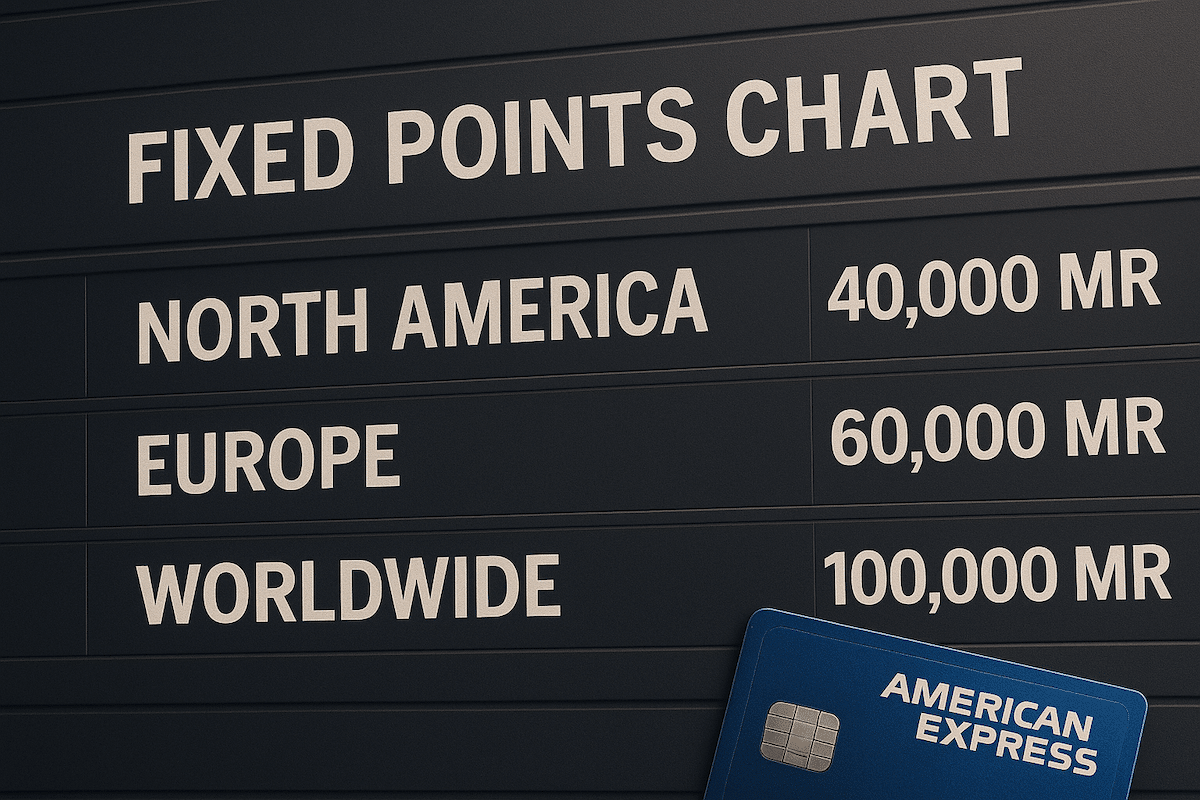
If you’re an American Express cardholder, you’ll often be bombarded with advertisements promoting their fixed-points redemption program.
On paper, this can seem like a great idea. You can get an easy itinerary somewhere that costs a single, round number of points. This might sound better than transferring points out and learning other rewards currencies like Air Canada Aeroplan can require extra micromanaging, after all.
But is the Amex Fixed Points Travel Program a good deal? Let’s find out.
What is the Amex Fixed Points Travel Program?
The Amex Fixed Points Travel Program is run through American Express’s in-house travel agency.
Similar to the CIBC Aventura Airline Rewards Chart and RBC Air Travel Redemption Schedule programs, this offers a simple value proposition. You can redeem Membership Rewards points in fixed increments, for example, maybe 15,000 Membership Rewards (MR) points for a short-haul domestic economy round-trip flight. The maximum base fare of such a redemption (excluding taxes, fees, or fuel surcharges) would likewise have to be $300.

Such a fare would theoretically get you 2 cents per point (cpp) if utilized to its maximum. Amex lets all cardholders redeem MR points at 1 cpp on any travel transaction, so this is theoretically worth up to double.
The issue is that you’re not often going to be able to squeeze every last time out of each transaction. The other issue is what’s up next….
Beware the Ides of The Fuel Surcharge
A wise oracle said to Caesar in the forum of Rome before he was betrayed:
“Airlines will try to pass as many costs onto consumers, especially during reward redemptions. Beware the fuel surcharge costs because you’ll have to pay for those in cash, no matter what points you used on the rest of your itinerary.”

It’s true, I read it on ChatGPT. It’s hardly new, either. We’ve already written about how WestJet and British Airways are ruthless and notorious for high fuel and carrier surcharges.
Here’s an extremely egregious example I pulled from the Amex travel portal:
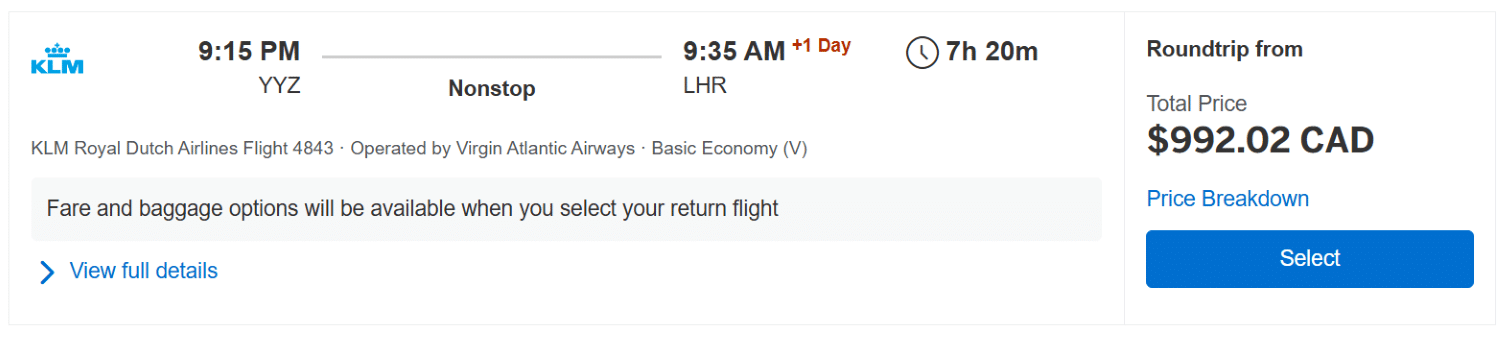
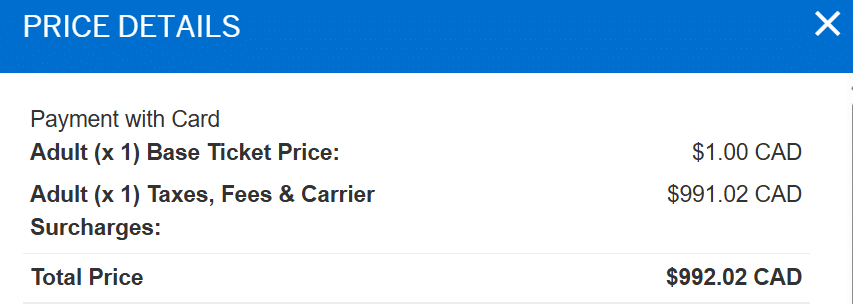
$1 in base fare and $991.02 in taxes, fees, and surcharges. I kneel before the generosity. Keep this bit of information in mind throughout the rest of this article.
Amex Fixed Points Travel – Economy Class Reward Chart
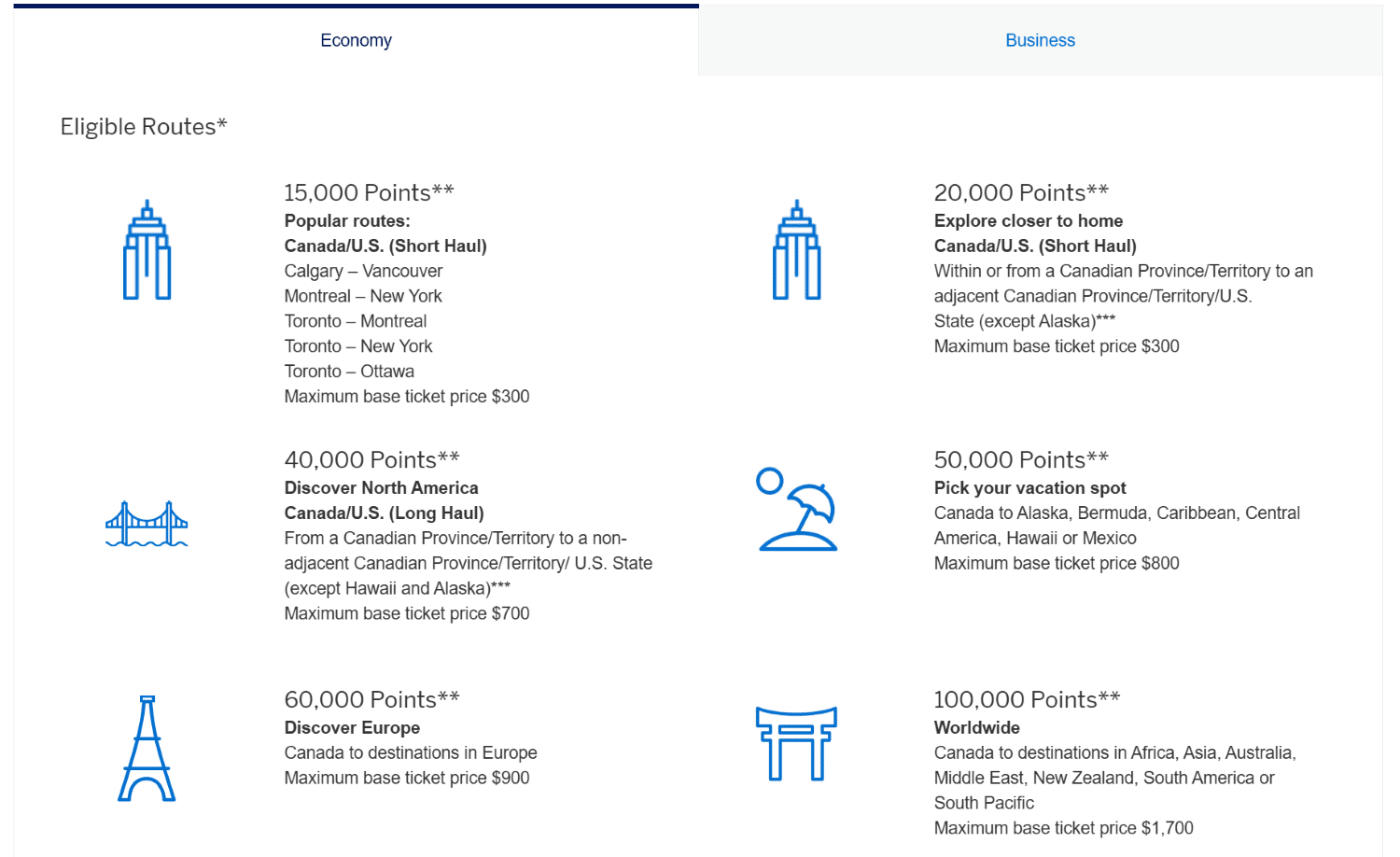
The economy class redemption award chart is as follows and only applies to round-trip departures from Canada. You also have to have enough MR points in your account to book any itinerary, so keep that in mind. The prices range between 15,000 and 100,000 points per itinerary, up to a maximum of $1,700 in base fares.
Canada & U.S. (Extra) Short-Haul
This specific category acts as the sweet spot of the entire fixed points program and is likely the only place you will find me spending my hard-earned points. For a reasonable redemption of 15,000 Membership Rewards points, you can book a round-trip flight with a base fare of up to $300. This works out to a value of 2 cents per point, which is double the standard rate if you were to just use points as cash against a statement.
The catch is that this is restricted to very specific high-volume commuter corridors, such as Calgary to Vancouver, Toronto to Montreal or Ottawa, and flights from Montreal or Toronto down to New York. If you are a commuter on these routes, this is excellent value, but remember that you are still on the hook for the taxes and fees.
Canada & U.S. Longer Short-Haul
If your travel plans take you to an adjacent province or state that isn’t on the popular list above, you fall into this slightly less lucrative category. Here, you are coughing up 20,000 Membership Rewards points for that exact same maximum base ticket price of $300. This effectively drops your value per point down to 1.5 cents.
While this is still better than the baseline 1 cent per point redemption, it stings a little knowing that flying to Saskatchewan costs 33% more points for the exact same monetary value. It serves as a good reminder that in the world of credit card rewards, flexibility often comes with a price tag.
Canada & U.S. Long-Haul
For those looking to cross the continent, the long-haul category requires 40,000 Membership Rewards points for a maximum base ticket price of $700. This covers travel to a non-adjacent province, territory, or U.S. state, though it notably excludes Hawaii and Alaska. Mathematically, this works out to a value of 1.75 cents per point, which is respectable enough if you are cash-poor and points-rich.
However, once you start throwing around 40,000 points, you have to start wondering if you could have found a better deal transferring those points to another frequent flyer program like Aeroplan or, better yet, British Airways Avios.
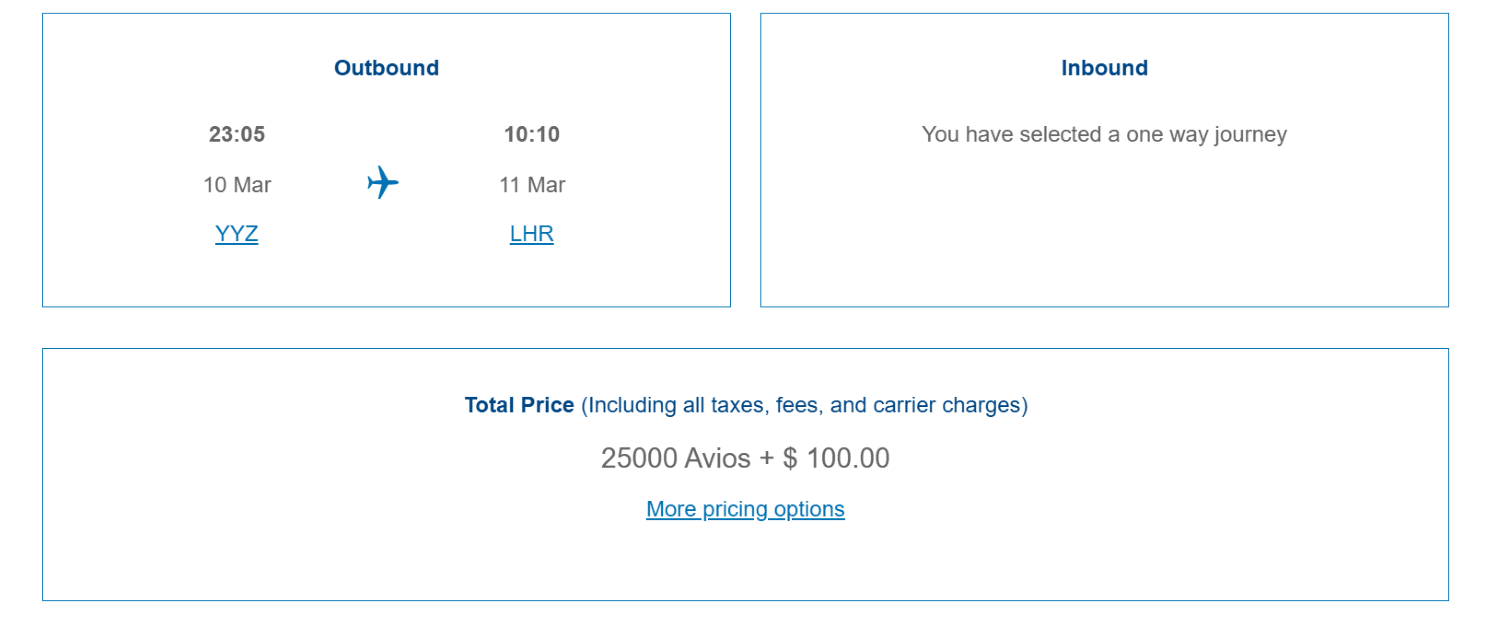
To put things into perspective, 25,000 Avios (which Amex MR transfers to 1:1) is enough to get you from Toronto to London in Economy, with only $100 in taxes and fees, just take a look:
Alaska, Bermuda, the Caribbean, Central America, Hawaii, Mexico
This tier is designed squarely for Canadians looking to go on vacation, and I think the inclusion of Alaska as an option is quite interesting. Perhaps it’s best for those who wish to take an Alaskan cruise?
You will need to redeem 50,000 Membership Rewards points for a maximum base fare of $800, yielding a value of 1.6 cents per point. The real kicker here is the taxes and fees, plus once again the opportunity cost of not transferring your points.
Europe
The value proposition takes a serious nosedive when we look at flights to Europe. You are required to spend 60,000 Membership Rewards points for a maximum base ticket price of $900. This results in a valuation of just 1.5 cents per point.
When you consider that 60,000 points transferred to Avios would literally get you to London, like I just proved above, and leave you with 10,000 points in your pocket, this doesn’t seem like great value for an economy ticket.

Moreover, for 60,000 points, you could potentially get a one-way business class ticket to Europe on a partner airline, burning them here for an economy ticket with a capped dollar value feels like a crime against value. Unless you absolutely cannot find award availability elsewhere, I would steer clear of this redemption.
Worldwide
This category covers just about everywhere else, including Africa, Asia, Australia, the Middle East, New Zealand, and South America. You will need to shell out 100,000 Membership Rewards points for a maximum base ticket price of $1,700.
This nets you a value of 1.7 cents per point. While 100,000 points is a significant amount of capital to tie up, cash fares to these destinations can often be astronomical, so if the base fare is right at the limit, it might make sense. I’d recommend using this only if you’re trying to get somewhere obscure that it’s hard to find transfer partners for, so perhaps Australia and New Zealand are the best examples.
While someone trying to be smart might say you could transfer to Aeroplan and suffer in Air New Zealand’s economy award space, that airline simply doesn’t release much of the stuff anymore. Therefore, getting the ability to actually book the fare and use your points gives it a unique value.
Amex Fixed Points Travel – Business Class Reward Chart
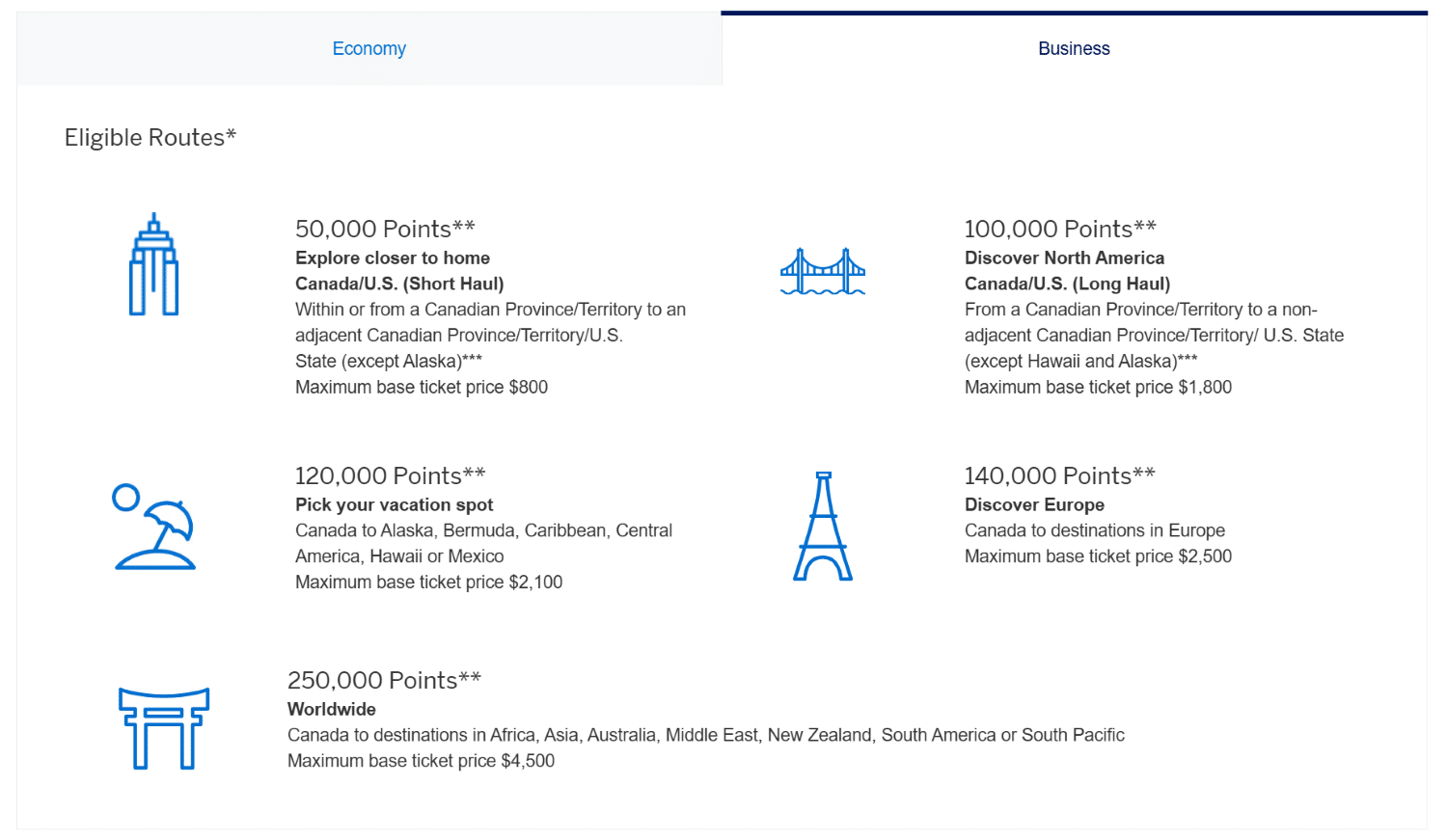
The business class redemption award chart is thus, and boy is it rough. It starts at 50,000 points and a maximum base fare of $800, and scales up to 250,000 points… with a max of $4,500 in base fare. We’re going to crunch the numbers and show why this isn’t great.
Canada & U.S. Short-Haul
If you thought the fuel surcharges were bad in economy, welcome to the business class chart, where value often goes to die. For short-haul flights to adjacent provinces or states, you are looking at 50,000 Membership Rewards points for a maximum base ticket price of $800. This gives you a value of 1.6 cents per point.
The issue here is twofold. First is the product itself. Domestic business class on short-haul routes is often just an economy seat with the middle seat blocked out or a slightly wider recliner. Burning 50,000 points for a one-hour flight in a slightly nicer chair isn’t a winning strategy to begin with… until you realize that on many transfer partners, a one-way business redemption costs much less than 25,000 points.
Canada & U.S. Long-Haul
For longer domestic and transborder flights, the cost jumps to 100,000 Membership Rewards points for a maximum base fare of $1,800. This works out to 1.8 cents per point, which is mathematically okay, but practically painful. 100,000 points is a massive sum.
To put it in perspective, that same amount transferred to Avios could potentially get you a business class seat to England, albeit with crazy fuel surcharges. Or you could put it into Aeroplan and probably eke out a round-trip business class fare, assuming you were searching carefully.
Alaska, Bermuda, the Caribbean, Central America, Hawaii, Mexico
This tier requires 120,000 Membership Rewards points for a maximum base fare of $2,100, which yields a return of 1.75 cents per point. If you manage to find a route with a true lie-flat business class product, perhaps to Hawaii or a major hub, this could be tempting.
The issue is that most aircraft that fly to vacation destinations aren’t the intercontinental wide-bodies that service the business traveller crowd. You’re likely paying a huge premium for an aircraft that is functionally providing a domestic business experience.
With the extreme hike in price of getting to Hawaii, I think that’s your “best” bet here, but again, 120,000 points to go to Hawaii is a huge opportunity cost for other types of trips. Of course, you need to travel how you want, it just doesn’t seem to be super effective.
Europe
This is where the Fixed Points program really struggles to justify its existence. You need to redeem 140,000 Membership Rewards points for a maximum base fare of $2,500. This gives you a value of roughly 1.78 cents per point. While that sounds consistent with the other tiers, 140,000 points is an enormous amount of currency.
For that amount, transferred to a partner like Aeroplan or Flying Blue (if you’re lucky, that is – Canadian MR transfers at 1 MR point to 1 Flying Blue points), you could likely book a round-trip business class ticket to Europe. Capping the value at $2,500 severely limits the upside when business class cash fares to Europe can easily exceed that and cost north of $2,000 per direction.
Worldwide
Finally, we arrive at the most expensive tier. A quarter of a million points. Let that sink in. For 250,000 Membership Reward points, you are getting a maximum of $4,500 in base fare value, which comes out to 1.8 cents per point.
The halcyon days, savvy travelers using that same amount of points book partner First Class suites that retail for fifteen thousand dollars or more are now behind us. I guess some of us points people and certain influencers feasted too heavily. None of that stops the fact that 250,000 points is often enough to get you a fantastic round-trip premium cabin award flight just about anywhere for one person.
Moreover, the $4,500 base fare limit is a serious problem, as once you look at longer flights, the prices usually get more ridiculous. Let’s take a look at the cheapest YVR-SYD flight I found:
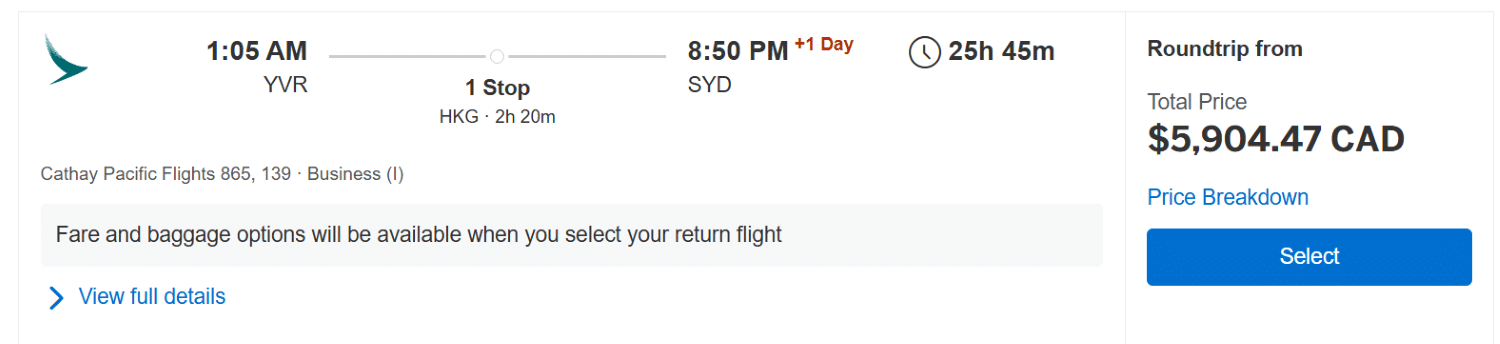
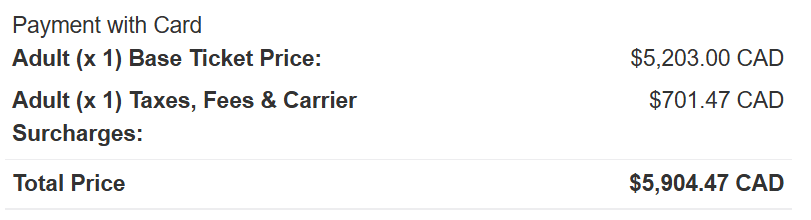
You’d be redeeming 250,000 points and still be $703 over the $4,500 statutory maximum, plus $701.47 in taxes and fees. I wouldn’t feel good about burning 250,000 MR and $1,403.47 on this round-trip flight and still having to layover in Hong Kong, personally.
How to Book a Flight with the Amex Fixed Points Travel Program
To make a booking using the Amex Fixed Points Travel Program, first head over to the Amex Travel website.
Once logged in, go ahead and make a flight booking thusly:
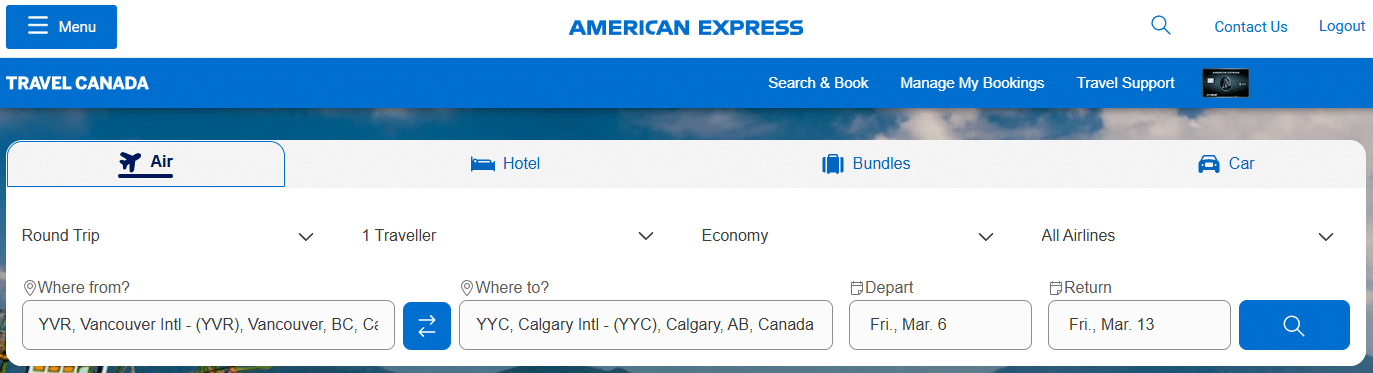
Once the search is done, you’ll have a pile of choices to select from. As you can see, you need to have all the required MR points to make a Fixed Points booking, but you’ll be able to pick your flight.
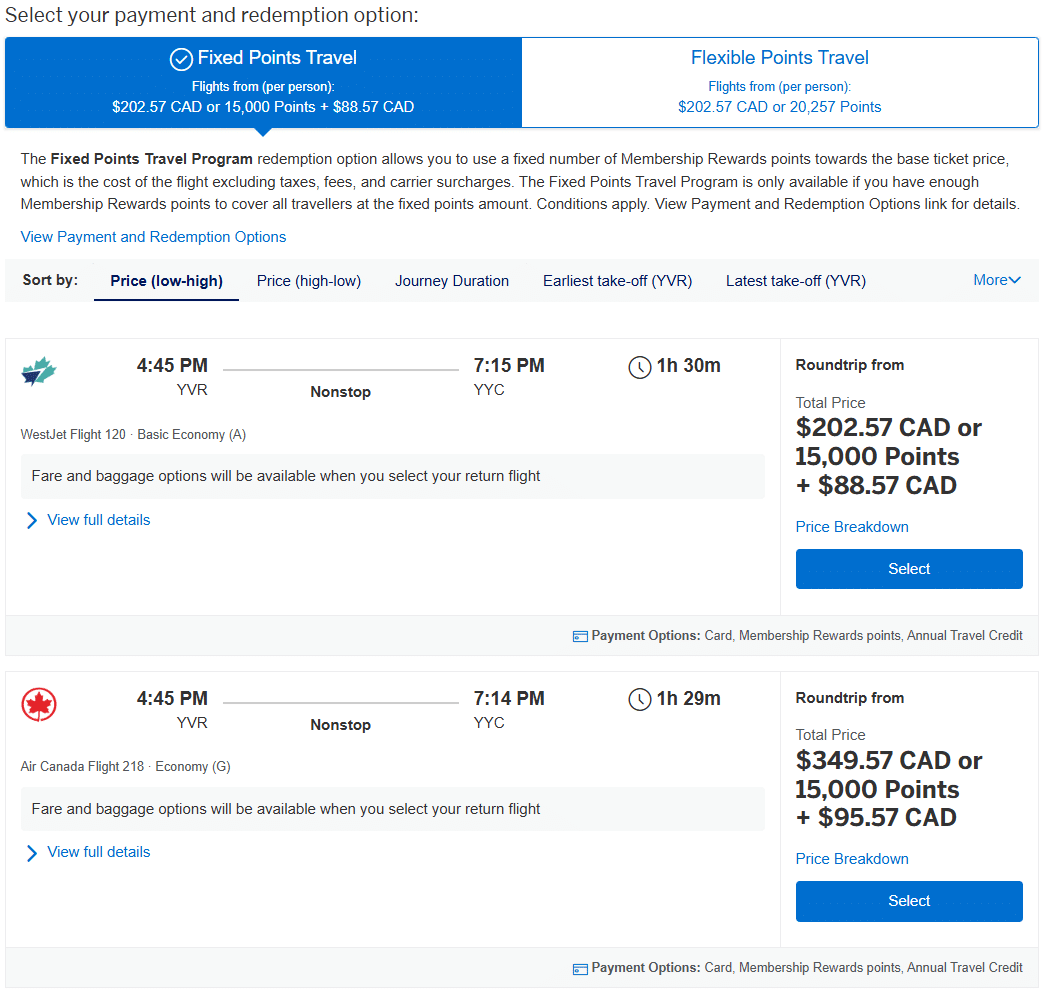
Once you hit “select” you’ll be required to choose which level of service you want – whether you need a refundable ticket, a basic one, or other options. Pay close attention to the little luggage symbols to see if you’ll be getting free checked luggage or not.

Once you’ve selected your flight, you’ll be prompted to continue to checkout, and it will tell you how much it will cost in either cash or in MR points as denoted by the Fixed Points Travel Program.

Once you’ve selected this, you’ll have a final checkout page. You have the option of stacking this with any travel credits that may come on a card, such as the $100 travel credit on the Amex Gold Rewards Card. This will also let you use MR at 1 cent per point via the flexible points travel program if you want to (you don’t).

Once you’re done booking, you’ll receive an itinerary confirmation. Have a great flight, and I hope you got a good deal.
Is There Value In The Amex Fixed Points Travel Program?
I’ll be real. I think that the Amex Fixed Points Travel program leaves much to be desired. It’s really not great.
Let’s use some extremely specific examples. Here’s a scenario: your significant other is a teacher, and thus your family can only travel at peak season vacation dates, then there’s actually decent value in the Fixed Points program.
Here’s an itinerary from Montreal to Anchorage, Alaska, during March Break:


So basically, you could use the fixed points chart to get about 1.57 cpp. You’d need 50,000 points per passenger, and to shell out $214.39 a head. This is about the maximum value. Is it a better value than Aeroplan?

…OK, so it’s actually cheaper 1-way on Aeroplan even if the taxes and fees are a bit higher. Assuming you can find availability, of course, as inventory availability isn’t the same.
Personally, I think the main use case scenario for the fixed flight award chart is the one I gave a while back: long-haul economy to destinations that it’s hard to find partner award availability to, such as New Zealand. There’s so much demand to go there that airlines don’t feel a need to release award seats for anything not commensurate with the cash price.
Would I want to burn 100,000 points to rot in economy class both ways? No, but it might be the only way to get to Melbourne.
The business class redemption chart just doesn’t make much sense to me. I can’t help but feel that, in most cases, you’re just better off transferring.
The Best Way to Earn American Express Membership Rewards Points
If you find a flight via this program that’s a good deal, or if you just want to hoard a mountain of points to transfer to somewhere else, the American Express Cobalt Card is the undisputed king of the Canadian credit card scene. It earns 5x points for every dollar spent on eats and drinks. That includes grocery stores, restaurants, and food delivery.
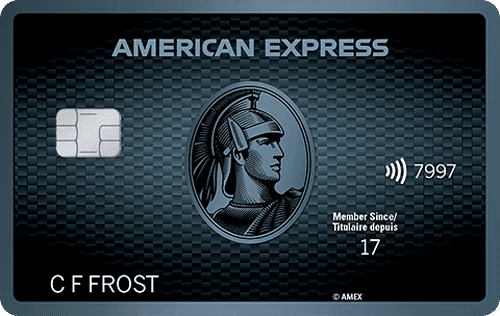

The American Express Cobalt® Card gives cardholders the opportunity to earn 5x Membership Rewards on eligible restaurant, food delivery, and grocery store purchases in Canada. With the American Express Membership Rewards® program, it makes for an excellent everyday credit card.
15,000 Membership Rewards points
$9,000
$300+
$191.88
Yes
–
There is a cap of $2,500 in spending per month on the 5x category, up to $30,000 annually, but if you play in two-player mode with a partner, you can double that household limit to $60,000 a year. That is 150,000 MR for one person, or 300,000 MR for two, assuming you can hit the limit every year. See our American Express Cobalt Card review for more information as to why we love this card.
If you need a massive injection of points quickly, the American Express Platinum Card and Business Platinum Card are your go-to options. The welcome bonuses are usually huge, often enough to cover a significant chunk of a redemption instantly. Just be ready for the spicy annual fees that come with them. Fortunately, they have some travel credits to offset, and the personal version has an annual credit for dining. See our review of the American Express Platinum Card for all the details.
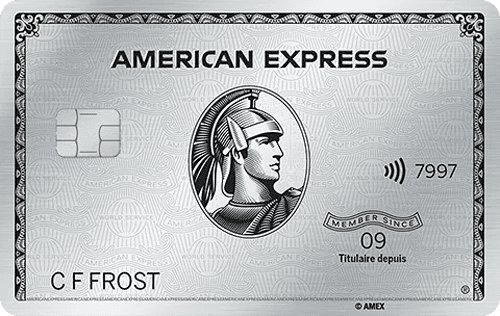

The American Express Platinum Card is a premium card offering a $200 travel credit and $200 dining credit. From access to participating airport lounges and special benefits at participating fine hotels around the world, to exclusive events and elevated service, experience the world with the many benefits of Platinum.
100,000 Membership Rewards points
$10,000
$2,000+
$799
Yes
–
Finally, if you have maxed out your Cobalt caps and burned through your Platinum bonuses, the American Express Gold Rewards Card is a solid backup with four lounge passes per year and the aforementioned $100 travel credit to keep the points faucet running
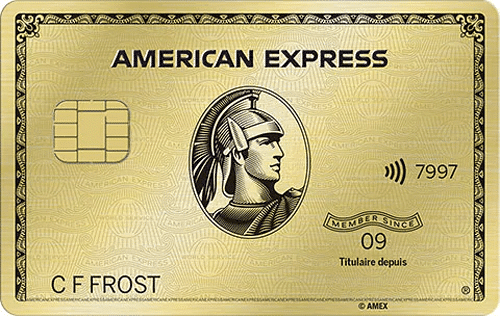
The American Express Gold Rewards Card offers a variety of benefits including an annual $100 travel credit, $50 NEXUS credit, and four complimentary Plaza Premium airport lounge passes per year.
60,000 Membership Rewards points
$12,000
$1,200+
$250
Yes
–
Conclusion
So, is the Amex Fixed Points Travel Program a hidden gem? I’d argue not in most cases. The program looks simple, but the math rarely works out in your favor.
In my opinion, the best case for the Fixed Points Travel chart is if you have a super-specific case to make it worth your while, such as flying to Australia in economy class, because if you don’t suffer leg cramps, you won’t be able to go at all. If that doesn’t sound appealing to you, the strategy is simple: earn as many Membership Rewards points as humanly possible using the Cobalt Card, and then transfer them to a partner where you can get a better bang for your buck.

Kirin Tsang
Latest posts by Kirin Tsang (see all)
- Canada Post MyMail: Track Your Incoming Credit Card Mail & More - Oct 12, 2026
- Scotiabank Amex Offers: Don’t Leave Cash On The Table - Oct 5, 2026
- EU261 Regulations: Know Your Air Passenger Rights - Oct 2, 2026
- BMO eclipse Visa Infinite Card Review - Oct 1, 2026
- BMO Blue Rewards World Elite Mastercard Review - Sep 27, 2026